
A story inspired by The Windsor Girls’ School Archiving Team.
For more than a century, a substantial house stood on Osborne Road close to the junction with the Long Walk. Known at different times as 1 Queen’s Villa, Osborne House, Uruguay House and, eventually, Carfax, its changing names reflected an equally remarkable succession of occupants and uses.

It began life as an imposing private residence for some of Windsor’s wealthier inhabitants. It later became the home of a South American diplomat, housed a family closely connected with Windsor Castle, became a nursing home, accommodated an evacuated London girls’ school during the Second World War and finally provided classrooms for generations of Windsor schoolgirls.
Then, in 1972, Carfax disappeared.
Today there is little at this busy Windsor junction to suggest that such a distinctive house ever stood there.
From Queen’s Villa to Osborne House
Carfax appears to have been built in 1856, on land leased from the Crown for 99 years to London architect William Sim, who was associated with several properties in Osborne Road. The Georgian-style house was substantial, with arched windows and a particularly distinctive rounded bay or turret rising through several floors.
Early photographs and illustrations show Carfax as one of a pair of imposing houses behind low boundary walls, with mature trees and generous grounds. A conservatory or orangery once extended alongside the property.
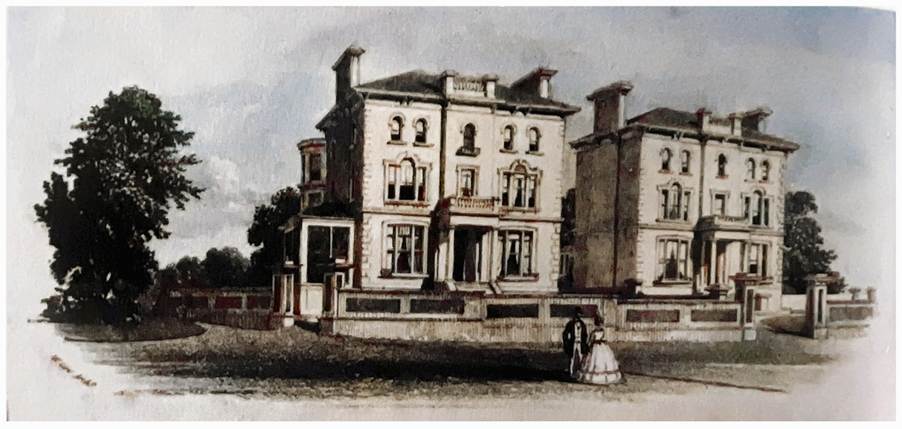
In its earliest years, the address was 1 Queen’s Villa, although by the 1871 Census it was being called Osborne House.
One of its first families gives us an indication of the lifestyle for which the house had been designed.
The Madox Blackwoods
By the 1861 Census, William and Maria Eleanor Madox Blackwood were living at 1 Queen’s Villa with their daughters Caroline and Sarah.
The family were substantial landowners, with important property interests around Dunfermline in Scotland. Their holdings included Pitreavie Castle and a 338-acre farm at nearby Masterton, providing a considerable rental income. The family’s Scottish estates help to explain the distinctly affluent household they established at their Windsor residence.
William was described as a landed proprietor and was a Fellow of the Society of Antiquaries. The 1861 Census gives us a wonderful glimpse of life inside the house: alongside the family were a cook, two housemaids, a coachman, the coachman’s wife and a 16-year-old “footboy”.
William died in 1863, but his widow Maria remained at the house for many years. By 1871 it was being recorded as Osborne House, and Maria was living there with her daughters and a smaller domestic staff of a cook, two housemaids and a footman.
The family’s connection with Scotland continued after their time in Windsor. In 1885, Caroline Augusta Madox Blackwood established a substantial trust to benefit Holy Trinity Church in Dunfermline, involving £5,000 and property at Masterton. The family sold Pitreavie Castle that same year.
Maria had died in 1882, bringing the family’s long association with the Windsor property towards its end.
For a short period in the later 1880s, the house was occupied by the Rev. William Bradstreet, formerly Rector of Theberton and Rural Dean of Dunwich in Suffolk.
Then came one of Carfax’s more unusual occupants.
Uruguay House
In March 1891 the Windsor & Eton Express reported the arrival at 1 Queen’s Villa of Dr Alberto Nin, a distinguished Uruguayan lawyer and diplomat.
Nin had been a member of the Supreme Court of Uruguay and represented his country abroad, becoming Envoy Extraordinary and Minister Plenipotentiary to the United Kingdom. By the mid-1890s the Windsor property was being referred to as Uruguay House.
It was an appropriate name for the Windsor residence of a senior foreign diplomat. In 1894, Nin presented his credentials to Queen Victoria, and contemporary newspaper reports referred to his return to “Uruguay House, his Windsor residence”.
The diplomatic interlude appears to have been relatively brief. By the end of the century another family had arrived—and the name Carfax had become established.
The Ansons at Carfax
From about 1898 until she died in 1918, Carfax was the home of the Hon. Caroline Maria Anson, widow of Canon Frederick Anson.
The Ansons already had strong Windsor connections. Frederick had been a Canon of St George’s Chapel from 1845 and the family had lived within Windsor Castle at 4 Upper Cloisters. Caroline herself was the daughter of George John Warren, 5th Baron Vernon.
Frederick and Caroline had married in 1845 and had fourteen children. After Frederick died in 1885, Caroline eventually made Carfax her home.


Kelly’s Directory for 1899 simply records:
“Anson, Hon. Mrs, Carfax, Osborne Rd, Windsor.”
A small newspaper advertisement from 1916 provides a glimpse behind the doors of the house. Caroline was seeking a “single-handed housemaid”, offering annual wages of between £24 and £26.
She died in Windsor in August 1918. Caroline and Frederick are buried at St Andrew’s Church, Clewer.
By now the house had been a prestigious private residence for more than sixty years. That chapter of its history was about to close.
Carfax Nursing Home
In 1920, Carfax acquired an entirely new purpose when Marion Augusta Blamey opened Carfax Nursing Home.
Born in 1865, Marion had trained as a nurse at the London Hospital in Whitechapel before moving into private nursing. She already had experience running nursing homes, first in Sussex and later at Datchet.
Carfax became home not only to its patients but to nurses and other staff. The 1921 Census provides a snapshot of life inside the building, while newspaper and other records reveal some of the people who spent their final months or years there.

Among them were Matilda Ann Headlam, widow of a Manchester barrister and magistrate; Mary Evelyn Greenhow, the daughter of a Northumberland clergyman; and Mary Denison Adam, whose family had connections with another of the Queen’s Villas.
Carfax remained a nursing home until 1935, when Marion Blamey closed it to concentrate on another nursing home she had established at Sunbury-on-Thames.
The next great change came with war.
A London School Comes to Windsor
When war was declared in September 1939, thousands of children were evacuated from areas considered vulnerable to enemy attack. Among them were pupils of Carlyle Girls’ School in Hortensia Road, Chelsea.
Carlyle was one of several London schools evacuated to Windsor. Initially its pupils shared accommodation, but in September 1940 Carfax was taken over by the Education Committee for the Carlyle girls.
The grand rooms which had once accommodated wealthy Victorian families and nursing-home patients were now filled with evacuated London schoolgirls.
Carlyle remained in Windsor for four years. In December 1943, most of its pupils returned home, although around twenty remained because their families had moved to Windsor. Contemporary accounts suggest that warm relationships had developed between the Windsor and Chelsea schools during their enforced partnership.
Carfax subsequently became associated with nearby Victoria Barracks between 1944 and 1947.
But its days as a school were not over.
Carfax and the County Girls
Across Osborne Road stood Elmfield, home of Windsor County Grammar School for Girls. The school had opened there in 1920 and had expanded steadily as pupil numbers increased.
By the late 1940s it needed still more room.
From 1948, Berkshire County Council leased Carfax to provide additional accommodation for the school, subsequently purchasing the property in 1959. To generations of Windsor girls, this former mansion became simply part of their school.
Plans from 1948 show how the old house was adapted. The basement contained cloakrooms, a scullery and facilities for cold dinners. Three classrooms occupied the ground floor, while the first floor provided another two classrooms together with a form room and sick room.
By 1949 there were 283 pupils spread between Elmfield, the school’s purpose-built Wing and Carfax.

It is quite a transformation to imagine. Rooms once occupied by diplomats and Victorian society families now echoed with lessons, bells and generations of Windsor schoolgirls moving between classes.
In 1952, further work was undertaken, including fire precautions and the conversion of the top floor into residential accommodation.
Carfax had successfully adapted yet again.
The End of Carfax
By the late 1950s, Windsor County Grammar School for Girls had outgrown its collection of buildings around Osborne Road. Planning for a completely new school began, and in 1962 the school moved to its present site in Imperial Road.
Carfax was left behind.
Exactly how the building was used during its final decade requires further research, but photographs show that it was certainly still standing in 1967, while maps and aerial photographs record the changing landscape around it.

Osborne Road itself was changing. The needs of the motor car and increasing traffic were reshaping this part of Windsor, and neighbouring buildings began to disappear as the road junction and roundabout were enlarged.
Finally, in 1972, Carfax was demolished.

A photograph taken during the demolition is a melancholy end to the story. The distinctive house which had stood on Osborne Road for more than a century was reduced to rubble, and other surviving Queen’s Villas followed soon afterwards.
One House, Many Lives
Carfax had stood for roughly 116 years, but describing it simply as a lost Victorian house hardly does it justice.
It had been 1 Queen’s Villa, Osborne House, Uruguay House and Carfax. Its rooms had accommodated landed families and their servants, a Uruguayan diplomat, the widow of a Canon of St George’s Chapel, nurses and their patients, wartime evacuees, teachers and hundreds of Windsor schoolgirls.
Each generation had altered the building and given it a new purpose.
Perhaps that is what makes the story of Carfax particularly fascinating. Buildings are not simply bricks and mortar: they accumulate the lives of the people who pass through them.
Today thousands of vehicles pass the site where Carfax once stood, probably without their occupants giving the vanished house a second thought.
But for more than a century, Carfax was part of Windsor life.
Acknowledgments
Emma Dyson of the Windsor Girls’ School Archivist Team (2025-26)
Sunbury Nursing Homes 1932 – 2009.
“Girls in Green: Windsor Girls’ School, 1920-2005” by Susan Mercer
“Windsor in WW2” by Brigitte Mitchell and Derek Hunt (unpublished).
“The Story of Windsor” by Maurice Bond.
Photographs from the John Handcock Collection donated to the Windsor Local History Group.
The Berkshire Records Office.
“The Windsor County Girls School” on the Royal Windsor Web Site [accessed 23 Sep 2026].
Drawings of the Ansons (NT652628 and NT652627) from Sudbury Hall and originals owned by the National Trust Collection and © Courtauld Institute of Art; used for educational and non-commerical purposes.