
The arrival of the original Bayeux Tapestry at the British Museum has focused attention once again on one of the world’s greatest surviving works of medieval art. But there is another Bayeux Tapestry in Britain with a remarkable history of its own. Created by a group of Victorian embroiderers, it has travelled across Britain and overseas, found a permanent home in Reading—and in 1896 was brought to Windsor Castle especially for Queen Victoria.
The Original Bayeux Tapestry
The original Bayeux Tapestry tells the story of the events leading to the Norman Conquest of England and the Battle of Hastings in 1066. More than 70 metres long, it is not technically a tapestry at all but an embroidery, with coloured woollen yarn stitched onto linen.
Its precise origins remain uncertain. It was probably commissioned during the 1070s, possibly by Bishop Odo of Bayeux, William the Conqueror’s half-brother, and some historians believe that it was embroidered in England. The first known written reference dates from 1476, when it was recorded in the treasury of Bayeux Cathedral. It is normally preserved at Bayeux in Normandy.
“So That England Should Have a Copy of Its Own”
The story of Britain’s replica began with Elizabeth Wardle, an accomplished embroiderer and founder of the Leek Embroidery Society in Staffordshire. Elizabeth and her husband Thomas Wardle, a leading silk dyer and printer, visited Bayeux in 1885. Friends of William Morris, they shared the growing Arts and Crafts enthusiasm for reviving traditional skills and using natural materials.
Elizabeth conceived an extraordinarily ambitious project: to reproduce the entire Bayeux Tapestry at full size, “so that England should have a copy of its own.”
Thirty-five women took part. Using wool and traditional embroidery techniques, they recreated the hundreds of people, horses, animals, ships, buildings and Latin inscriptions appearing in the medieval original. Each woman embroidered her own name beneath the section on which she had worked—a striking contrast with the anonymous craftspeople responsible for the original.
The enormous undertaking was completed in 1886. The result was a nearly 70-metre-long piece of Victorian craftsmanship which was itself destined to become a historic object.
The Photographs That Made the Replica Possible
The Victorian embroiderers did not have the original Bayeux Tapestry sitting beside them while they worked. An important part of their source material came from an extraordinary photographic project undertaken for the South Kensington Museum, now the Victoria and Albert Museum.
In 1873, photographer Joseph Cundall and his assistants photographed the entire original tapestry. The task took more than two months and required over 180 glass plates. Full-size prints were subsequently produced and hand-coloured by students from the School of Art in London.
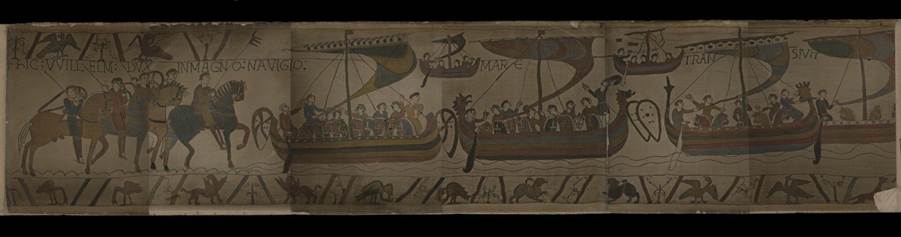
The resulting photographic panorama was itself remarkable: more than 200 feet long and one of the largest photographic projects of the nineteenth century. The South Kensington Museum acquired two copies, and these images provided crucial source material for Elizabeth Wardle and her embroiderers.
There is an amusing consequence. Some naked figures in the original were made rather more respectable in the Victorian photographs. The Leek embroiderers faithfully copied what they saw, with the result that their replica acquired some distinctly Victorian additions. The needlewomen have sometimes been blamed for this modesty, when in fact they were reproducing alterations already present in their source material.

Taking the Tapestry on Tour—and to Windsor
Once completed, the replica was first exhibited at Leek in 1886, where visitors paid a shilling to see it. It then embarked upon an extraordinary touring life, appearing in towns and cities across Britain and travelling as far afield as Germany and the United States.
By 1895 it had reached Reading, where former Mayor Alderman Arthur Hill supported its exhibition at the Town Hall and subsequently purchased it for the town.
Then came perhaps its most distinguished viewing.
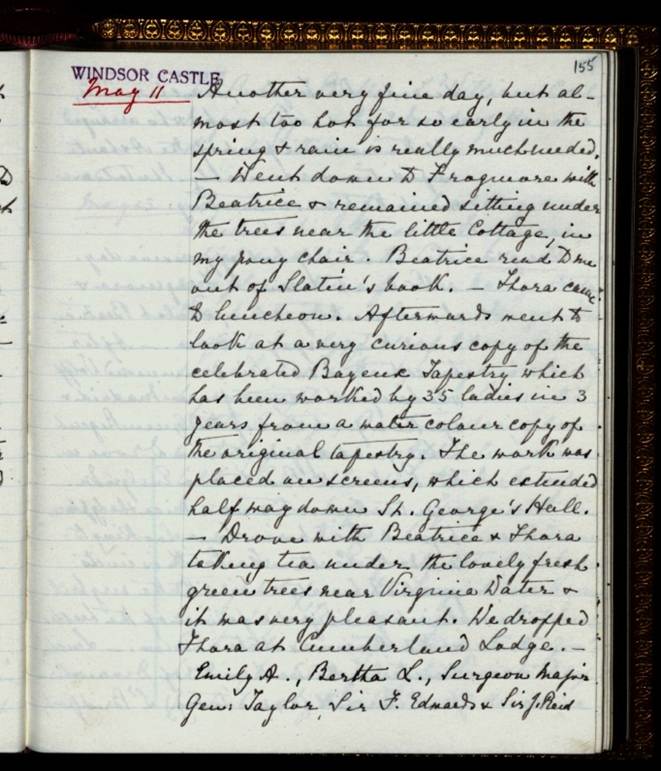
On Monday 11 May 1896, Queen Victoria went to see the replica at Windsor Castle. Her journal records that the work had been placed on screens extending halfway down St George’s Hall.
The Queen described seeing “a very curious copy of the celebrated Bayeux Tapestry”, noting that it had been worked by 35 women from a watercolour copy of the original.
It must have been an extraordinary sight: almost 70 metres of embroidered Norman history stretching through one of the grandest rooms in Windsor Castle.
A Permanent Home at Reading
Thanks to Arthur Hill, the tapestry had found a permanent home in Reading. He purchased it for £300 and presented it to the town, where it became one of the early exhibits in the new Reading Museum and Art Gallery after it opened in 1897.
There was an appropriate historical connection. King Henry I, youngest son of William the Conqueror, founded Reading Abbey in 1121 and was buried there following his death in 1135.
The replica continued to travel occasionally—including a visit to South Africa in 1931—but Reading remained its home. In 1993, a purpose-built Bayeux Gallery opened at Reading Museum, allowing the complete work to be displayed as a continuous sequence.
Today visitors can walk alongside the full 70 metres and examine the extraordinary achievement of Elizabeth Wardle and her fellow embroiderers. With the original Bayeux Tapestry visiting Britain, 2026 offers the unusual opportunity to encounter both the medieval masterpiece and its remarkable Victorian counterpart in the same country.
Arthur Hill—the Man Who Gave Reading Its Tapestry
The survival of the replica as a public treasure owes much to Arthur Hill (1829–1909). A businessman, councillor and former Mayor of Reading, Hill stepped in when the years of touring had become increasingly difficult for the Leek Embroidery Society. He purchased the complete work for £300 and gave it to the town.

Hill was a notable local philanthropist. He served as Mayor of Reading from 1883 to 1887 and was later awarded the Freedom of the Borough. He supported public swimming baths and concerts, while after his death his wishes resulted in 13 acres beside the Thames being given to Reading—the area now known as Hills Meadow.
There was philanthropy elsewhere in the family too. Arthur was the half-brother of Octavia Hill, the celebrated social reformer and housing campaigner who became one of the three founders of the National Trust.
Without Arthur Hill’s intervention, the Victorian Bayeux Tapestry might have continued travelling until its future became uncertain. Instead, he gave it a permanent home. More than 130 years later, it remains one of Reading Museum’s greatest treasures—and a fascinating link between Bayeux, Reading and Windsor Castle.
