
Mrs Florence Mary Carteret-Carey
Published in Windlesora 26 (2010)
© WLHG
Windsor’s first woman mayor presided over the preparations for the Second World War. Cllr Mrs Florence Margaret Carteret-Carey became Mayor in November 1937 and served two consecutive terms ending in November 1939, by which time the war was well under way.
She was a very good choice in the circumstances as she had been awarded an OBE in November 1920 for her work in and around this area during the First World War. The citation read:
Florence Margaret, Mrs. Carteret-Carey.
for work in connection with canteens in
Munitions Works and other local war charities.
She was also awarded the Portuguese Order of Christ for work with Portuguese Woodworkers in Virginia Water. She had run a canteen for them with Princess Alice.
Born Florence Mary Stock in Clevedon, Somerset on 12 November 1864 to William Ravenhill Stock and Margaret (nee Beloe), she married Careret Walter Carey on 11 December 1890. They had one daughter, Vera Carteret Priaulx Carey (1892-1969), a granddaughter Audrey Fellows (Mrs Van Oss) and four great-grandchildren. The Carey family had held important posts including Bailiff, in Guernsey on and off since the 14th century, and still do, but her husband, who was the third son, joined the army in 1873. He held the rank of Major-General when he died in 1932.
They came to Windsor in 1913 when he was appointed Governor of the Military Knights at Windsor Castle following the death of the previous governor, Major-General EH Courtney, and they lived in the Governor’s house no 11 Lower Ward. When her husband died she moved into number 6 close lose to the Henry VIII Gate.
She was elected as a borough councillor for Castle Ward in 1925 and county councillor in 1933. In September 1937 when she was chosen as Mayor, the reasons given were that she had helped her husband with the work that he had done for people in this area and on his death in 1932 she redoubled her efforts. She held important posts in many organisations including those for ex-servicemen such as Princess Alice’s home for totally disabled soldiers and sailors, the NSPCC, the Council for the Preservation of Rural England, the local area of the Women’s Section of the British Legion and the Society of Friends of St George’s and Descendants of the Knights of the Garter.
Just a few weeks before she was instituted into the office of Mayor an ARP unit was started in the Borough. Immediately she started to make additional preparations for the war that was on the horizon. Apparently nothing had been done in the town until then, but when war was declared Windsor was one of the best prepared towns in the country.
In May 1938 she took part in an exercise in South Bucks and Windsor in which simulated bombings took place and the ARP was tested with thousands of volunteers taking the part of the victims of air raids. These included some Eton boys who were affected by an incendiary bomb which was simulated at the Burning Bush and then a gas bomb on the corner of Keats Lane and Dorney Road. The black-out was also tested as was the reporting system. The Mayor was at the headquarters in the Guildhall and went on a tour of the first aid stations after the exercise and was fully satisfied with the day.
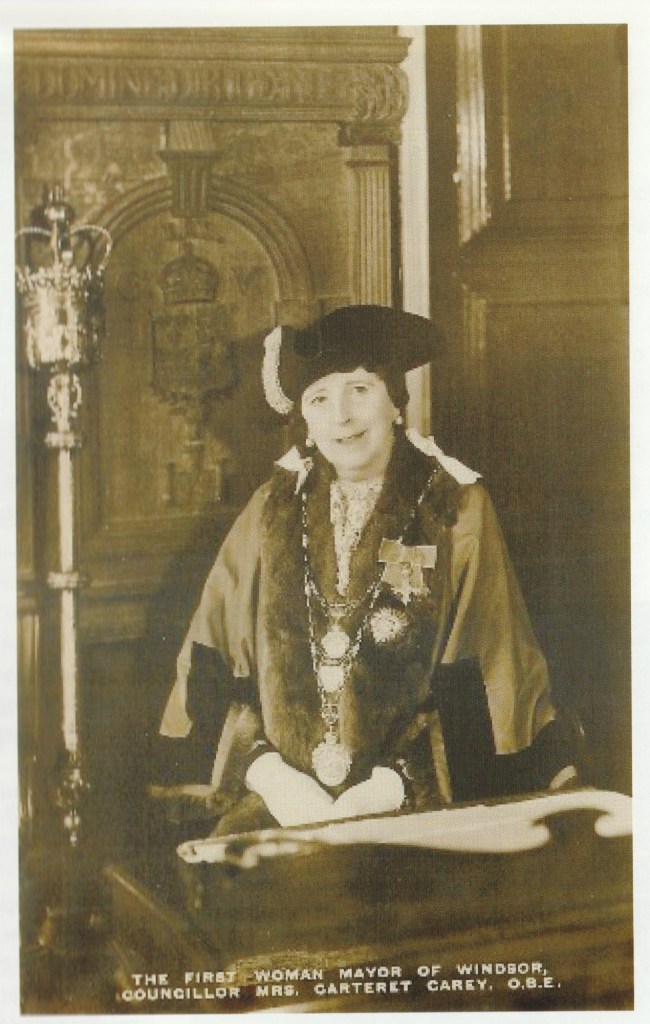
Windsor’s first woman Mayor (1937-39) sitting on the Mayor’s Chair in the Guildhall.
In September 1938 she was re-elected. Her first year in office was greatly praised. Councillor Pickin, who seconded the nomination said:
‘Hers had been a wonderful year; she had done extraordinarily good work, endeared herself to everybody, and it was their and his hope that she would enjoy very good health to carry on in what was going to be a very arduous year.’
She chose Arthur Churcher to be her deputy as he had been for her first year in office.
She took a great interest in sport during her mayoralty. She learned to play bowls and darts, and was rumoured to have practiced darts at the Guildhall. It was in 1938 that King George VI gave part of Home Park to the borough and she was determined to have it made available for sport for the people of the town. Her plans were thwarted by the onset of the war but later it was used for sport as she had wished. One of the few news photographs that appeared in the papers at that time and reproduced below was of her opening the new dressing room for Windsor footballers at Stag Meadow, where she regularly attended matches.
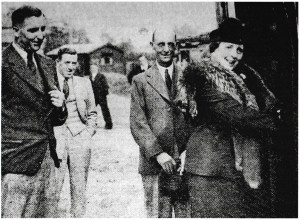
She was the first person to suggest that baskets of flowers should be hung on the lamp posts in the town, and had a part in arranging the floodlighting of the castle for the coronation of George VI.
She was made an Alderman and was still on the council representing Castle Ward at the time of her death, although comments in the Windsor Express make it clear that age was taking its toll.
She died on Saturday 3rd September 1949. On the Friday evening she had been to the Theatre Royal, where she was a regular patron, felt unwell on her return and died on the following day. Her funeral was at St. George’s Chapel and her coffin was surmounted with her Aldermanic robes and tricorn hat. The mourners included everyone of any importance in the town and representatives of the many organisations of which she had held office. People who remember her describe her as an imposing woman, but she had a nickname because she always wore make up with rather a lot of rouge. Some people remember her as Floodlit Flo.
Pamela Marson
Sources
Windsor Express various 1913, 1932,1937.1938.1939 and 1949
Minutes of Council of Royal Borough of New Windsor various 1925 — 1949
Website, History of the Carey family of Guernsey.
 Windsor Local History Group