
Published in Windlesora 21 (2005)
© WLHG
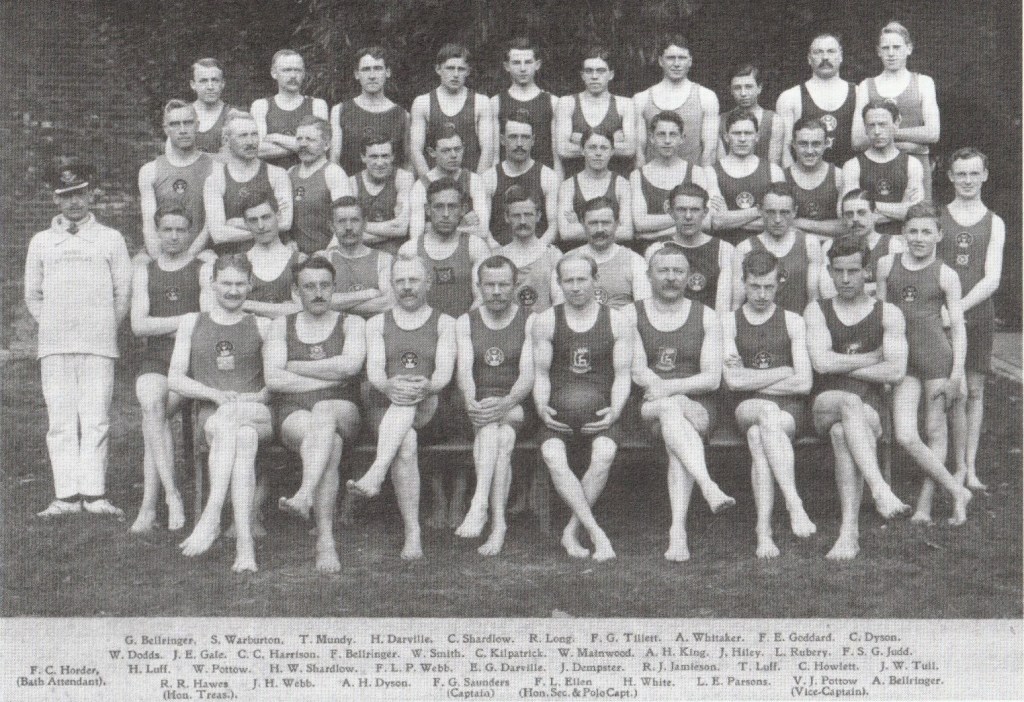
The Windsor Swimming Club was restarted in 1907 by my father FG Saunders, the pharmacist who had a shop at 41 St Leonard’s Road, when he came to live in Windsor. Fred Saunders had been a keen swimmer while living in Brighton and for many years he was Windsor Club Captain.
All the swimming in those days was in the river or the swimming baths which were in a backwater of the river Thames where the old Great Western Railway Bridge crosses it. A club house was built on the island beyond the backwater, which was turned from a wilderness into a pleasant garden with neat lawns, rose arches, apple trees, and a miniature golf course. There were landing stages and a diving springboard. To hide the railway, Fred planted conkers and now these are large horse chestnut trees. In most winters the river would flood, making the water on the island about knee-deep, so the club house had to be above that height. Over the years it was enlarged again and again and the bar was a very popular feature. With its magnificent view down the Thames and Windsor Castle it was an ideal place for entertaining visiting swimming teams including, from time to time, swimmers from abroad.
The stream used as ‘the baths’ had lawns on both sides backed by a row of changing cabins, known as boxes, where you left your clothes while swimming. There was also communal changing in the arches. The railway bridge divided the baths into two parts, and until the late 1930s there was no mixed bathing except on Wednesday and Saturday afternoons. Otherwise the men swam on one side of the bridge and the women swam on the other side. On each side there was an area deep enough for diving from the high diving boards. One side there was a five metre board and a springboard and on the other side the highest was three metres. At each end there was a shallow area divided from the deep end by a wire strung across the bath. The bottom was slightly slimy shingle and the water was a greenish brown. You could not see your feet at the bottom. In a warm summer towards the end of August the temperature of the water might reach 70°F. ‘Luxury’ we would think. By mid-September the water was too cold for swimming for pleasure. After Spm it cost 2d to go in for a swim and a season ticket cost 4 shillings.
My first experience of being taught to swim was being put in a horrid cold damp canvas belt and being dangled in the cold water from the end of a pole held by the baths superintendent, Mr Horder. This was not a success, and after two attempts and floods of tears it was given up. Soon after that, on holiday near Bognor Regis in the sea on a shallow sandy beach, I found I could swim. I became the youngest member of the Windsor Ladies Swimming Club and soon was swimming in a gala held in the Windsor Swimming Baths.
In the summer the Windsor Ladies Swimming Club met on Tuesday evenings at the baths. There would be two or three races of about 30 yards. Some were handicapped and that was about the limit of our training. During the season the Windsor Swimming Club and the Windsor Ladies Swimming Club would both organise swimming galas, which would be a programme of swimming races and diving competitions, some of them open to other clubs. There were some County events held at Windsor and the evening ended with the men playing Water Polo Matches which were always popular.
In hot summer weather the baths were very popular and often crowded, but in the late 1930s there was a polio scare and the river water was blamed, so the baths had to be closed, to open a year or so later.
After WW2, in the 1940s the Windsor Ladies Swimming Club swam for a while at the Slough Social Centre Pool, and for a year or two, about five of us pre-war swimmers were winning county events until the new swimmers could be trained.
At last, in the late 1940s Windsor was to have a new swimming pool. Not the indoor pool we needed, but an outdoor one. Even in summer a heated outdoor pool is not ideal for training, when it has to be used in the evening after the pool has been closed to the public, or early on Sunday morning. The two clubs, the men’s Windsor Swimming Club and the Windsor Ladies Swimming Club had been amalgamated and our coach Alf Spain had big ideals, and to do enough training we swam at many other pools. We went to Slough, Ashford and Staines and even booked a lane at Crystal Palace for a time on Sunday mornings. We organised circuit training and the club really took off and under many coaches we have had since the swimmers have improved and improved.
Windsor had always been renowned for swimming long distance races in the river. A quarter of a mile, half a mile, a mile accompanied by a flotilla of rowing boats acting as safety boats. Then early on a Sunday morning, timed to finish before the locks opened, the lock to lock race from Boveny Lock to Romney Lock a distance of two and a quarter miles. After the race we went back to the club house, for a magnificent barbecue breakfast. Some people, not content. with the downstream race would swim it upstream, against the current, or even upstream and then down again, or even from Maidenhead to Windsor.
To celebrate the 60th birthday of the club a 60 mile team swim was organised from Abingdon to Windsor. The swimmers set off from Abingdon on Saturday morning and swam through the night to reach Windsor on Sunday morning. This was a big operation and the launch Windsor Belle was hired as the ‘mother ship’ together with a fleet of dinghies to act as safety boats. A team of six swimmers was chosen, each swam for about an hour at a time. The target was achieved 1 hour and 8 minutes ahead of the estimated time.
The possibility of catching Weils Disease eventually caused the river swimming to be abandoned.
An invitation to swim in Paris to celebrate the 40th anniversary of the Sports Club of Windsor’s twin town Neuilly started the swimming club on a series of twin town swimming competitions. At Neuilly we were also competing against their other twin towns from Belgium and Germany. We were greeted with national flags and national anthems. It felt like competing in the Olympic Games. Our nervous, youngest backstroke swimmer won the first race and Windsor went on to win the competition. This led to a return match in Windsor which included Windsor’s twin town Goslar, which in turn led to other competitions and opportunities for travel in return for hospitality in Windsor, and many international friendships were made. During these visits, great use of the club house on the island was made.
However, when the outdoor pool was closed, the new indoor pool was built with slides and waves and this was useless for serious swimming. The club house was used less and less, was vandalised and had to be given up. With the new 25 metre pool now at the Leisure Centre it might have been saved — but that is another story.
The standard of the Windsor Swimmers goes up and up, but this is not my story; my story is of the enjoyment I have had through swimming and the pleasure it gives me to help the young beginners and improvers over the years.
 Windsor Local History Group