
Published in Windlesora 14 (1995)
© WLHG
In 1892 Frederick William Camm and his new wife Maria moved into a newly built “two up two down” house at 2 Bounty Terrace, Alma Road, Windsor – now known as 10 Alma Road. They had twelve children, but it was their oldest son Sydney (b. 1893), and their second son Frederick James (b.1895), who owe most to Windsor Model Aero Club, though George and Charles were also involved. Sydney designed the Hurricane aeroplane and was knighted in 1952 and Frederick (FJ) became editor of George Newnes “Practical” magazines, technical journals and books on all branches of engineering.
Both boys attended the Royal Free School in Windsor where they learned woodwork and drawing. However, Sydney once said that his interest in aviation was started off when he saw some drawings of the Wright brothers’ biplane in a Windsor model shop. He made the model but it was not very successful. He read reports of early aviators in Flight magazine.
In September 1911 many local boys were able to see the Coronation Aerial Post from Hendon to Windsor. It was due to land on the Review Ground in Windsor Great Park but in the event Gustave Hamel came down in the meadow between Frogmore Mausoleum and the Long Walk. More and more of these boys became makers of model aeroplanes.
Guided by reports of other clubs in Flight, Sydney and FJ arranged for local boys to co-operate, extolling the advantages of a club workshop and enteringcompetitions. The first meeting was held in the garden shed at 10 Alma Road. Soon premises were obtained in Arthur Road. The rent was one shilling and sixpence per month. There was no lighting, so an oil lamp was borrowed and a medicine bottle to keep the paraffin.
On 20 April 1912 Flight magazine contained this report:
“Windsor Model Flying (Sec. S. Camm, 10 Walma (sic) Road Windsor).
The above club has been formed, and it is hoped that some good work will be accomplished during the summer as the club has unequalled facilities for experiments with “rising-from-the-ground” and hydro-aeroplane models. Despite the gale last Saturday week, some good flying was done by S.Camm, E.A.Dowsett, and F. Stanbrook. Flying today (Sat) at 2.30 p.m. in the Home Park. Would firms kindly send catalogues?”
Flight of 20 April 1912
On 27 April, Flight reported:
“Windsor Model Flying (Sec. S.Camm 10, Alma Road) The following members turned out with models last week:- E.A. Dowsett, S.Camm, E. Stanbrook, F. Camm, G. Hendry and H. Hamblin. S.Camm averaged 55 secs. duration, 350 yards distance. In view of the facts set forth in last week’s Flight, it has been decided that all models must be protected. Contests will be arranged soon. Flying as usual today (Saturday) in Home Park.”
Flight of 27 april 1912
Meetings were held every Wednesday and Sunday during the summer. Members made up to three models a week, since losses and crashes were frequent. Competition rules required that timed flights be from launch to landing – or until the model passed out of sight. This was the fate of several models including one of FJ’s.
Younger brother George Camm was sometimes called upon for help. He was used to retrieve lost models from the railway viaduct and to buy Japanese silk from the dress fabric shop in Peascod Street. At the age of 12 he found this a great embarrassment.
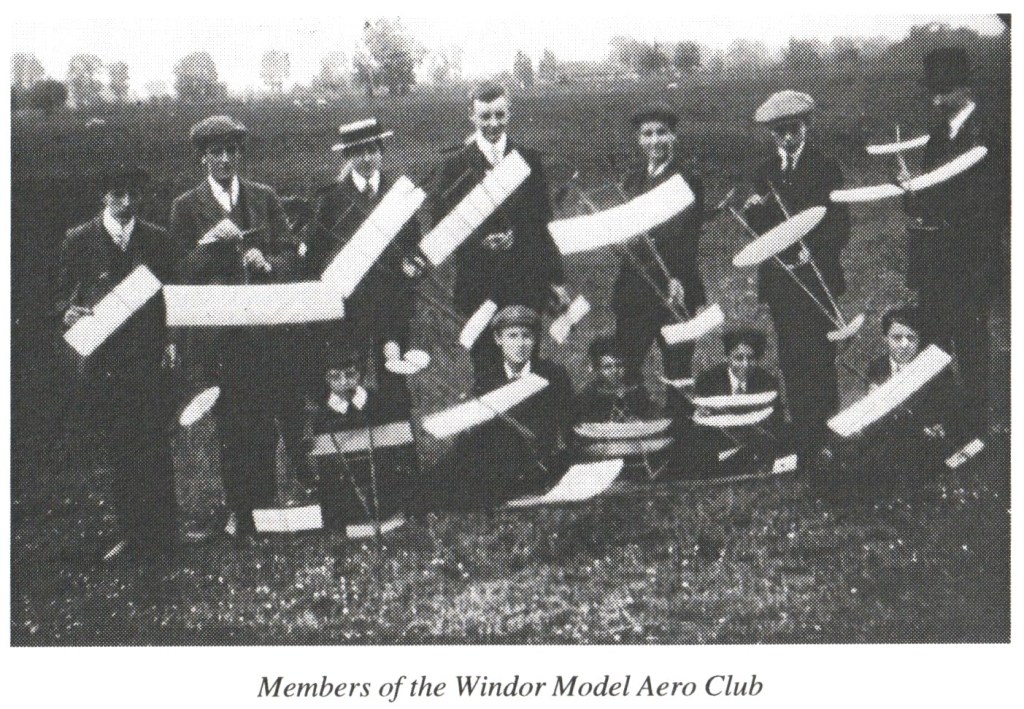
Members of the club decided to build a man-carrying glider. This was reported in Flight on 31 August 1912 together with the plea: “The club would be glad to hear of enthusiasts willing to help.” They worked quickly for the 14 September report concluded: “Flying Saturday by Barton (tractor mono), S.Camm (hydro), Dowsett (biplane),Stanbrook, F.Camm and Hamblin. Glider expected out today week.” There were several reports that there was not enough wind for gliding and by 30 November the report says “Incredible as it may seem, there has not yet been a good wind on a Saturday, and this, combined with the short days, has made it impossible to do any gliding.” By the end of the year the glider was flown with Charles Camm occupying the pilot’s seat. On one flight this position was taken by Stanbrook and the glider crashed on landing, breaking his collar-bone. On 4 January 1913 Flight published a photograph of the glider with nine members of the club standing beside it. The club’s report for January reveals that the machine had a 32 ft wing span and that they considered this was excessive for body control and somewhat dangerous.
As well as building the glider, members of the club had been preparing for an exhibition at Olympia and the report in Flight of 22 February 1913 is very favourable:
“The Windsor Model Aero Club exhibits several models, of which one alone is hand-launched. We feel that a special word of encouragement is due to this club, which at present is quite a small one and which, we learn, has not possessed the advantage of seeing any other model flying than their own. A very tasteful and pleasing effect is made in the case of their exhibit by their seven models all being covered with a similar coloured fabric – in the case of small combined exhibits the effect is decidedly good. Of the six self-rising models, four are tractors and two Canard type. F. Camm exhibits a tractor monoplane, single propeller twin-gear, built-up fuselage, laminated propeller. S. Camm, a hand-launched biplane, -Canard type- with staggered planes, with a slight negative angle at the tips, combined with swept-back wings, built-up fuselage, and laminated twin propellers, also a monoplane on very similar lines. F.A. Dowsett, a biplane -tail type- twin propeller, rear fin and channelled section wood, triangulated chassis, extended upper plane. A. Eldridge, a tractor monoplane in which the propeller is unprotected by any skid. E. Stanbrook, a double-surfaced tractor biplane, fitted with four-bladed propellers built-up covered-in fuselage and rigid chassis, the skids are steel sprung and laminated. E. Vevers, a tractor fitted with a single propeller, twin gear (i.e. two cogs of the same number of teeth), spring chassis.”
Flight of 22 February 1913
On 5 April 1913, it was reported that the glider had been destroyed when it was taken out in a gale, but on 3 May they published the specification of their new glider. They also changed their name to Windsor Model and Gliding Club. The new machine was made in three sections for convenience of transport, two 9ft 6in end sections and a 6ft 6in middle section, making a total span of 25ft. The control was by interconnected ailerons, with rudder and rear elevator. The ailerons and elevator were controlled by universal lever, and the rudder by a foot bar. The wings were built with an18in flexible trailing edge. The chassis was of ash with two rubber-sprung wheels. An aluminium bucket seat was fitted. The rest of the material was mostly spruce. The weight of the machine was 75lbs.
Sydney dreamed of flying around Windsor Castle’s Round Tower as Sopwith had done in 1911 and so an engine was needed. An advertisement in Flight was brought to his attention. It was for an air-cooled 20 bhp AVRO Cowley engine, once used by AV Roe in an unsuccessful attempt to achieve powered flight. The price was £25 and Sydney just raised that amount, but it did mean not paying the rent on the club shed.
The engine arrived from Ireland where it had been the property of Irish aviatrix Lilian Bland and had been dug from a bog. One Sunday, Sydney and FJ bolted it to their father’s workbench and, although they were dressed in their Sunday best, they took turns to swing the propeller. Suddenly the engine started, with an unsilenced roar, spoiling the peace of that quiet Sunday afternoon. Although it was claimed to be balanced, the engine’s vibrations caused the workbench to “walk’’ round the shed, while the flailing propeller sent wood shavings and straw hats flying. The propeller made it impossible to get near enough to stop the engine and the uproar brought the police. When the engine stopped, probably because it became overheated, the brothers, now covered in oil, were given a stiff warning. This was echoed in the Windsor Express, with caustic comments.
The club did not survive the Great War. Many of the members were called up into the army and there were financial difficulties. The workshop rent was in arrears and the landlord locked the members out, with their precious glider and engine inside. George Camm cut through the brickwork so that they could salvage their property and rebuilt the wall so carefully that the landlord was astonished to find the birds flown. The glider was broken up in 1919 and the engine was cherished by George Camm for many years. He lent it to the Windsor Collection as part of a display at the Windsor Guildhall. Apparently, Lilian Bland returned to this country, after many years in America, and rang George Camm to find out what had happened to her engine.
The last surviving member of the club was Bob Mainwood. He used to tell stories about the club, its successes and failures, with great gusto. He told how members who had bicycles used to go to see real aeroplanes flying, often at Hendon. They delighted in watching pilots “looping the loop” and performing inverted flying.
The site of the club, which is now part of Ward Royal, is marked with a plaque.
Gordon Cullingham
Mr Cullingham has been instumental in arranging that FJ Camm’s work is not overshadowed by his better-known brother. An exhibition has been prepared for display at Windsor Heritage Centre at the end of 1995 and elsewhere in 1996.
 Windsor Local History Group