
Book Review by Hester Davenport
Published in Windlesora 20 (2003)
© WLHG
‘The past is another country,’ wrote L.P. Hartley, and there can be few of us who have not at some time wished we could travel to this alien land as easily as to some foreign tourist destination. Failing a time machine however, paintings and photographs can bring the past visibly before us, and enable us to get some sense of what it might have been like to stand in a place familiar to us, take in its changed landscape, imagine its sounds and smells, and scrutinise its people, so like yet so different from us.
It is in this respect that Sheila Rooney’s latest book, Windsor & Eton: Centuries of Change, scores so highly. She has found a great many images of the past, and commissioned new ones, enabling us to make comparisons and move in imagination from one era to another. Photos of Daniel’s department store today and yesterday for example, remind us of changing tastes and changing prices; men and boys in flooded Eton streets in 1894 can be matched with a scene of flood clear-up in Windsor in 1947: the same problem but the differences of half a century. Photographs only exist from the second half of the nineteenth century, but there are paintings, such as one of Windsor High Street in 1830 – turn over the page and you have moved a a few yards up the street but jumped sixty years into a George Henton photograph of the 1890s. Paul Sandby’s paintings offer similarly remarkable images of Windsor and its people in the 1760s; they are Crown Copyright, but Daphne Fido has captured the essence of one of them in a line drawing which looks through the Town Gate of the Castle towards Peascod Street, where boys roll beer barrels while in the foreground a redcoat flirts with a maid at a window. And so the succession of absorbing images continues.
Part of the success of this book is owing to the excellence of the quality of the reproduction, and the generous spreads given to the pictures. Some will already be familiar to local historians, but they are given a new lease of life in being reproduced across a double page. For example, the photo showing a crowd on Windsor Bridge in 1898 celebrating the end of tolls imposed for crossing it, is well-known. But now it is possible to look at it more closely, noticing details such as two small faces peering between legs, or the thin-faced boy leaning against the bridge in a man’s hand-me-down coat.
The bridge is the link between Windsor and Eton, and its contentious nature in tolls and costs of repair and replacement down the centuries typifies the slightly uneasy relationship between the towns. It may have seemed anobvious pairing to the publisher, but the two communities, one Castle- and one College-dominated, are distinct and different, and their histories have not fused altogether successfully in this book. There would have been an argument for concentrating solely on Windsor and presenting its history in greater depth. Nevertheless there are striking images of Eton, not least the portrait of the dispenser of royal medicaments beneath his badge of warranty ~ this will surely feature in local histories of the next centuries. There are many such striking modern photographs largely, we are told, the work of Pamela Marson, but the book could have done with clearer identifications of artists and photographers. George Henton in the 1890s was meticulous in recording the dates and even times of day of his photos, but not all are even credited to him, let alone dated.
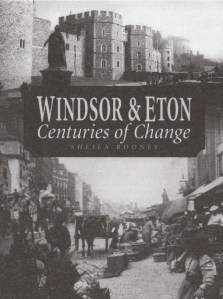
The book is divided into sections – Servicing Windsor Castle, Soldier, Soldier, Religious Buildings, Education, and so on – and each is prefaced by a short essay, which newcomers to the subject will find useful. Perhaps the
most interesting section is that which deals with wartime Windsor and Eton, a period near enough in time for some of us to remember, and all of us to have connections with, but now rather distant. Here one would have liked a longer introduction, with more about, say, the 40 air-raids which are recorded but with only brief detail. Mrs Rooney has, however, unearthed some fascinating pictures and histories. There is the story of the young Jewish girl evacuated to Windsor, whose bright-eyed face claims the reader’s sympathy. A tale told in strip cartoon, not related to Windsor and Eton but giving good period feel, tells of poor Mrs X, faced with the choice of being an air-raid warden or a ‘good’ wife serving hot suppers, until she discovers Mrs Peek’s puddings. Finally there is the splendid photograph of a VE party for children in a bunting-clad Arthur Road in Windsor; the women unselfconsciously pose in their pinnies, while the children sit a little uncertainly at tables piled with food. They are dressed in neat coats and strap shoes, not a T-shirt or pair of trainers to be seen.
Printed by Breedon Books, 2002.
Hester Davenport
 Windsor Local History Group