
The Unique Story of Windsor’s Royal Academy artist
And how his descendants are searching for and buying back, his collection of works from around the world, to bring back to Windsor for display.
Published in Windlesora 35
© WLHG 2019
The Huggins family history in Windsor goes back to the 1800s. Tudor’s great-grandfather, a man named George Poynton Shaylor, was a boy soprano soloist who performed at Windsor Castle in 1906. This was a command performance of Robin Hood and given for King Haakon VII of Norway and his son, Olaf. During World War 2, the Shaylor family gave their Thames-based boat White Lady, to evacuate troops from the Dunkirk beaches.
George Shaylor’s sister Ethel was also a Windsorian. She became a nun and moved to a French convent where, along with the other occupants, she was murdered when the Nazis raided it.
David Colby-Jones, Tudor’s other great-grandfather, was Aide-De-Camp to Winston Churchill, who was godfather to Hugh Anthony Spencer Colby-Jones, the author’s maternal grandfather.
Wilfrid Huggins was a Civil Engineer by trade and also a talented artist. He gave up his career as an engineer to pursue art and went on to become a member of the Royal Academy. Wilfrid was a prolific artist, particularly during World War 2. He produced a diversity of works in pen and ink, oil, and watercolour. Most of his artworks were kept within the family, and over the last 80 years have ended up as far afield as Zimbabwe, South Africa, Australia, Canada, and the USA.
Family and collection move to Africa
His marriage to wife Edith produced three sons, Spencer, Marsden, & Grandi
Marsden Huggins, the second son of Wilfrid and Edith, was born in 1914. He was a
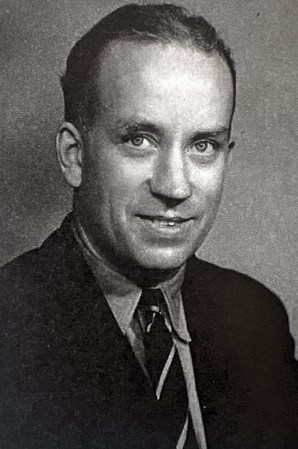
Windsor businessman and councillor, as well as a captain of the Windsor football team. He is believed to be the youngest councillor in Windsor, being just 23 years old when elected. He served Windsor from 1937 to 1939, 1941, and 1946.
During World War II, Marsden was engaged in the manufacture of radar equipment which contributed to the saving of many lives. His wife Joyce volunteered as an ambulance driver in Windsor. The couple were very successful, owning a garage and a car yard where, during the war, they repaired the cars of servicemen free of charge. Following the war, Marsden imported bicycles to Windsor to help ease the transport crisis.
Located at 437-441 St Leonard’s Road in Windsor, the garage and the original residence still stand, and today the site remains in the ownership of the Marsden-Huggins family. In 2019, the family started the planning and application phase to redevelop the site as a hotel. It is intended that the hotel will provide much-needed affordable overnight accommodation in the town in line with the Windsor Tourism plan. Behind the site is the Windsor Cemetery, where both Wilfrid and Edith Huggins are buried. Marsden bequeathed a part of the land at St Leonard’s Road to the council in order to provide easy public access to the cemetery. Subsequently, Marsden was also buried there, and in recent years the family organized the restoration of his headstone. There are plans to also restore the graves of Wilfrid and Edith.
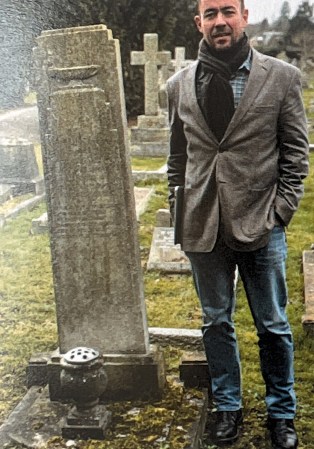
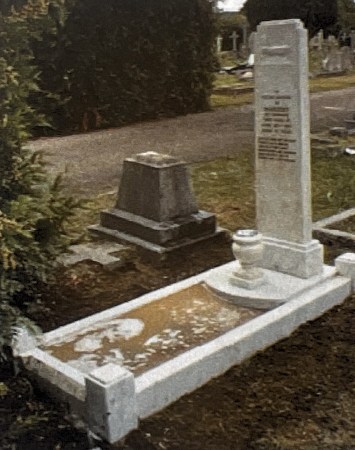
Tudor Marsden-Huggins at the grave of Marsden Huggins
In the summer of 1947, whilst holidaying with friends in Brighton with his wife Joyce and his two-year-old son John. Marsden enjoyed a game of table tennis with his friend. Later that night, he woke feeling unwell and asked Joyce to get some water. When she returned to the bedroom, Marsden was dead. During a recent operation to remove his appendix, it seemed that surgeons had left Marsden with a large clot, which ultimately travelled to his heart and killed him. It was a shock for the 25 year old Joyce, and unable to drive, it was her brother Dudley who returned to Windsor by driving them back in Marsden’s car.
Since Marsden had died intestate, everything was inherited by his only child, John; his wife Joyce was provided with a lifetime income. Marsen had been captain of the Windsor football team, and within a few weeks of his death, one of his teammates, Stanley Hiscock, visited Joyce to offer his condolences. Being a tall, dark and handsome striker, it wasn’t long before his attentions started to win over the young widow. He was unable to divorce his Roman Catholic wife, and the convention of the day meant that a couple living together out of wedlock was frowned upon, so they moved to the British colony of Rhodesia, taking the artworks with them. Joyce gave away many other pieces inherited by her son John and his descendants.
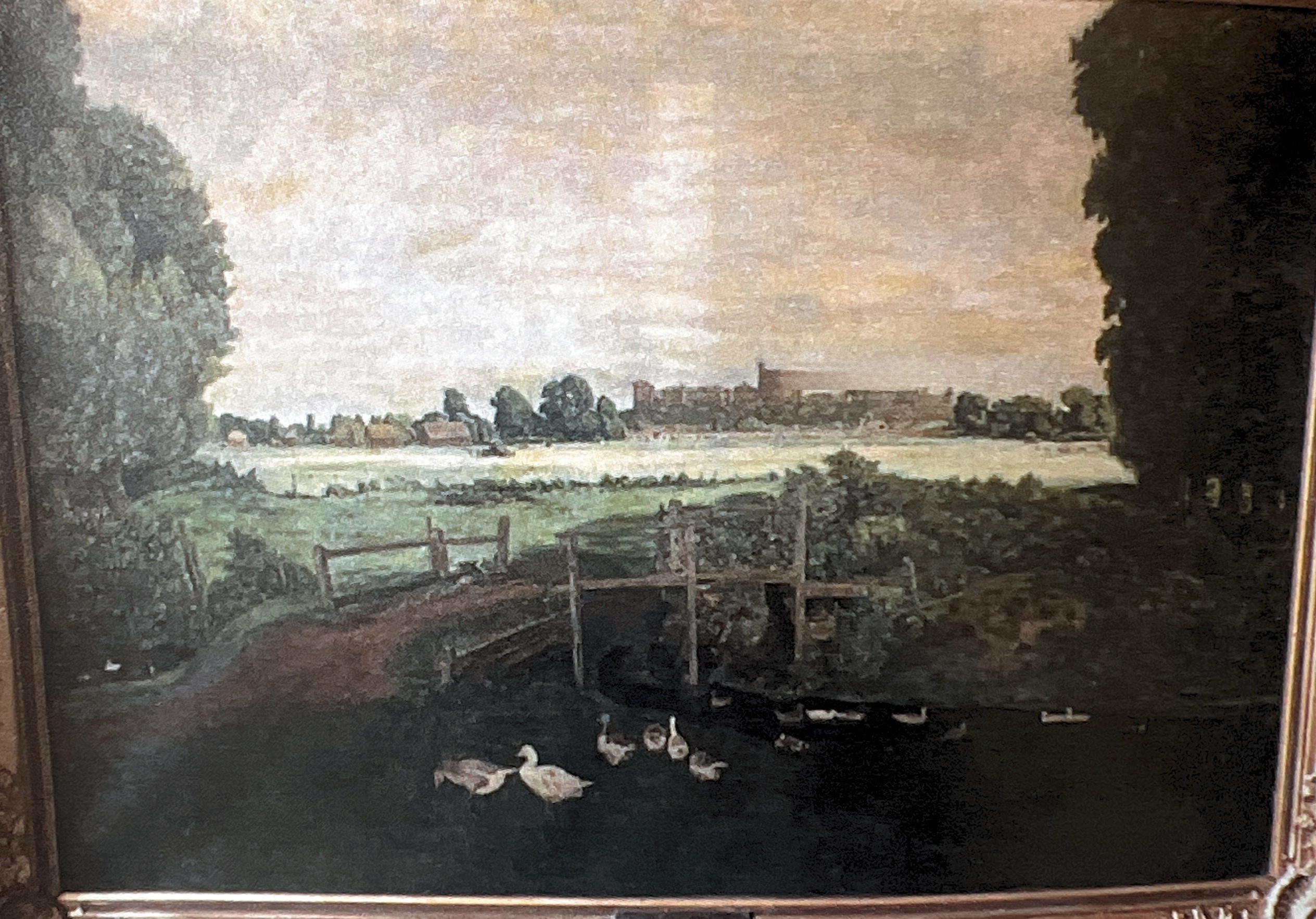
After the untimely death of Marsden, Wilfrid donated a painting to the Windsor Council in his son’s memory. The painting is a part of The Royal Borough of Windsor and Maidenhead’s Civic Collection, but it subsequently disappeared. It was displayed in the Guildhall according to Art UK, but during a visit by the author, no one knew anything of it. Although Wilfred’s great-grandson resides in Australia, he visits Windsor frequently and has made it his mission to track down the missing painting.
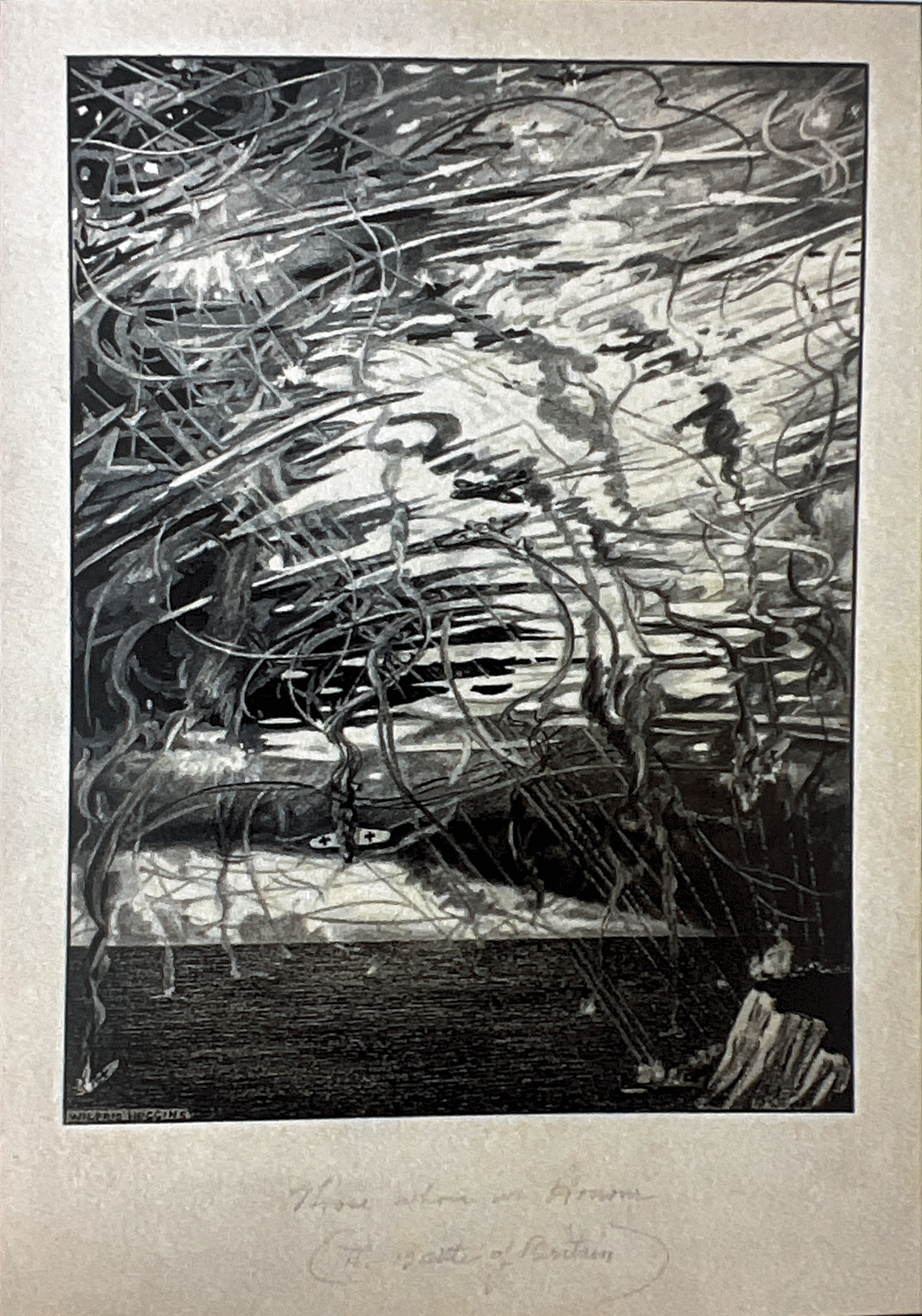
Wilfrid’s art is both beautiful and vastly diverse. One particular collection of original drawings, held by the Marsden-Huggins family, contains 54 drawings depicting various people, campaigns, and other aspects of World War II. This evocative drawing, The Battle of Britain, looking out over the Channel from the White Cliffs, works like a time-release image for a whole day’s dog-fight. The vapour trails of aircraft are traced across the sky, entwined with British and German warplanes. Exploding shells light up the dark sky, several battle cruisers join in by firing salvos, and all-around aircraft are ditching into the sea. A scene of utter chaos. Centre stage is a Hawker Hurricane, the aircraft designed by Windsorian Sir Sidney Camm. He grew up in Windsor about the same time as Wilfrid Huggins, and they must have known one another.
In collaboration with Dr Brigitte Mitchell, it is intended to publish a coffee-table book, showcasing these 54 drawings. Whilst working on the book with Dr Mitchell, the author talked about the missing painting, and Dr Mitchell said she had a contact who may know its location. After a 4 year search, the painting was finally found in the basement of the Maidenhead Town Hall, and during a visit in January 2019, he was finally able to view the painting for the first time. He committed to the necessary restoration work being done so that the painting can again be enjoyed by Windsorians.
At the time of publication, Andrew Scott, Civic Team Manager from RBWM, has confirmed that quotes are being obtained in order to progress the restoration. They are yet to find a place for it to be displayed.
The Wilfrid Huggins Society was established in 2019. Its aim is to promote Wilfrid’s work and to return the collection to Windsor for public display. A number of other pieces have been tracked down and purchased, and eventually they will be repatriated to Windsor. The Society are actively searching for other pieces to purchase and add to the collection.
VIEW OF WINDSOR CASTLE FROM ETON WICKBY WILFRID HUGGINS ESQ.
DEDICATED TO THE ROYAL BOROUGH OF WINDSOR
BY THE ARTIST
IN MEMORY OF HIS SON
MARSDEN HUGGINS
A COUNCILLOR FOR WINDSOR 1937-1939; 1941 & 1946
WHO DIED JUNE 1947 AGED 33 YEARS
Leta and Tudor Marsden-Huggins
Notes
All images Tudor Marsden-Huggins and family.
 Windsor Local History Group