
The Life of James Thomas Bedborough
Stonemason, Builder and Property Magnate
Published in Windlesora 26 (2010)
© WLHG
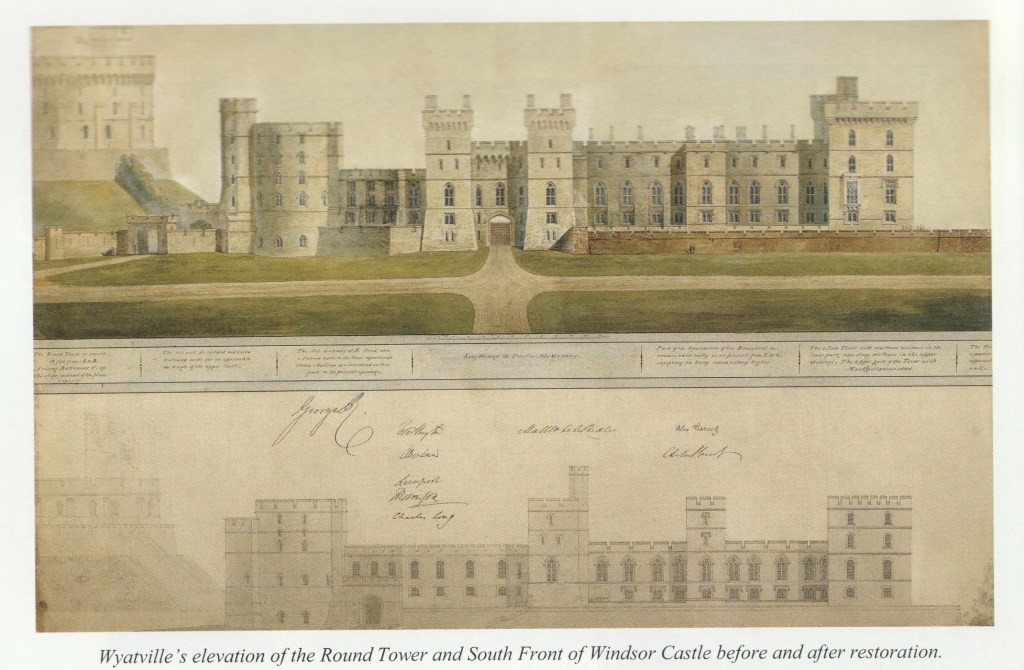
According to his obituary, James Bedborough worked on the heightening of the Round Tower.
The Royal Collection © 2009 Her Majesty Queen Elizabeth II
In December 2008 the Windsor Local History Group was approached by researchers for the BBC Television programme ‘Who do You Think You Are? ’ with a view to including a feature on the 19th century Windsor personality James Thomas Bedborough who was the great great great great-grandfather of TV presenter Davina McCall. This was to be the start of a voyage of discovery both for me as a historical researcher and was also to the start of an emotional journey for Davina as she slowly pieced together the genealogical jigsaw of her newly-discovered Windsor ancestors.
The research carried out on James Thomas Bedborough showed him to be a builder, politician philanthropist and entrepreneur, who could truly be described as the ‘man of the moment’ and was involved in many aspects of Windsor life. Bedborough, who started his career as a simple stonemason’s apprentice, was to accumulate a vast property empire, but by his death in 1860 was unable to leave his family any income. This led both to legal battles and also family tragedies – and remained unsettled for over seventeen years. In this article we consider Bedborough’s career as Stonemason and builder and how he became a great property developer and owner.
Early Family History
James Thomas Bedborough was born into a family who for at least three generations had been stonemasons. On 17 October 1787 James Thomas Bedborough was born to Thomas and Mary Bedborough in the Parish of St Sepulchre, London and was christened the following year on 15 June 1788.
At this time his father Thomas would have been a jobbing stonemason working in London (although he kept a home in Windsor) and James Thomas was destined to follow in his father’s footsteps. Nothing is known of his youth but in 1804 he began his apprenticeship aged 16 as a stonemason to his father Thomas Bedborough. James Thomas’s grandfather and great grandfather had all been stonemasons going back to the beginning of the eighteenth century.
On 18 June 1807 he married Sarah Wild at the fashionable church of St George Hanover Square. Shortly after their marriage they were living in New Windsor and a year after their wedding James and Sarah had their first child, Sarah, who was born on 25 May 1808. This was to be the first of at least nine children but only Bedborough’s eldest son Thomas James Bedborough was to follow in his father’s footsteps as a stonemason/builder.
The King’s Master Mason
James Bedborough became so proficient at his craft that in 1808 at only eighteen he was promoted to be King’s Master Mason on the death of John Slingsby who had held this position for twenty years. Trade directories of the time now describe Bedborough as ‘statuary and stonemason to His Majesty.’ He was responsible in his own right for carrying out works at Windsor Castle – the first was in 1810 for building part of the castle’s Terrace Walk. (1) Building account books show that he received £1042 for carrying out this work. According to Holden’s Directory in 1811 Bedborough had premises in Park Street. In 1811 he is recorded as ‘taking down and re-erecting a marble chimneypiece in His Majesty’s State Apartments’. Two years later in 1812 he constructed the Royal vaults beneath St George’s Chapel for which he was paid £3626. (1) The vaults consisted of simple fan vaulting so as to pay homage to William Virtue who had constructed the Chapel Quire in the fifteenth century.

The old medieval parish church of New Windsor was demolished in 1820 as it was in a dilapidated state – a new church was designed by architect Charles Hollis. (2) Robert Tebbott was selected as the builder of the new church and James Thomas Bedborough as the mason. In September there was a grand Masonic ceremony when the NW corner stone was laid. This included a long procession of Masonic hierarchy and Berkshire masons – however also in the procession were members of the Corporation of New Windsor, the architect Charles Hollis and the builder Robert Tebbott and of course James Bedborough, the stonemason responsible for building the new church.(3)
Shortly after his accession to the throne King George IV selected Jeffrey Wyatt, who at that time was a renowned country house architect, to work on the renovation and enlargement of Royal Lodge, a cottage orné which had been created by John Nash. It was situated in Windsor Great Park and was to become the principal residence of the King whilst a major refurbishment of Windsor Castle took place.
In 1824 Jeffrey Wyatt’s new plans and designs for the restoration work for Windsor Castle were selected by King George. In 1824 James Bedborough wrote to Jeffrey Wyatt to apply for the contract for the alterations to Windsor Castle for which he was successful. The main reason for this was that he had offered to carry out the works 5% cheaper than the Office of Works prices. Wyatt knew of Bedborough’s work as he had been mason for the work at Royal Lodge. The other principal contractors who were chosen for the works at Windsor Castle had also worked on the alterations to Royal Lodge.(4)
On 12 August 1824, in celebration of his birthday, the King laid the first stone « it is rumoured that after that ceremony, Wyatt had suggest that the King augment the change of his name from Wyatt to Wyatville. Bedborough as the King’s Stonemason would have been responsible for a large number of stoneworkers and workmen who came into the Castle as casual labourers. (4) Although he was in overall charge of the stonemasons working at the castle, one of the works he completed himself was the heightening of the Round Tower during these restoration works. (5)
Building accounts show that Bedborough worked at the Castle until 1836, twelve years from the start of his contract. Moreover he was paid well for the Castle alterations – over twelve years he made the sum of around £70,000 which equates to 3 million pounds today. With this money he was able to purchase land and develop new building estates (see below). Further evidence of Bedborough’s appointment as the King’s Mason can be found as part of a major landscaping project at Virginia Water. In 1816 The Prince Regent had accepted a gift of a portion of the ruins from Leptis Magna in Tripoli. The ruins were in the first instance stored in the basements of The British Museum as it was thought that a portion of them could be used to form the portico for the British Museum. This project never came into fruition and instead in 1826-7 the King asked Wyatville to produce a plan for the layout of part of the ruins known as Temple of the Gods as part of the Virginia Water landscaping project. The actual construction of the ruins was left to Bedborough. In Bells Life in London and Sporting Chronicle for 25 Nov 1827 we are told of a visit to the ruins where the King met him:
”His Majesty- We are glad to find that the King continues to enjoy excellent health, and takes his usual rides in the Great Park when the weather permits. On Wednesday his Majesty accompanied by the Lord Steward, visited Virgina Water, for the purpose of inspecting the ruins; Mr Bedborough, his Majesty’s stonemason, was in attendance, and had the honour of receiving his Majesty’s commands for the completion of this delightful spot…’’
In 1829 the corporation minutes show that Bedborough continued to work on public buildings in the town of Windsor. He is recorded as enlarging the Guildhall by adding a brick extension to the rear of the building where previously there had been a butchers shambles erected in the early eighteenth century. This new extension effectively doubled the size of the Guildhall. The work also included the insertion of the grand double ‘swept’ balustraded staircase which survives today. This replaced the far simpler 17th century staircase designed for the original Guildhall.(6)
In June 1829 the foundation stone was laid by Alderman James Eglestone who had contributed a large of sum of money to complete these works.

The Property Magnate and Landlord
In 1828 Bedborough, with the help of carpenter Thomas Jenner, was able to purchase ten acres of land in the Parish of Clewer from land owner Arthur Vansittart. Bedborough had been in partnership with Jenner for a number of years and had also both been involved in Wyatville’s alterations to the Royal Lodge and Windsor Castle. The cost of the purchase of the land came to the sum of £4189 which equates to just over £200,000 today. The land consisted of gardens and pasture known as Home Gardens, Magpie Close and two messuages with gardens near Clewer Lane. As part of a covenant to this land Bedborough had to provide three roads across it; one of these roads was Clarence Crescent where Bedborough was both later to live and die. However, Bedborough seems to have included an extra road — the roads he laid out were Clarence Crescent, Claremont Road, Trinity Place and Dorset Road- this whole area was known as the Bedborough Estate.
Early in 1828 Bedborough started to develop his newly acquired land and firstly built a double row of small artisans cottages leading off Charles Street which was to be known as South Place There were 28 houses with a mixture of one room downstairs and one on the upper floor or alternatively two rooms on the lower floor and two rooms upstairs. At the back there were six enclosed yards with communal privies and washrooms.
This street was not a nice place to live as it was often awash with ‘affluent effluence’ from the sewers of Clarence Crescent and was also a place where there were squatters – it was where ‘four women of the lowest descripton were apprehended in one of Mr Bedborough’s unfinished houses, where they sought shelter’. However these slum type dwellings were masked by a crescent of high status villas known as Clarence Crescent which fronted onto a amall park and were occupied by Windsor’s gentry. When the Crescent was built between 1829-30 the back windows of the South Place dwellings were bricked up and formed the back yards of Clarence Crescent. (7)
By 1836 the Bedborough estate had grown immensely. The land and properties were leased out to tenants. This enabled him to take out a mortgage with the City of London Bankers and Co Partners for £12,000. The mortgage document gives a full extent of his land holdings at that time. They consisted of:
13 Capital messuages called Clarence Crescent together with pleasure gardens laid out in front; nice messuages adjoining them called Clarence Road; three messuages opposite Spinners Field; coach houses and stables on the south side of Clarence Road called Alfred Mews; 28 messuages at the back of Clarence Crescent called Charles Street and 28 messuages in South Place. (*)
Security for the loan consisted of some 81 dwellings. With this loan he was able to purchase more land. The tithe apportionment document which accompanied the tithe map for Clewer of 1838 showed that Bedborough’s estate now consisted of 21 acres, 3 roods and 3 perches. The land included a further portion of meadow together with an orchard adjoining Spinners Field, – a meadow adjoining the Cavalry Barracks, a brickfield on the opposite side of St Leonard’s Road and Grove Place. The brickfield mentioned in this document was situated in Spital, and was later sold to the Crown for £1,500. This land was later used for the building of Osborne Road and Frances Road. The area covered by the disused brick quarry can be identified today where the buildings are built at a lower level to the roads.
In 1842, by which time Queen Victoria was on the throne, he purchased by auction a large tract of land consisting of 29 acres in the parish of Upton near Slough from farmer John Pocock, costing over £1000 per acre. On his newly purchased land he designed a large estate of fifty houses fronting a communal park. This was part of a larger lavish scheme which he had submitted to Prince Albert for consideration — his main goal was to unify the two towns of Windsor and Slough by a road which led from Thames Street in Windsor across a new bridge over the Thames (which by-passed Eton) to the newly built railway station at Slough. As part of this overall scheme he even tried to change Slough’s name to Uptonville. Sadly none of these plans were ever accepted — but Bedborough was now free to redevelop his Upton Park Estate and the plan appears to have been revised due tofinancial constraints — only 29 of the proposed 50 villas were ever constructed.
The proposed layout of the estate is shown on a conjectural drawing by the architect Benjamin Baud who is believed to have been responsible for the design of the villas fronting the park. (8) Benjamin Baud was an architect who had worked with Wyatville at Windsor Castle and so in turn would have known James Bedborough. At one time it was thought that the park, which acted as a centrepiece for the Upton Park villas, had been designed by Joseph Paxton who was also responsible for the Crystal Palace in London. Extensive research, however, has shown no evidence of Paxton’s involvement in Upton Park. The only mention of Paxton designing the park is in an 1870’s sales catalogue for the Upton Park Estate.

There were three main elements to the estate — built on top of a slope wore three blocks of grand buildings known as Victoria Terrace. In each block was a terrace of impressive villas consisting of twelve bedrooms in each. The grandest of all these villas is the central block and this is where Bedborough lived between 1843 and c.1849. He then moved into one of the grand villas in Clarence Crescent. Behind each block was a garden which fronted onto Upton Park. To the east and west of the park were a range of smaller villas known as East and West Villas. At each entrance into Upon Park were three lodge houses. The only one to stand today is Diana Lodge. During the time Bedborough was alive both the houses in Upton Park and Clarence Crescent were leased to tenants and were only sold off after his death.
Bedborough did not go on to develop any more large property estates in Windsor or Slough. He was later in his life to become more of a benefactor than landlord and took an important role in local politics.
Elias Kupfermann
References
(1) Rupert Gunnis – Dictionary of British Sculptors (1951), Odhams Press Ltd, London, p.44
(2) Elias Kupfermann — The Bridge at Windsor and its Masonic Dedication Ceremony in Windlesora No. 24 (2008) p.37
(3) Elias Kupfermann — John Ramsbottom, Banker, Brewer, MP and Freemason in Windlesora No. 23 (2007) p.29
(4) HM Colvin (ed) – History of the King’s Works (1973), Vol.4 1782-1851 p.386 n.
(5) This is mentioned in JT Bedborough’s obituary – Windsor & Eton Express, 25 February 1860. There is no mention of this in the building accounts.
(6) Raymond South – Transcripts of The Fifth Hall Book of the Borough of New Windsor, 1828 – 1852 (1974), p.7.
(7) Brigitte Mitchell – Problems of a Garrison Town, Windsor 1815 – 1855 – PhD Thesis (2001), University of Reading.
(8) Lithograph of proposed Upton Park Estate, designed by Benjamin Baud -Buckinghamshire Record Office (ref: D67/11)
(* Web Editor note February 2024 – definition of messuages – dwelling places and adjacent buildings and land associated with the household )
 Windsor Local History Group