
Published in Windlesora 21 (2005)
© WLHG
Have you ever wondered where people got their water from in the past? Although the first waterworks in Windsor had been built in Eton in 1697, mains water was not supplied to many households until the 1930s. During the eighteenth century, water was pumped up from the river using wooden pipes, and supplied only to a few of the wealthier households in Windsor and Eton. Water from the Thames had been pumped up to the castle since 1681, but there were also a number of wells; however, when Queen Anne was in residence, she had her water carried up by donkeys from a well in Chalvey.
Wooden mains only lasted 20-30 years, and the water company soon had to replace them with lead pipes. They then pumped the river water into lead cisterns to be distributed to those who could pay, at certain times during the day. Not only was the water contaminated with lead, but the river-water was taken from the Thames just below the bridge. Sewage from Windsor and Clewer, and effluent from the gas works were discharged into the river just above the bridge. By 1849 four hundred houses in Windsor and Eton paid good money for the privilege to have this lethal concoction pumped into their homes. The water rate for a cottage was ld per day.
Between 1847 and 1888 new cast-iron pipes were laid and wells sunk to clean up the water supply, but in the gravelly soil of Windsor, the contents of cesspits often leaked into the wells and flood waters from the river into the water-pumps which now pumped the water up from below the river. In 1888 the Windsor Corporation acquired the Waterworks for £131,000 from the Cutler family, who had run them for 141 years. They created a separate water committee with Christopher Sainty as the new water engineer. Between 1890 and 1900 eleven miles of mains had been increased to twenty-five miles, but still only a fraction of householders received piped water.
Most ordinary people in Windsor relied for their water supply on public wells, from which they had to carry their water home in buckets. Occasionally these wells were inside houses. The best documented was in 26 High Street, the old Token House. The well is now only accessible through 3 Peascod Street, but no longer on view to the public. The last public well was sunk in the Datchet Road in 1852. During early Victorian times a large number of houses were built in the water-meadows of Clewer Within and Clewer Without, to answer a growing need of houses for poorer families. Ground water wells could be easily constructed in this flood-plain and many houses had their own wells in the back gardens. One of these was recently discovered in the back garden of 73 Bexley Street. It is a typical ground-water well, because the lower courses have no mortar, to allow water to seep into the well.
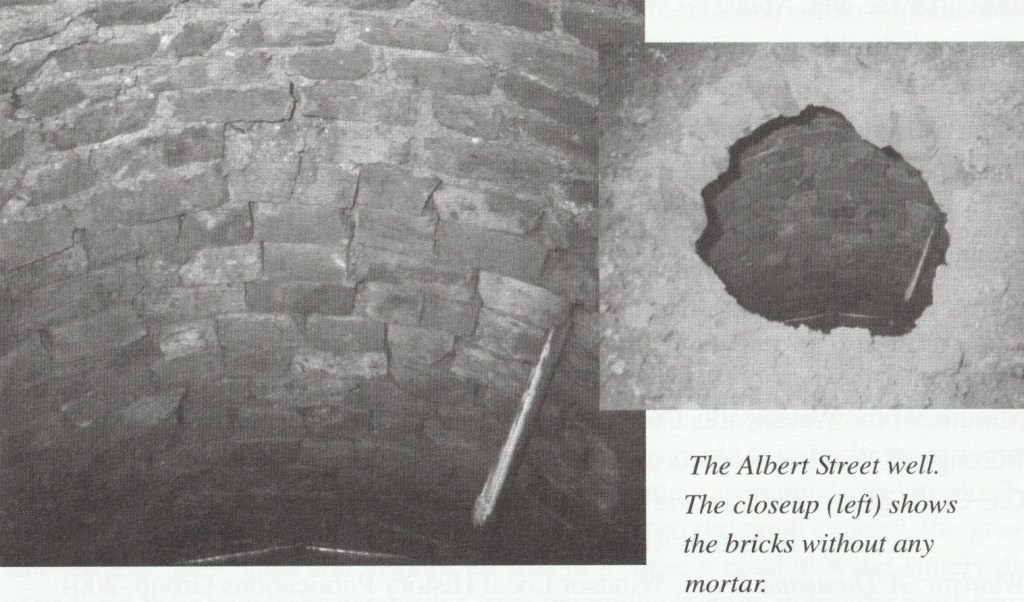
During the 1860s Albert Street was built, but here wells were actually incorporated into the houses. In fact, two houses shared one well which was under the dividing wall of the kitchens. One of these was recently discovered between 58 and 60 Albert Street. A pump in the kitchen drew up the water from the well below, which was constructed in exactly the same way as the one in Bexley Street. It was round, 1.20 metre in circumference and 3 metres deep. The circular shape resisted the ground pressure from all sides, and the upper courses which were set in mortar, resisted downward pressure of the wall above. The well was 2/3 full of relatively clean water. Some people still remember the pumps in the kitchens of the houses in Albert Street, but have never wondered where this water came from. This water supply was probably better than most in Windsor, as it would not have been contaminated by cesspits.
In 1915 the water supplied by the waterworks was tested by the army who declared it to be dangerous; householders were advised to boil the water, until new filters and the first chlorination plant could be installed. In 1923 new mains were laid to the Clewer Hill area, in 1934 new housing estates in Dedworth were connected at a cost of £360, and in 1937 the mains were extended to new houses in Kentons Lane and Maidenhead Road. New solutions for a more efficient water supply had to be found, thus in 1939 a borehole was sunk in Wolf Lane with satisfactory results. Steps were taken to acquire land at St Leonard’s Hill for a reservoir, but this had to wait until after the war. At last all Windsor households could rely on a clean and efficient water supply.
By 1950 ninety miles of mains had been laid, and in 1960 the works were taken over by the newly formed Middle Thames Water Board. In September of that year a new underground reservoir was opened on St Leonard’s Hill which could hold three million gallons of water. It was described as being ‘like a Cathedral Underground’.
Brigitte Mitchell
Sources
Minutes of the Waterworks Committee, WI/AC2/5/3, Berkshire Records Office.
Borough of Windsor Reports and Minutes. Windsor Library.
GC Cullingham, Windsor and Eton Waterworks, Industrial Archaeology, Feb. 1968, pp.65-71.
Windsor: A Thousand Years, Windsor Local History Publications Group, 2001
 Windsor Local History Group