
Published in Windlesora 03 (1984)
© WLHG
When the war broke out in 1939, the political parties in Britain were preparing for a General Election in the following year. The ‘National Government‘, based largely upon Conservative support, had been in office since 1931, but the Labour Party was making progress and was hoping for a successful come-back. When the General Election did eventually take place at the end of the War, Labour was in fact victorious, securing 393 seats in the House of Commons against 213 for the Conservatives and their associates. For the time being, however, an Election was deferred and party political activities were suspended or at least limited. National unity against Nazi aggression seemed the priority.
In May 1940, the Labour Party in fact joined Churchill’s National government, for the formation of which it had considerable responsibility, and Clement Atlee, Labour’s leader, became Deputy Prime Minister. So while party policies were never completely submerged, they could no longer dominate the political scene.
By-elections were the big problem. M.P.s continued to die from time to time – some from natural causes, some serving in the Forces – and their places had to be filled. An Electoral Truce was proclaimed among the parties and, as the outcome of this, the party to which the previous M.P. had belonged was given the right to nominate his successor, neither of the other parties putting up candidates. The democratic process could not, however, be entirely suspended – even if elections had to take place on an out-of-date Register. The Windsor M.P. A.A. Somerville, died in 1942 and when Charles Mott-Radclyffe was nominated, an Old Etonian, Norfolk landowner and serving officer, he was opposed by the playwright, William Douglas Home, standing as Independent.
The uncertain factor was the attitude of the Labour Party in the constituency, which at this time covered not only Windsor, but also Maidenhead, Bracknell, Cookham, Twyford, Crowthorne, Sandhurst, Ascot and many of the smaller villages in East Berks. That official Labour should stand meekly on one side and allow a Tory to be elected was unacceptable to many Labour supporters – even during a critical period of the War.
The full story can be told from the Constituency Labour Party Minutes of the time and they make fascinating reading. The Party had never willingly accepted the Electoral truce. The War situation modified the Party’s views, but when the matter was put to the test by the death of Windsor’s Conservative M.P. there was great disinclination to toe the official Party line.
At an emergency meeting of the Party’s Executive Committee on 2nd June, all the developments were reviewed. In particular a letter to County Councillor Rickards, the President of the Constituency Labour Party, from the Conservative Association was read. The letter stated that the Association “would put forward before the electorate a Candidate who is a supporter of the National Government and who will be pledged to give full adherence to the Prime Minister and to a vigorous prosecution of the War in all its aspects. 1 shall be pleased to write to you again as soon as the Candidate has been selected and it is hoped that your Party, in view of the Party truce, will afford this candidature their active support.”
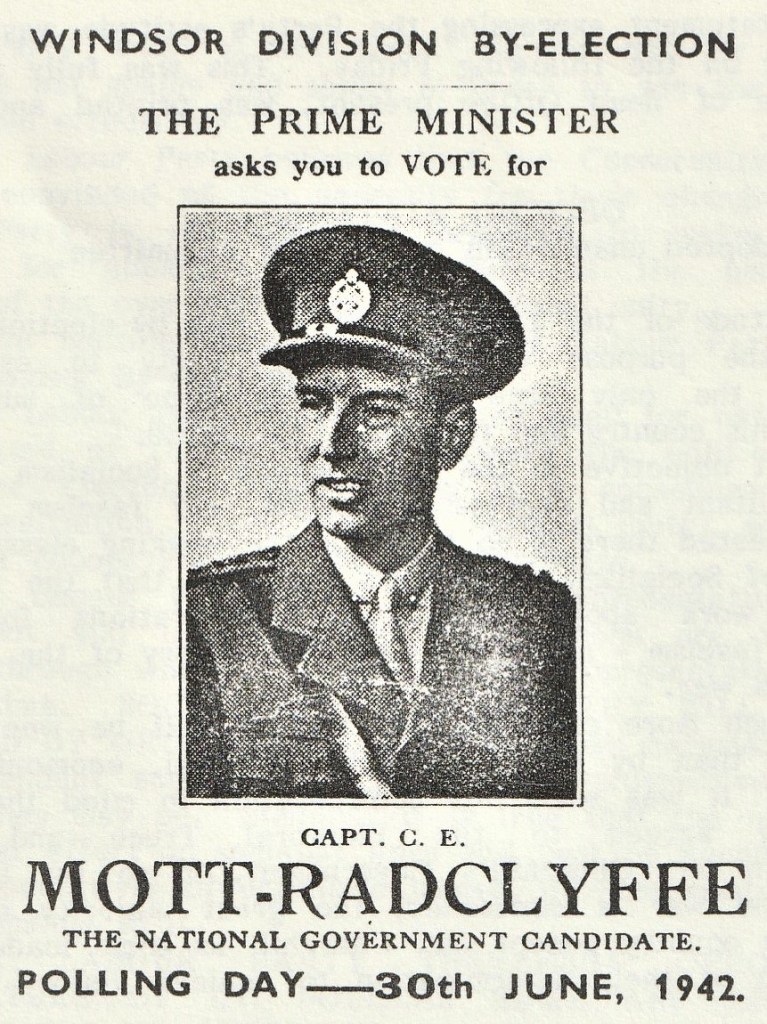
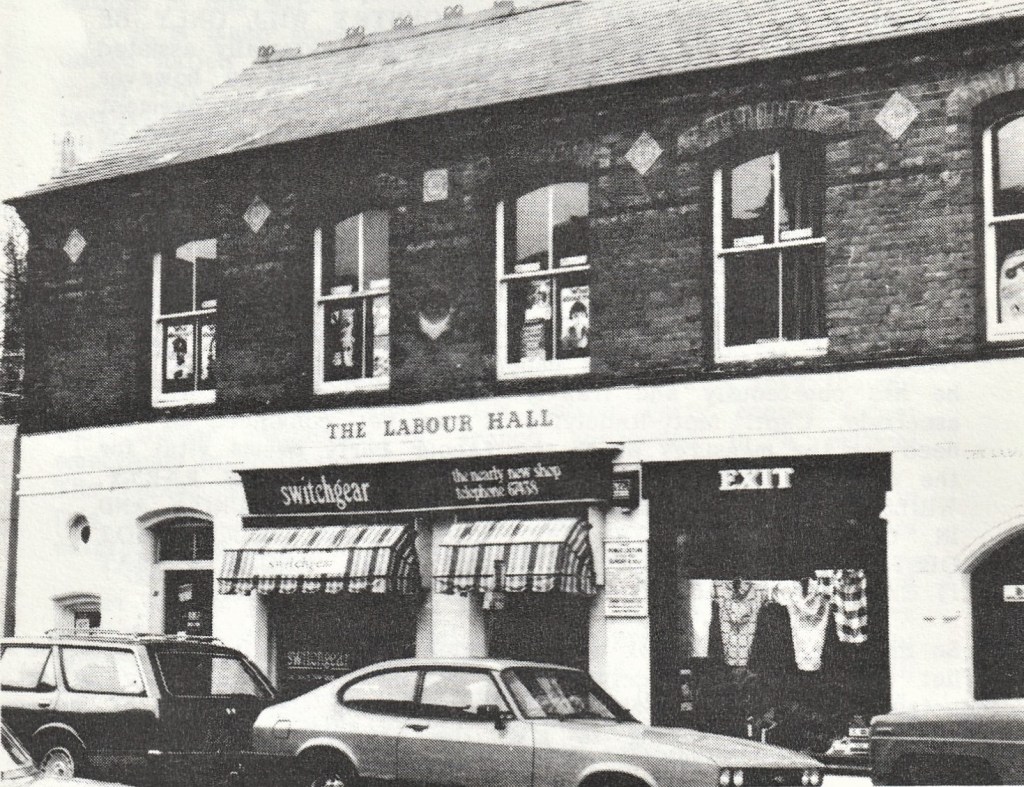
This the Labour Party was not prepared to do at this stage; any decision would be deferred until the party had had an opportunity to put a questionnaire to the Candidate. Events then moved fast. Mott-Radeclyffe was selected as the Candidate and he expressed his preference for meeting the Party’s Committee and answering their questions in person. This meeting was arranged for the Labour Hall, St. Leonard’s Road, Windsor, on Monday 15th June. Between thirty and forty members of the Constituency and Local Party committees were present, with Councillor Rickards in the chair. The E.C. had held a special meeting on the previous evening to draw up a list of questions and had these sent to Captain Mott-Radclyffe before he came to the Party meeting. He was courteous in his answers, but his attitude was often summed up in the words, “It is best to leave it until after the War.“
An official Statement expressing the Party’s attitude was adopted at a further meeting on the following Friday. This was fully approved by the representative of Head Office present, was printed and circulated widely. It reads:-
OFFICIAL STATEMENT
Adopted unanimously by General Committee
The attitude of the Labour Party to this by-election must arise from the purpose of the Labour Party to establish Socialism as the only sure and lasting hope of suffering humanity in this country and throughout the world.
The first objective in the achievement of Socialism is the defeat of militant and aggressive fascism. If fascism is not decisively defeated there is no hope for the working classes and no prospect of Socialism. It follows therefore that the Labour Party must work above all other considerations for the overthrow of fascism – and that means the victory of the United Nations in this war.
It is much more probable that victory will be won by a united nation than by one divided by political, economic and social strife. It was with this consideration in mind that the Labour Party agreed to the Electoral Truce and then participated in Mr. Churchill’s Government. In so far as the winning of the war is concerned, the great majority of the people of this country accept Mr. Churchill as their leader and the spokesman of their determination to achieve victory at all costs.
The Labour Party cannot, however, forget that there were in this country powerful forces which were prepared to compromise with fascism and even to strengthen it for the sake of their private and selfish vested interests which they thought were otherwise threatened. The Labour Party cannot forget that similar influences in France succeeded in a critical emergency in coming to an agreement with the fascist invaders. The Labour Party realises that these forces may still lurk in this country and is strengthened in this realisation in its determination to maintain national unity round Mr. Churchill.
On the other hand, the Labour Party believes that the full effort of this nation will not be exerted in this war until there is much more effective control by the government of the private interests which still in the main direct our production and until there is a much greater degree of equality of sacrifice. Further, a great transformation of our colonial and imperial policy is needed before the colonial peoples can reasonably be expected to be whole-heartedly with us in this struggle. The Labour Party want to see these changes not for any party advantage but simply and solely in order to win the war more quickly and effectively.
The Labour Party believes that the Conservative Party is not yet convinced of the necessity for these changes, but the Labour Party is not therefore prepared to make them the occasion for unlimited party warfare at the present time because of the over-riding need for national unity.
These considerations determine the Labour Party attitude to the Windsor By-election.
The Labour Party, because of the need for national unity and because of the agreement between the political parties, called the Electoral Truce (which is a consequence of the Party’s realisation of the need for national unity), will not put forward a Labour Party or Socialist Candidate.
The Labour Party feels that its representatives in the Government and in the House of Commons are the proper channel through which they should make representations at the present time. SOCIALISM IN THIS COUNTRY WILL ONLY BE ACHIEVED BY ORGANISED LABOUR and not materially assisted by independent socialists or independent progressives however sincere they may be. Similarly it is true that the improvement of our war effort on socialist lines will best be accomplished by the representatives of organised labour, in close contact with it and responsible to it.
THE LABOUR PARTY THEREFORE OPPOSES THE CANDIDATURE OF LT. DOUGLAS HOME AND ADVISES ITS MEMBERS NOT TO ASSIST HIM IN ANY WAY.
CAPT. MOTT-RADCLYFFE on the other hand is a Conservative. The Labour Party has questioned him closely on those topics which we deem important at the present time and he has courteously and frankly replied. So far as we can ascertain, Capt. Mott-Radeclyffe is not yet convinced of the need for the measures which the Labour Party deems vital for the effective prosecution of the war. THE LABOUR PARTY, WHILST IT WILL, IN THE INTERESTS OF NATIONAL UNITY AND IN CONFORMITY WITH THE ELECTORAL TRUCE, NOT OBSTRUCT HIS CANDIDATURE IN ANY WAY, REGRETS THAT IT CANNOT GIVE HIM ITS ORGANISATIONAL SUPPORT.
So the Labour Party took up its position on the sidelines and left the conflict to Capt. Mott-Radclyffe and Lt. Douglas Home. The latter conducted a vigorous open-air campaign, receiving the support of many who believed it was wrong to give the Churchill Government carte blanche for the prosecution of the war. Mott-Radelyffe was elected, but with a majority of only 2,740 on a low poll.
The Labour Party’s opportunity did not come until the General Election of 1945. In the Windsor constituency the figures were: C.E. Mott-Radelyffe (Con.) 26,901; Majorie Nicholson (Lab.) 16,420; N.C. Tufnell (Lib.) 6,331.
Windsor and Maidenhead were too powerful a stronghold to yield to attack, but the Labour vote was the second highest the Party has ever attained in the constituency and almost all the neighbouring constituencies – Slough, Reading, Wycombe and Spelthorne (Staines) – returned Labour M.P.s.
Raymond South
Raymond South was Hon. Secretary of the Constituency Labour Party at the time of the by-election and is currently doing research on the Party’s records.
 Windsor Local History Group