
Published in Windlesora 26 (2010)
© WLHG
The National Union of Townswomen’s Guilds is 80 years old in 2009. The first guilds were formed in 1929; one year after the vote was given to all women over the age of 21. This was not just co-incidental as the movement had grown out of the struggle for universal suffrage.
The fight for the vote for women had been a long one. In the early days women were restricted by the social customs of middle class Victorian England. They were encouraged to support their husbands but ‘Ladies never, never spoke in public’. When the World Anti-Slavery Convention met in London in 1840 there were four women in the American delegation. The British delegates were shocked saying it was against the word of God. The four women were made to sit behind a curtain while the male delegates discussed whether it was seemly for them to take part. When the decision went against them the Americans returned to the States and started a women’s rights movement.
It was against this background that some women in Great Britain began to unite to collect signatures for the Married Women’s Property Bill and from these beginnings in 1865 a group of women met and subsequently became known as the Kensington Society. This was described as a Ladies Discussion Society. After debates on such subjects as to whether women should take part in public affairs they found that all members were in favour of political activity even to supporting women’s franchise. From this ladylike society grew the National Union of Women’s Suffrage Societies and from them many movements including the National Union of Townswomen’s Guilds.
The first four guilds were set up in 1929 at Haywards Heath, Burnt Oak, Moulsecombe and Romsey. By the end of the year, 26 guilds had opened. In 1933 the name of the National Union of Townswomen’s Guilds was chosen for the organisation. The NUTG went on to adopt the colours of the National Union of Women’s Suffrage Societies:- red for courage; white for faith and green for hope. The objects of the new organisation were and still are – ‘To advance the education of women, irrespective of race, creed and party so they can make the best contribution towards the common good. To educate such women in the principles of good citizenship and to provide or assist in the provision of facilities for recreation or other leisure time occupation for such women in the interests of social welfare and with a view to improving their conditions of life.’
Locally the first guild in Windsor was opened in 1938. This guild met once a month in the afternoon but in 1946 after the Second World War, an evening guild was also started. These two guilds became part of an umbrella organisation, the Chiltern and Castle Federation. Federations were set up to enable guilds in the same area to get to know and help each other. In 1962, Windsor was expanding to the west with the building of several new estates, It was felt that there could now be an opportunity to start yet another guild in the area, particularly as many of the new residents had moved into the area from other parts of the country, and might not have a network of friends and family in the area, and would therefore welcome the chance to meet other women with similar interests.
Accordingly leaflets were posted through doors on the new estates advertising a meeting at Dedworth Green School to see if there would be sufficient interest to start another guild. In the event the meeting was packed and it was decided there and then to open not one new guild but two. The names Windsor West and Windsor Dedworth Manor were chosen for the new guilds and they met for the first time on the first Tuesday and the first Thursday of the month respectively, at Dedworth Green School in May 1962. The Federation was on hand to help with the organisation of getting the guilds up and running with such things as the appointment of the committees with the four necessary officers: chairman; secretary; treasurer and vice- chairman.
All four of the guilds have taken part over the years, with a great deal of success, in a variety of different activities. These included drama events, choir competitions and sporting events such as bowls, many of which were organised by the Chiltern and Castle Federation. The bowls team from Windsor Evening Guild achieved excellent results for several years and in 1995 were the winners of the Regional finals, There is a National General Knowledge Quiz every other year and Windsor Dedworth Manor Guild has won the Federation round on several occasions. Arts and Crafts are also very important and in 2005 Windsor Dedworth Manor contributed much to Chiltern and Castle’s success in an inter-federation competition.
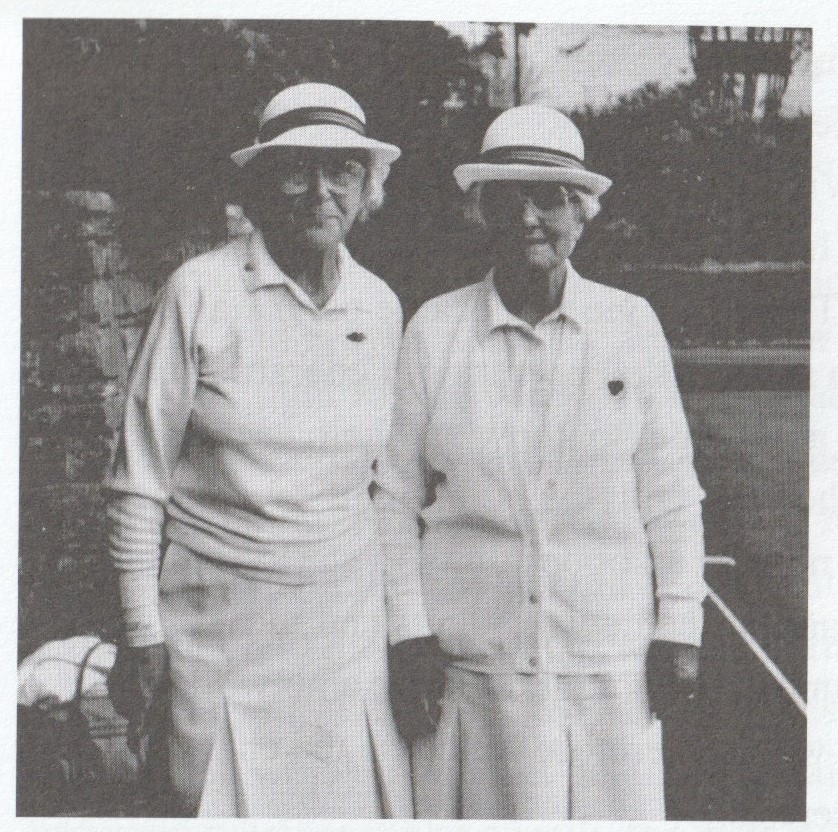
Mrs Upton and Mrs Gambriel of Windsor Evening Guild who won through the Regional bowls finals in 1995 to compete in the National Finals at Leamington
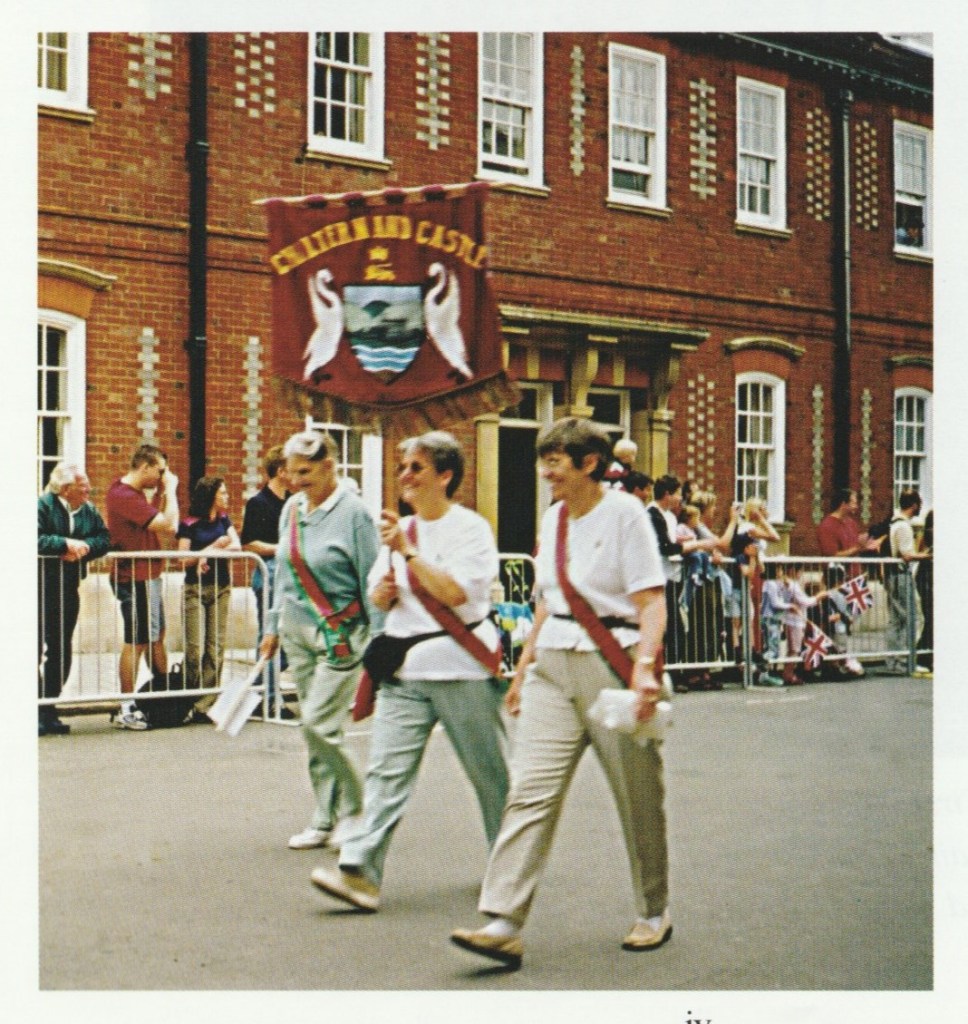
Three members of the Dedworth Manor Guild carrying the Chiltern and Castle Banner in the parade to celebrate the Queen’s Golden Anniversary in June 2002. Left to Right: Margaret Wagg, Penny Paramore and Pat Jones
Each guild chooses its own individual activities according to the interests of their members, such as social studies and outings, flower arranging, keep-fit, rambling and arts and crafts. Over the years these change as new members join. All four of the guilds have also taken part in voluntary work over the years, such as helping to take telephone trolleys round the wards at King Edward VII Hospital in the days before mobile phones, a service much welcomed by the patients. A member of Windsor Evening Guild, Eileen Gambriel was voted Woman of the Year in 1998 for her work with the Mentally Handicapped.
The guilds have always been keen to support charities and raise money for them, Sometimes this is through social occasions as well as by holding specific fund-raising events. Many charities that have been supported have been local such as the Thames Valley Hospice, now Thames Hospicecare, King Edward VII Hospital and Age Concern Windsor. Money has also been raised for children’s charities, in particular the Thames Valley Adventure Playground and Great Ormond Street Hospital.
The guilds have also been keen to support local events. In December 1974 it was decided to plant a tree in Alexandra Gardens to commemorate the 15th Anniversary of the founding of the NUTG. A maple tree was chosen by The Park Superintendent and the Mayoress of Windsor for that year, Mrs Helen Procter, was on hand to help members from all the guilds plant the tree. A plaque was placed by the tree but unfortunately this went missing and had to be replaced in 1990. In 2002, three members of Windsor Dedworth Manor Guild were proud to carry the Chiltern and Castle Banner in the procession through Windsor to celebrate the Queen’s Golden Anniversary.
Today there are only two guilds. The Afternoon Guild closed in 1996 and Windsor West was amalgamated with Windsor Evening Guild in 1997. This was because neither of the guilds had been able to form an executive committee. Some of the members of both these guilds still met socially after they closed and the choir of Windsor Evening Guild continued to meet for a time and rehearse under their conductor, Olive Gosling. The remaining two guilds have a full programme and are proud to be carrying on the objectives of the founding organisation and providing interest, support, and most importantly, friendship for all their members in Windsor.
Barbara Mitch
Sources
Stoll, Mary, Organisation Woman; Heinemann, 1978.
The scrap books and minutes of Windsor Dedworth Manor Guild
The scrap books of Windsor Evening Guild
 Windsor Local History Group