
Published in Windlesora 34
©2018, WLHG
The name Thomas Hardy conjures up an author who wrote stories that explore the social restrictions of rural Victorian society, set in a fictitious Wessex, like Far from the Madding Crowd, or The Mayor of Casterbridge. Hardy is best known as an author and poet; few people know that he was a successful architect before he took up the pen to write professionally.
He was apprenticed to an architect in Dorchester at the age of 16, then went to King’s College London, and in 1862 started working for church architect Arthur Blomfield (later Sir Arthur). Hardy got involved with the plans for All Saints Church in Frances Road, Windsor, which was designed in the Victorian Gothic style.
The second half of the nineteenth century saw a flurry of church buildings in the whole of the country. An Ecclesiastical Census in 1851 had revealed to a horrified Victorian society, that fewer than 50% of people went to church on Sunday 30th May 1851. The problem was that there were just not enough pews to accommodate everyone during the Sunday services. Most of the pews in the parish churches of St John the Baptist in Windsor and St Andrew’s in Clewer were rented to the wealthier members of the congregation. For instance only 200 of the 1,700 seats at St John the Baptist were free. All Saints aimed to provide 600 free pews.
As well as the churches of All Saints, St Agnes, St Stephen and All Saints in Dedworth for the Anglican congregation, and St Edward’s for the growing Catholic community were all built at this time.
Thomas Hardy came to Windsor on 21 November 1863 to witness Queen Victoria’s eldest daughter, Victoria, Crown Princess of Prussia, laying the foundation store, and getting mortar on her elegant gloves. Ellen Dollery told the story in her article ‘Thomas Hardy and All Saints Church, Windsor’, published in Windlesora 6. Some years later Hester Davenport gave a talk about Thomas Hardy at All Saints Church. She told us that Princess Victoria had made a deep impression on Hardy. He used the encounter in his first unpublished and now lost story: ‘The Poor Man and the Lady’, and later in: An Incident in the Life of an Heiress’.
Hardy had designed a beautiful altarpiece, or reredos in Caen stone, marble and alabaster for the east wall of the new church. We now know that it was installed, but for many years it lay hidden, and quite forgotten behind dark panelling. Although the design of the reredos was displayed at the back of the church, neither Ellen nor Hester realised at the time that it was right there, hidden behind the Altar.

In 1920 the reredos was covered up by a War Memorial screen, on which were carved the words:
This screen was placed here by the congregation of this Church to the glory of God and in thankful memory of those who gave their lives in the Great War.
11th July 1920
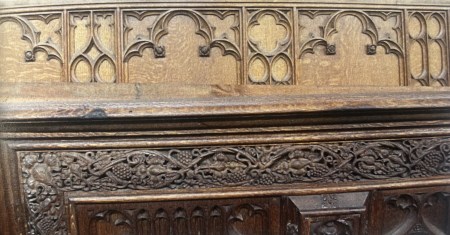
Over the years the memory of the reredos was lost. In 1970 Hardy’s design for the reredos was found behind the organ at All Saints, notes in pencil were identified as Thomas Hardy’s, but everyone assumed the beautiful and intricate work was never carried out. They should have looked at the photo in the London Illustrated News of 3 December 1864, taken when the church was consecrated on 21 November by Bishop Wilberforce of Oxford. A copy of it now hangs at the back of the church.
In 2014 All Saints celebrated its 150th anniversary; for this members of the congregation were keen to locate the original foundation stone, which had been laid in a grand ceremony by Princess Victoria 150 years ago. Two members of the choir Don Church and Stuart Tunstall decided that on a Sunday after church they would look for it. Armed with a torch they searched everywhere. Then they thought of looking behind the wooden panelling, which they noticed stuck out from the wall more than necessary. Stuart laid down on the floor, and shining his torch upwards, he discovered not the foundation stone, but ‘a ringed marble pillar and a large carved motif of what looked like a winged lion’. They instantly identified it as part of the Hardy reredos. Money came in from many generous donors to restore the Hardy reredos to the Church.
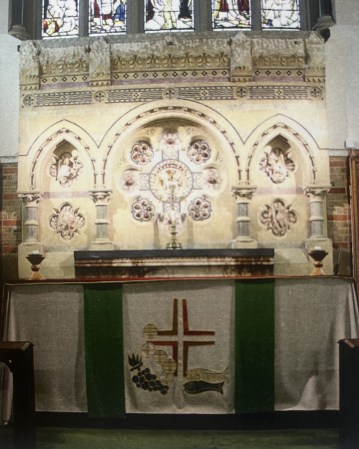
In 2017 the Diocesan Advisory Committee finally gave permission to have the wooden panelling removed and the reredos restored. The panelling has to remain in the church as it is a War Memorial. It took a year of painstaking work cleaning the reredos delicate fabric. Unfortunately, when the panelling was attached, damage was done to the top of the reredos, but it was decided to leave it as it was.
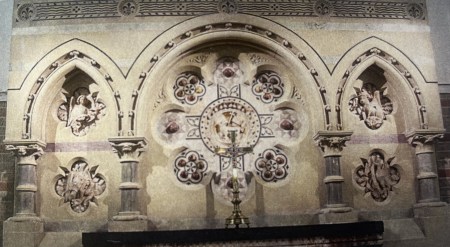
The design is in a triptych format, with a large centre arch and two smaller arches to the right and left. At the centre of a decorative cross is the figure of the Lamb of God, a symbol which represents Jesus Christ in the Christian church. In St John’s Gospel (John 1:29) John the Baptist said: ‘Behold the Lamb of God, who takes away the sin of the world’. On either side are two winged beasts, representing the four Evangelists: St Mathew top left by a man, St Mark bottom left by a lion, St Luke top right by an ox and St John bottom right by an eagle. These interpretations are taken from the Old Testament (Ezekiel 1) where God is in a chariot drawn by four winged beasts: a man, a lion, an ox, and an eagle.
Dr Brigitte Mitchell
Sources
- Ecclesiastical Census Returns, 30 March 1851, HO 129 131
- All Saints’ Church Frances Road Windsor, compiled by A.E. and J.S. Drewett 2006, updated 2017 by E. Stone
- All Saints’ Church Frances Road, Windsor, The Thomas Hardy Church. A story of Discovery, and the Thomas Hardy Connection.
- Additional source added in 2025: ‘Thomas Hardy altarpiece is returned to its original splendour‘ on the The Thomas Hardy Society [accessed 02/07/2025].
 Windsor Local History Group