
Published in Windlesora 23 (2007)
© WLHG
On the morning of 13 September 1926, in the Law Courts in St Leonards Road (now the Arts Centre), James Henry Edmond of Cambridge Terrace, Hyde Park, was committed to the next Quarter Sessions on three charges of jewel theft. He was accused of stealing a gold cigarette case belonging to Sir John Hanbury Williams, Marshall of the Diplomatic Corps, from the Henry III Tower of Windsor Castle, while other charges related to a theft of jewelry worth £1,700 from a Lady Crewe in the Isle of Wight, and diamond and turquoise rings from an address in New Sarum. To all three charges he declared his intention of pleading guilty so that everything against him could be ‘cleared off‘.
Edmond was then returned to the cells attached to the court, where he had been for a month since his arrest in the Castle precincts. PC Hake, the gaoler constable, brought him some lunch at 1.15 and left him to it. But when he went back for the dirty dishes at 1.40 the cell was empty and the bird had flown.
It was a bold escape, though the 74-year-old was no daring and glamorous Raffles. His age had put his gaolers off their guard, along with his eagerness to admit his offences and a ‘docile and obliging’ manner. But the dessert spoon with his lunch proved a handy tool to force the lock of his cell door. Police on duty saw and heard nothing as Edmond went through the corridor and let himself back into the Magistrates’ Court, left under escort just a short while before. This time, alone, he was able to pass through the building to the magistrates’ entrance. The outside door was locked and barred but the bolts were on the inside and the key had been left in the lock. Emerging onto the street the thief faced his moment of greatest danger, but was in luck: it was the lunch hour, the shops opposite were shut, no one was around and no one saw him go.
Police on motor-bikes scoured the area; next day the disappearance made the national newspapers. A description was circulated to all forces: Edmond was 5′ 4¾” tall, thin-featured, with grey eyes and a noticeable scar across the bridge of his nose. His moustache and hair had been dyed brown, but he had acquired a month’s growth of straggly grey beard. He had left hatless and without collar or tie, wearing a brown tweed suit on top of a pair of pyjamas with a broad heliotrope stripe.
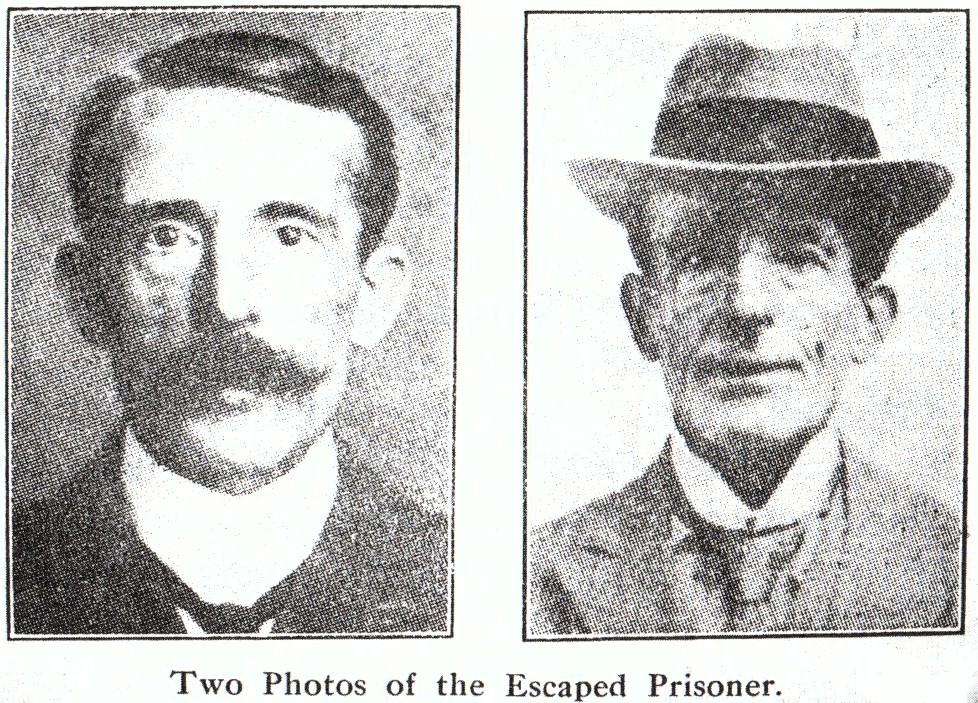
The stripey pyjamas drooping over his shoes proved a giveaway, though only to enable police to discover more about his escape route. A bus conductor. Mr AA Salter. reading the description in his evening paper realised that the passenger he’d picked up in Windsor around 1.30 pm, ‘obviously ill at ease’ and gazing anxiously round, must have been the thief. At the time he simply thought him ‘a lunatic’. Somehow Edmond had secreted money in his cell and had been able to pay his fare. The bus crossed Windsor Bridge for Slough, and when it stopped there the scruffy passenger asked if there was time to nip into a draper’s shop. He came out wearing a cap costing 3s 6d according to the shopkeeper, who also remembered him tucking the pyjamas into his trousers. Thus rendered a little less conspicuous (in those days a bare-headed man was a rarity) he stopped on the bus till it reached Colnbrook. There he got out and was last seen setting out along the London road. It would have been a long walk for an out-of-condition 74-year-old: the extra pyjama layer may have made sense before the night was over.
The Flying Squad was detailed to search for the escaped thief but to no avail; a reporter on the London Evening News was told that police had no doubt he would be lying low with friends till the heat was off. Edmond, it was said, was ‘a master of make-up’ and known in the past to have chatted to the very police hunting him. Did he elude them again? Since he is not to be found in the papers in the following weeks he probably did.
Hester Davenport
References
Windsor and Eton Express, 17 September 1926
The Times, 14 September 1926
 Windsor Local History Group