
Published in Windlesora 20 (2003)
© WLHG
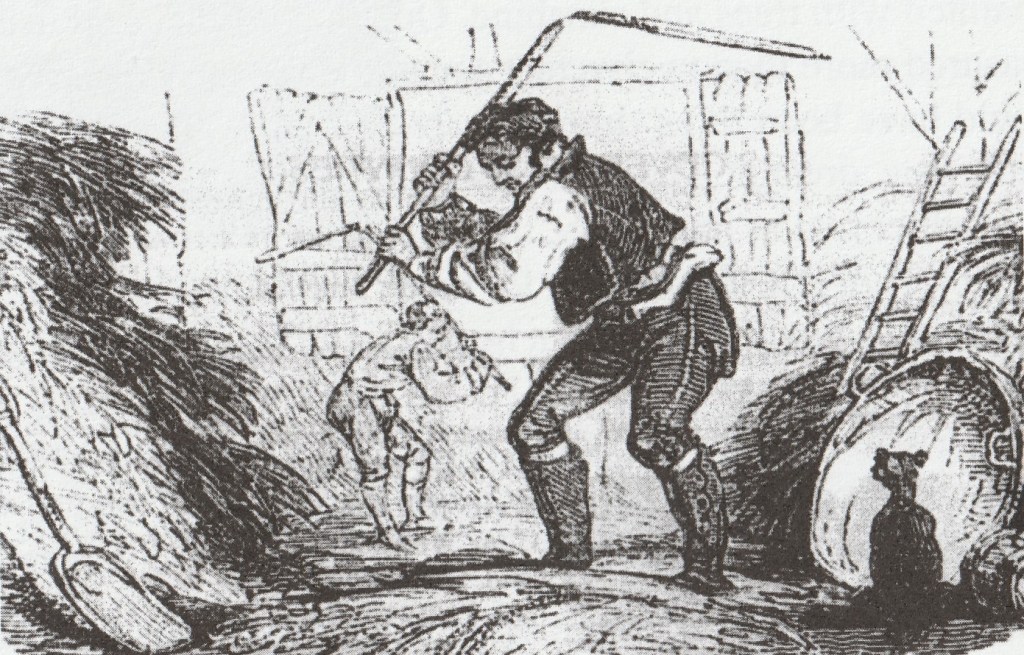
After The Napoleonic Wars (1795-1815) a great many agricultural labourers returned home to find their winter threshing employment had been replaced by machines. Farmers, tenant farmers and tenants were suffering from tithes and high rents, which found them unable to employ, or pay a living wage even if they wished to. Riots against these machines spread from Kent throughout the rural areas of England during 1830 to 1831 and their destruction only compounded the problem. The riots were thought to have been started by a ‘Captain Swing’ but this was never proved. However, ‘Swing’ was adopted throughout the country by anyone writing a threatening letter. It was likely to have been taken from the ‘swingle’, a part of the threshing machine which was most easily broken.
If it is possible to imagine oneself in the shoes of both rioters and victims of destroyed threshing machines, burned ricks and threatening letters it is easy to see how serious were the ‘swing’ riots. The more vocal of the rioting labourers fanned the discontent showing how desperate was their cause. Many of them were sober family men, engendering much sympathy, but were willing to bear the retribution, which they knew would come their way. Many were deported, imprisoned and in a few cases, hanged for their part in the riots.
The government and landowners must have been worried about the speed of revolt, so soon after the French Revolution, in spite of statements to the contrary. It certainly appeared to be dealt with fairly effectively at local level. Many special constables were speedily sworn in.
Historians Hobsbaum and Rudé had researched the swing riots andpublished their results in “Captain Swing” (Penguin, 1985), but an Essex member of FACHRS (Family and Community History Research Society) has discovered a greater number of incidents in his county than had been reported. Fellow members were invited to research their own county, noting incidents reported in the local papers between 1829 and 1831. Thirty-eight counties were represented by twenty-seven members, sending results by email.
Most of the Berkshire incidents were in the Hampshire/Wiltshire border area during November/December 1830 and are reported in Windsor and Eton Express, Reading Mercury, and Berkshire Chronicle and Bucks and Windsor Herald under such titles as:
Agricultural Distress
On 22nd November editorial opinion thought that work should be found for the agricultural labourers, ‘however petty’. ‘We deeply lament to see that the horrid system of firing ricks, which has long devastated Kent and Sussex, has reached our county’.
The Alarming State of Berkshire
On 25th November it was reported that Abingdon, Wallingford, Newbury, Lambourne, Nettlebed, and Benson and had suffered more machine breakers. ‘Yesterday, Bath coach stopped between Newbury and Hungerford’. ‘Wallingford, 4 rioters, Lambourne, 10 rioters were taken to the House of Correction for threatening to break machines.‘ ‘Eastbury, I threatened to fire the town. Committed for trial.‘ ‘Special constables sworn in at Eton, Salt Hill, Burnham, Beaconsfield , Maidenhead, Winkfield, Egham, Chertsey, and Staines.’
Court Procedures
On 23rd November at Aston Tirrold, ringleaders were charged with assault and being unlawfully assembled with 100 persons for riot. One was imprisoned with hard labour and five were discharged at 20/- each. At Fastbury, ringleaders were charged with assault. Eleven were given prison sentences from three to nine months. Twenty-two were given imprisonment with hard labour. Two were sentenced at Reading to 18 months.
On 26th November at Abingdon those caught were charged with assault on a constable, rescuing prisoners, riot and common assault. Three were committed to prison; for his part in riots at Kintbury, Winterbourne, alias Smith, was executed.
There were however some events which at the time were deadly serious, but now make us smile.
Reported in a London Journal
An individual ‘with moustachios’ entered an experimental chemist in the Strand asking for ‘any preparation that would produce instantaneous light by contaction’. The chemist offered his invention The ‘Promethean’ for which he had obtained a patent. The invention, if attached to a small bomb, and fired from a rifle or cross bow, would, upon coming in close union with ammunition wagons, set them on fire instantly.
The man produced an arrow filled with combustible material to which they fitted one of the bulbs to the beard of the arrow and this was demonstrated successfully. The individual purchased 700 of these bulbs. A man answering to the description was seen lurking about a farm at Battle. He returned to London some time later minus his moustachios! The chemist reported this to the police because he felt he was guilty. The ‘invention unconsciously sold by the chemist has been the cause of so much destruction of property’. (Windsor Express December 18th 1830).
Mr Winkworth’s rick yard at Holyport was watched by a man who heard a report (less than a pistol shot) and a hiss, and saw flames issue from a straw house in the rick yard and spread to 4 barns. His ricks were of wheat, peas, barley and oats. Eight ricks out of 18 were preserved by engines from Maidenhead. Had they all been destroyed the value would have been £5,000. He had received a threatening letter; labourers of the area not suspected. (Reading Mercury)
The following reports were also put together from different local publications of 20th November 1830 with a different slant on the same case:
The Mayor remarked that ‘during a great part of this week Mr “Swing” appears to have been amusing himself’.
Several threatening letters signed ‘Swing’ had been circulating throughout Windsor. One threatened the Castle saying that there should be a more efficient guard. It was taken seriously and the Castle put on alert. ‘Six additional “centinals” were placed on duty’. One letter was received by the Mayor, Mr Bannister, which should have been sent to the butcher, Mr Adams. One was sent to Mr Wright the assistant overseer (of the Poor Law no doubt) as follows, in a threatening tone but respectful none the less.
‘Sir, I understand you are a hard hearted and oppressive overseer, this is to inform you, unless you alter your present proceedings, you will have much cause to regret the same. I am, Sir, yours etc SWING’
The Postmaster noted that all the letters had been written in the same hand and in order to catch the perpetrator an individual was stationed in a house opposite the post office to catch the ‘poster of letters’ by a sign from the postmaster who was waiting at the letterbox. Threatening letters were sent as usual, but not at the post office, even though watch was kept for two or three nights. A ‘who done it’. Was there some collusion somewhere?
A threatening letter to Dr Keate was sent to Windsor Herald Office at 38 High Street on December 3rd, and notes were sent requesting townspeople to attend a meeting at the White Hart Inn. Many turned up and found it to be a hoax. Some made jokes as follows:
- Hairdresser — work of a blockhead.
- Shoemaker — last time he would answer such a request.
- Printer — would not be pressed.
- Bookbinder — would not be bound to wait.
- Watchmaker — was wound up to the highest degree at the joke.
- Tailor — called it superfine.
The last word! December 3 1830.
A message was received at the Windsor Herald office that rioters were at Wooburn. Eton Boys and inhabitants were sworn in as constables and set off for Salt Hill armed with cudgels. Post chaises were provided to take them on. Some arrived at Burnham but there were disagreements and they would not move until all had assembled. They adjourned to a local pub until the rest arrived. They got to Wooburn after rioters had been dispersed by a detachment of foot guards and marched to Beaconsfield. Out of the 150 from Eton only 60 remained. All the others had gone home.
Valerie Batt Rawden
References
Hobsbawn E and Rudé G, Captain Swing 1985 (Penguin)
Windsor and Eton Express available on microfilm at Slough Library.
Reading Mercury and Berkshire Chronicle and Bucks and Windsor Herald
are available at Berkshire Records Office.
The drawing of threashing is reproduced by courtesy of the Swing Project.
 Windsor Local History Group