
Published in Windlesora 35
© WLHG 2019
On 14 June 1827, the Windsor and Eton Express newspaper reported that the Pasha of Egypt had offered King George IV a camelopard for his menagerie in Windsor Park. Two weeks later more was revealed about this mysterious beast. The article stated that two babies were procured by shooting the mother, who was then taken to Egypt and eaten. The babies were offered to the kings of France and England, but unfortunately, the one destined for England died. All was not lost; the Pasha immediately got another baby giraffe, which duly arrived in England in August, accompanied by two Egyptian cows to provide it with milk. The giraffe was said to drink 8-10 quarts of milk a day.
An article in the paper in December 1827 described the animal as very graceful, docile and gentle with a friendly disposition, even playful and not at all fearful. The writer observed that it had an awkward walk and noticed a deformed limb, which he put down to the treatment it had endured on the long journey from Sinaar to Cairo. The Arab traders had tied the poor animal to the back of one of the camels with tight ropes. This resulted in the injury from which it was never to recover.
Camelopard means “beautiful animal” and is in fact a giraffe.
For two months the giraffe was exhibited in London, and finally arrived at Sandpit Gate, Windsor Great Park at the end of October 1827. The King gave permission for it to be seen on Saturdays and Mondays. The artist RB Davis made several paintings of the giraffe for the King, and even the fashion world went giraffe crazy. Female fashion for April 1828 included an evening dress of giraffe-coloured tiffany silk.
Sadly, the deformed limb got worse. When the Duke of Cumberland and his son George visited the giraffe in May, it was held up in a sling, and the deformed knee was bathed with salt water. On 5 July 1828 the newspaper reported that ‘little hope is entertained of the recovery of the giraffe, which cannot stand and has to be held up in a sling, but a dozen fine kangaroos arrived at the royal menagerie at Sandpit Gate.
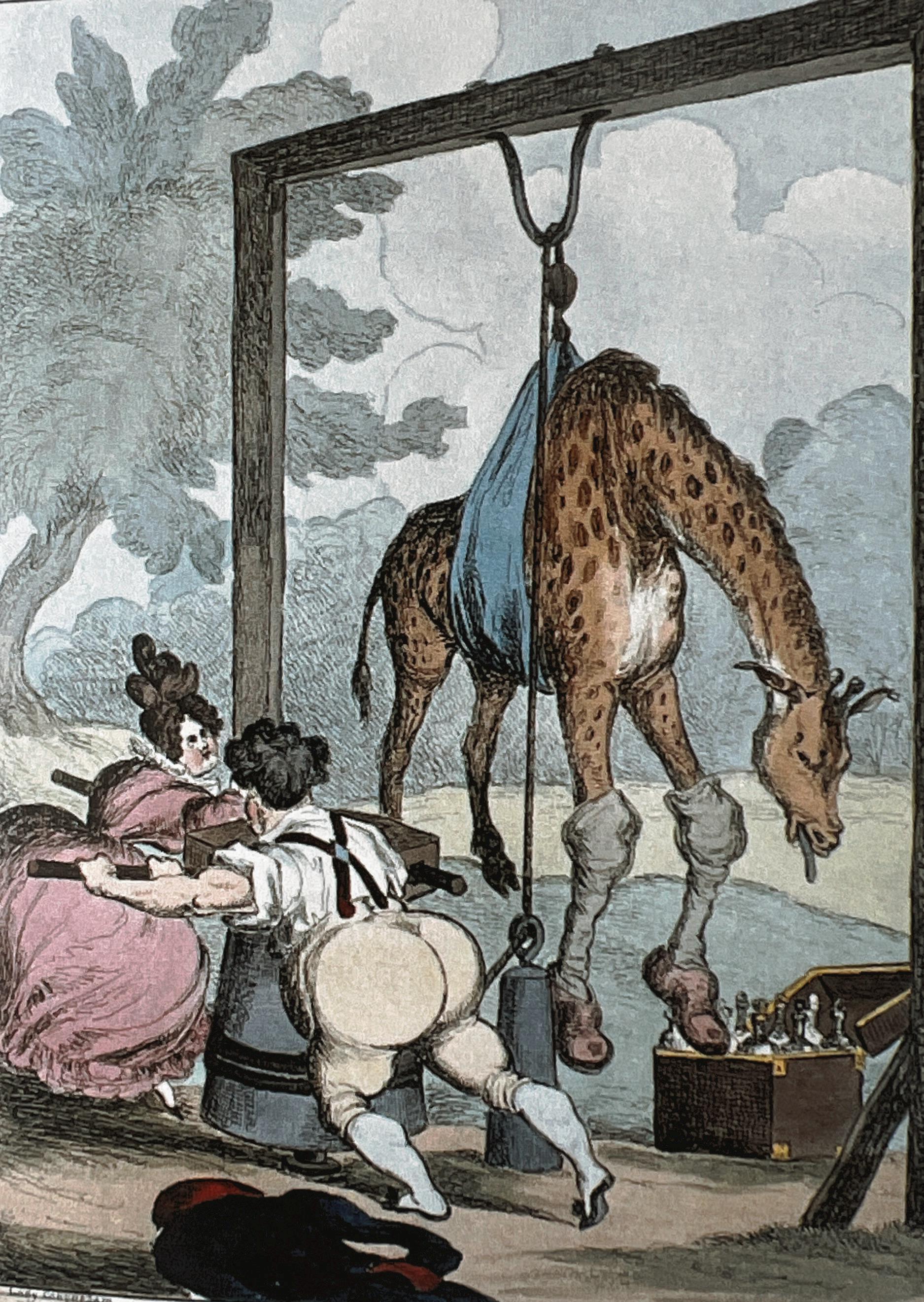
On 29 November, this poem was printed in the newspaper:
The Camelopard
What plaint from the Forest, oh gale, dost thou bear?Can sorrow be found in a region so fair?
From high palisades, or the fold of her tent,
Lone echo has wafted the Giraffe’s lament;
Beloved by a Monarch, ah who would not grieve,
A Lord so benign, so indulgent to leave!
But death, yet more potent, persists in his claim,
And languor pervades every nerve of her frame:
In hopeless dejection, extended she lies,
And thus to the Fawns, her attendants, she cries:
“Ah! Why was I brought from the desert afar.
To be followed and sought like a wandering star?
No creature in England e’er made such a talk,
Not even his Grace the Grand Falconer’s Hawk!
Rank, talent, and beauty my levee await,
Ambassadors sometimes alight at my gate,
While Royalty deigns all my charms to admire.
Dividing his heart between me and Maria (1)
And oft though he comes his poor Giraffe to see,
Not one of his subjects is jealous of me.
They say that young truants from Eton will run,
To Peacocks, all tail, and tall Emews with none:
And laugh at the gait of the quaint Kangaroo,
Who, scorning four legs, hops away upon two:
But people of judgement and taste must prefer
A visit to me, though unable to stir.
Oh clime unpropitious so misty and damp!
My eyes never close but I wake with the cramp.
In vain did the Arabs encircle my neck,
Ere long will the struggle of Nature be o’er,
And mine be the homage of Windsor no more.
In youth’s early morning I’m summoned away,
From him who would gladly my journey delay:
No Lady from Egypt to dear to a Prince,
Save the famed Cleopatra some centuries since.
And you kindred at Cranbourne who rove in the chase,
From whence they are soon to be sent in disgrace.
Will envy my fate when they’re destined to roam.
Like exiles of Parga, expelled from their home.
The animal continued to deteriorate. Briefly, in July 182,9 it could stand on its own, and the King was said to be delighted, but in April 1830 it died and was stuffed for posterity, but where is it now?
Dr Brigitte Mitchell
Notes
- Maria (Maria Anne Fitzherbert) was the long-term mistress of George IV.
Sources
Windsor and Eton Express newspaper 1828 – 30.
Windsor and Eton Express 1812 – 1830: The Charles Knight Years, pages 58 – 59.
 Windsor Local History Group