
Published in Windlesora 18 (2000)
© WLHG
First – What is a diorama?
We’ve seen various descriptions in dictionaries but perhaps the best, in this case, was in The Art of the Diorama by Ray Anderson. In it he says “No other kind of modelling grabs and holds viewers like a diorama, because it tells a story. In fact the roots of the word diorama mean a story in the round.”
The Royal Borough Museum Collection has quite a few dioramas and we have taken a particular interest in six of these. There are four in the Town and Crown exhibition at 24 High Street, Windsor and two are in the museum store in Tinker’s Lane.
The creators of the dioramas were Judith Ackland and Mary Stella Edwards. Judith Ackland was born in 1892 in Bideford and died there in 1972. She was the daughter of Dr Charles Kingsley Ackland of Stowford House, the Strand, Bideford. She painted in water-colours and her earliest exhibition was in Bideford in 1922. Her paintings were also exhibited at the Royal Academy and other prominent art galleries. in she 1945 patented a form of model making in cotton wool and called it “Jackanda”’.
Mary Stella Edwards was born in 1898 in Hampstead and moved to Staines at an early age. We believe she died there in 1989. She was the daughter of Richard Cromwell Edwards, an architect, and her family lived at 12 Fairfield Avenue, Staines. She also painted in water-colours and was a talented poet, writing five books of poems.
They met, in 1919, at the Regent Street Polytechnic where they were art students and became life-long friends. After leaving art school they set up their working home called The Cabin in a village in North Devon near Bideford. For the years up to World War II they travelled the country painting scenes whereever they stayed, including the Lake District, Yorkshire, Wales and the Quantocks. After the War the ladies turned their attention to the second part of their life-long working collaboration, the creation of the dioramas.
In 1949 came a commission from the British and Foreign Bible Society for their first diorama which was of Alexander Mackay with his printing press on the shores of Lake Victoria. Other commissions were to follow in 1952 and again in 1953 when the British and Foreign Bible Society placed commissions for five more. These were eventually displayed in a travelling exhibition called They Triumph.
In 1954 came the all-important Florence Nightingale commission from the Nursing Mirror for a Centenary Exhibition in the Seymour Hall. The fortunate loan to the Windsor Guildhall resulted in the dioramas we know today.
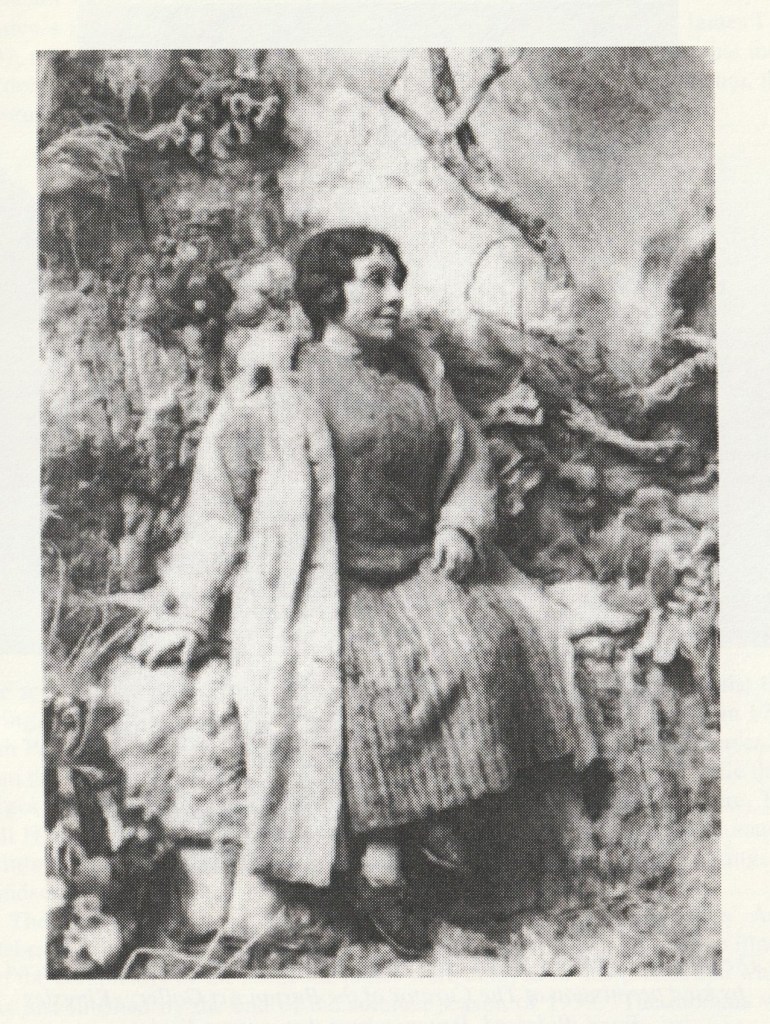
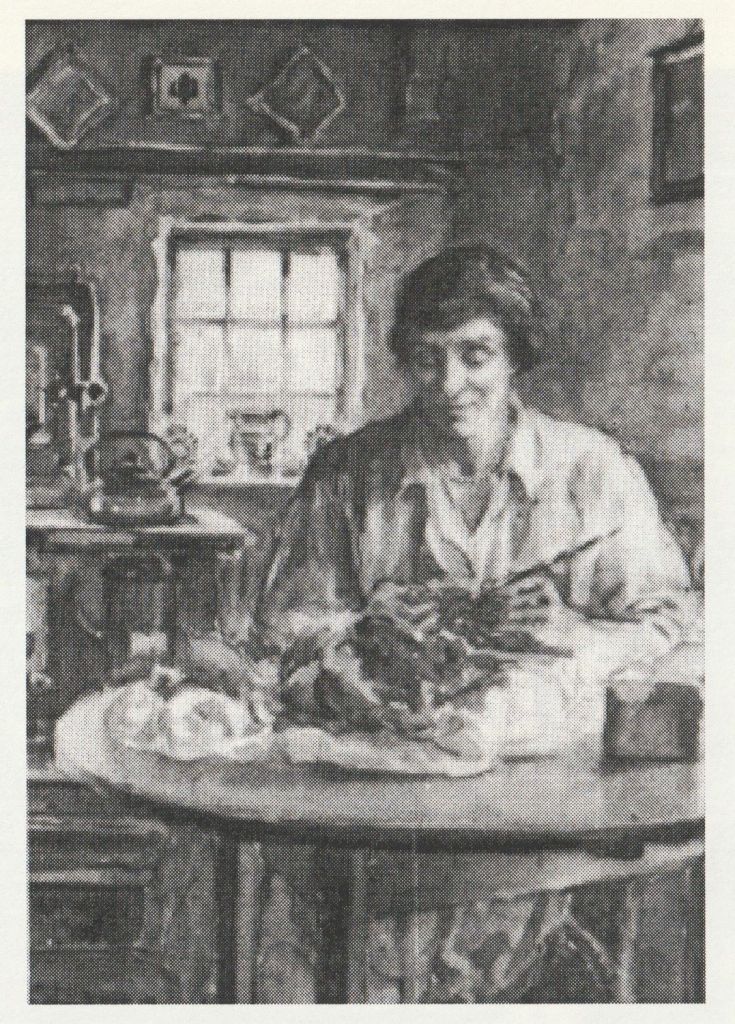
The portraits of Mary Stella Edwards and Judith Ackland are reproduced by kind permission of The Curator of the Burton Art Gallery, Kingsley Road, Bideford, Devon, where they are on display.
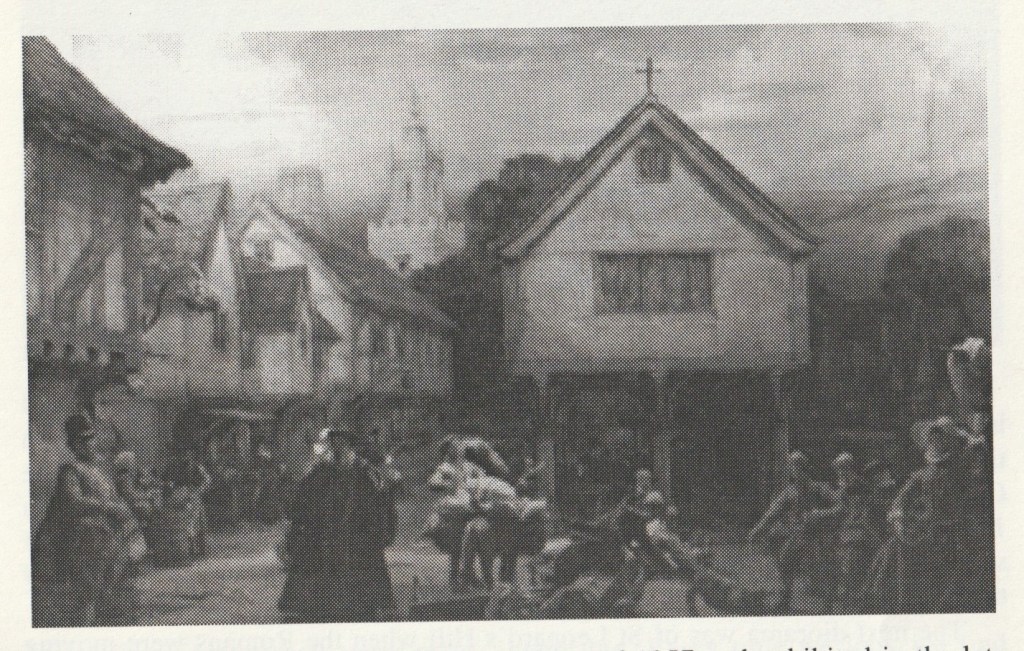
The first Windsor diorama (below) was commissioned in 1956 and exhibited in late spring 1957. It was of the Market Hall and Square in 1607 (the present Guildhall stands on the site of the Market Hall). The artists based their work on Norden’s Plan of the Town of Windsor and the Little Park made for James I in 1607, now in the British Museum. All the characters, their clothes and what they are doing were researched using data from the Victoria and Albert Museum, the Museum of English Rural Life and local records.
The second was commissioned in the autumn of 1957 and exhibited in the late spring of 1958. This was of a barge horse at the bottom of Thames Street in 1770 with Paul Sandby sketching. This shows the bargemen bringing their horses up from the tow path, over the street on the bridge, and back down again while their barges were manoeuyred in the restricted space under the wooden structure. The Toll House can be seen with the Castle in the background. The principal source of information for this diorama was the artist Paul Sandby, whose drawings of Windsor in the 1760s and 1770s are in the Royal Collection.
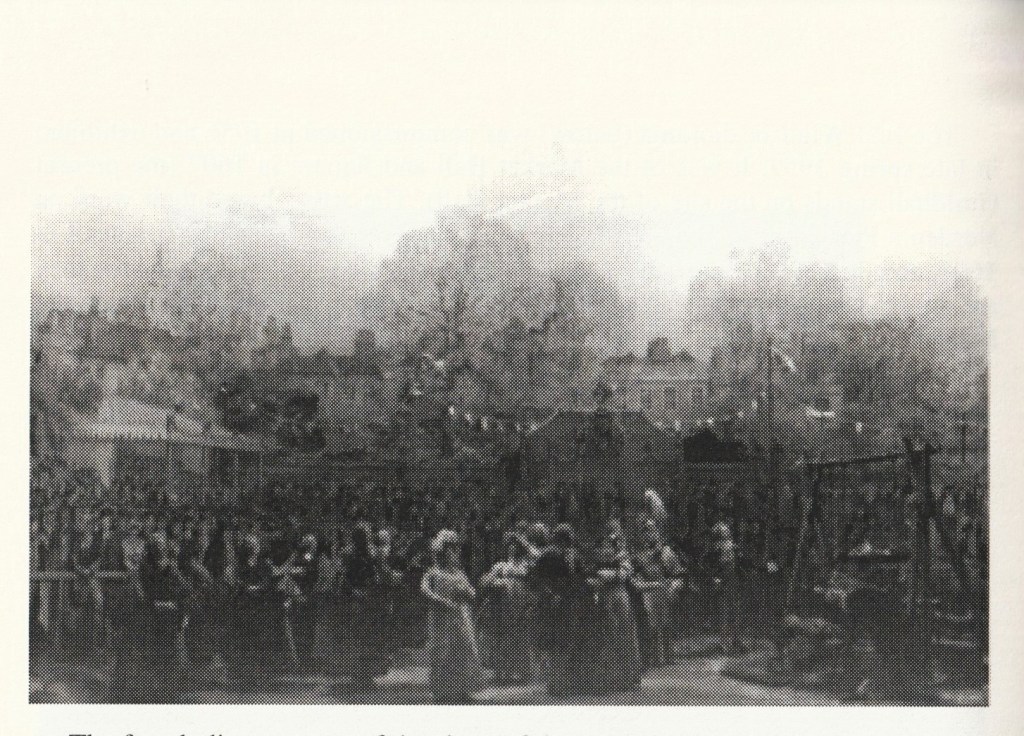
The third commission (below) was of the ox roasting on Batchelors’ Acre celebrating the Half Century of George III’s Reign. Unfortunately, due to illness and the complexity of the scene the ladies were delayed in this production which was just finished by the end of the summer season of 1959. The diorama was based on records of 27th October 1809 about the ox roasting. The King himself missed the event but Queen Charlotte and the rest of the Royal family were present. Information from the Royal Library in Windsor Castle and pictures of the Royal Family were used for the main portrait models. This work was arguably their best and most exuberant work but after the delay and extra cost of the diorama the Council restricted their work by imposing stricter price controls.
The fourth diorama was of the siege of the castle in 1216. This was completed by June 1960. The scene evolved from information about the castle in Henry II’s time (1154-1189) and records of the Castle when it was in the hands of the Constable for King John. It is being besieged by followers of Louis of France in 1206.
Naturally the ladies researched all parts of the scene including the type of siege devices used (trebuchets), the type of defences and the heraldic devices of the French and English Barons and Knights most likely to have taken part.
The next diorama was of St Leonard’s Hill when the Romans were moving westward. Completed in 1962 it was based on archaeological finds on St Leonard’s Hill and much influenced by cost. As usual the ladies did as much research as possible but this scene lacks their previous verve.
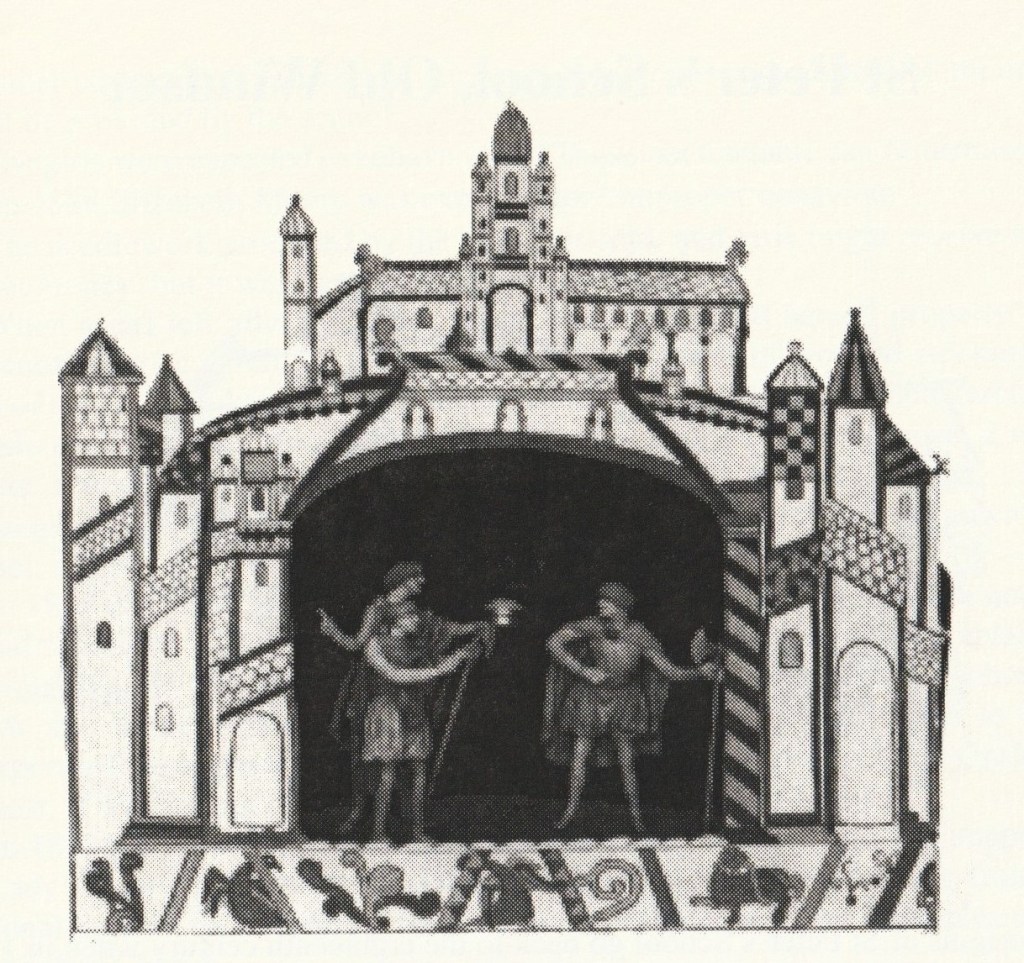
The sixth diorama (below) was Harold being offered the Crown in 1066 and was based on the Bayeux Tapestry. This was made as a very cheap throw-away item. Unlike the others, there was no box made of wood, just the cardboard stage. Also, unlike the others only one name appears on it – Judith Ackland. (The others all have both names written on them).
There was another diorama made in 1968 to commemorate the 150th anniversary of the Edward VII Hospital and called The Dispensary in 1818. It was later given to the hospital. The ladies did some work for Reading Museum and some for themselves and then, all too soon, Judith Ackland died in Bideford.
As a tribute, Mary Stella Edwards embarked on a series of exhibitions of her friend’s work, culminating in exhibitions at the Windsor Guildhall and Staines Town Hall in 1973. Mary Stella Edwards herself eventually finished her days in very sad conditions at her home in Fairfield Avenue.
We have found their work most interesting. Every time we look we find another interesting aspect; we hope therefore that if you find or see anything of their works, or anything about them you would let us know.
Clive and Christine Chambers
(Web Editor note February 2024. The National Trust look after ‘the Cabin’ at Bucks Mills on the steep path down to the beach, just off the South West Coast Path. It opens rarely, but visitors can peer in the windows at any time of year to see the original tiny rooms where the ladies painted.)
 Windsor Local History Group