
Published in Windlesora 20 (2003)
© WLHG
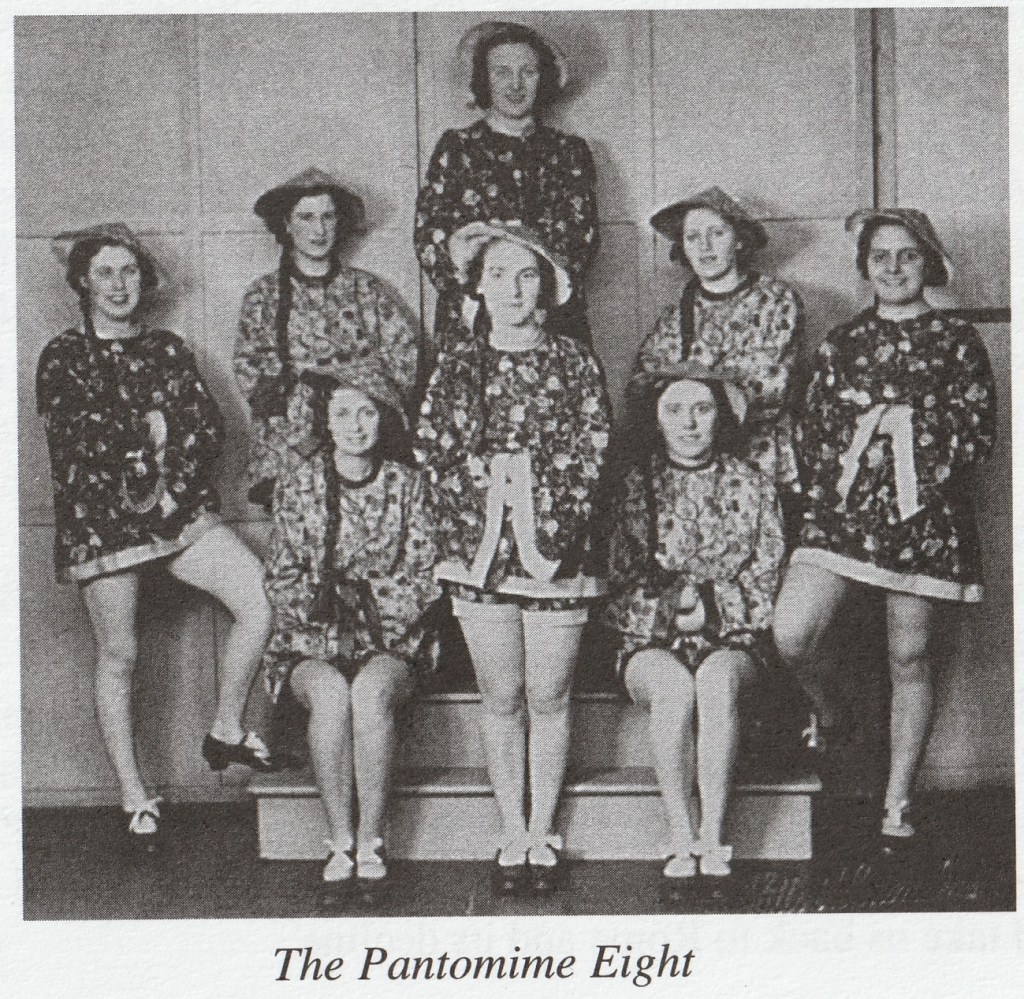
Peascod Street was busy on winter evenings. Apart from the pubs and hotels there were two cinemas, while the shops, if not actually open, remained lit. There were attractions too in neighbouring streets – the Playhouse, the Theatre Royal and the Royal Albert Institute with its orchestral concerts, lectures, choral society and Gilbert and Sullivan performances. However, on three or four evenings in February (in most years from the 1890s to the dark nights of the Second World War) there was something down to earth and extra special for over two thousand children – the Conservative Club Pantomime.
We entered through a narrow passage close to Holmes’ fish and chip shop, and some hundred yards beyond an excessively tall sign, which kept spelling D A R V I L L E S to the night sky. I am told that the Conservative Club Hall stood where Fenwicks stands today. If this is so then the owners have taken away the magic.
With the sound of Fred Hewitt’s fellow musicians tuning up and the cast (as yet hidden behind the plush curtain) falling over scenery we knew we were in for something good. One or two smartly turned out members of the St John Ambulance Brigade stood in readiness in case someone, overcome perhaps by excitement, might need resuscitation – head between the knees and face to face with the Sal Volatile bottle. Otherwise there was no question that we would be anything but well behaved, for who would be so stupid as to compete with the high spirits that would shortly break out on stage.
We were about to be totally involved in a show that drew on an early Victorian innovation but which had its origins in ancient Rome. But what did pantomime have to do with The Conservative Club and would any of us know a Conservative from, say, a Roman? These Conservatives (whoever they were) were obviously kind folk – for each of us would be handed a bag of sweets, an orange and a bun before we were finally ushered into the night. Our exit, by the way, was through another passage, this leading into Oxford Road, from where some of us would make our way back to the Borough Bus stop, home, bed and dreams of wonders untold.
There is something generous about pantomime, a quality that the Windsor Conservatives were keen to be associated with. Wasn’t Robert Richardson-Gardner (Windsor’s first wholly Conservative MP) associated with gifts of coal and pork pies? Let no one mention bread and circuses for that would take us back to Rome and its decline. There is something generous about pantomime, a quality that the Windsor Conservatives were keen to be associated with. Wasn’t Robert Richardson-Gardner (Windsor’s first wholly Conservative MP) associated with gifts of coal and pork pies? Let no one mention bread and circuses for that would take us back to Rome and its decline.
And what delicious fun it was to note that those handsome principal boys were nothing of the kind. ‘Oh no they werent’. Even six-year-olds sensed that only grown up ladies had thighs like that. But hush: there was an improving and hallowed story that underlay the show. The underprivileged would be raised up and their true worth recognised. The odd thing is that this miraculous transformation was achieved less by private enterprise than by a fairy godmother.
These shows were amateur in the very best sense of that misused word. In France (where pantomime underwent one of its many transformations) that word still simply means lover and it was love of the genre that gave these Windsor performances their élan, something which the slicker London shows seemed to lack. Unlike the cinema (where the young folk were corralled on Saturday mornings) these shows were real; there was no silver screen to act as barrier. They were the folks next door that strutted and pranced behind those glittering footlights and if we were near enough we could see the sweat and smell the greasepaint. And yet these kind people were changed, reality and fantasy were splendidly fused. As with the best conjuring tricks, first you see it, then you don’t.
John Calkin Spencer (Jack to his very many friends) started the Conservative pantomimes. His father, a painter and decorator, had been brought up at 18 Charles Street, a tiny part of one of Windsor’s unhealthier thoroughfares, now replaced by the broad and featureless road that serves King Edward Court car park. When Jacks father died from capillary bronchitis (aged 40) he left a wife and four young children. This meant that Jack, then aged 12, was first in line to become the principal breadwinner. Ten or more years later, when he came to write his first pantomimes, he must have had some insight into the life of another Jack, the son of Widow Twankey. However Jack Spencer’s mother (née Amelia Calkin) though described unflatteringly in the 1881 census as plumber, was much less plebeian than your average dame. Her father and several of her uncles were distinguished musicians and most of them had close links with Drury Lane and some with Covent Garden. Those theatres were famed for their pantomimes, great raucous and occasionally vulgar money-spinners. Jingoistic and anti-liberal, they often appealed to the average Englishman’s distrust of foreigners. This is where one might expect more political innuendo, but not so, we must look at another strand in the story.
Raised with his back to the wall (one built by the unscrupulous Whig Councillor, JT Bedborough) Jack developed an idealistic outlook. The unkind might argue that this was simply escapism on his part, but we think otherwise. Jack’s positive attitude may have been inspired by the Rev. Arthur Robins, (Rector of Holy Trinity from 1873-99) a passionate carer for Windsor’s many poor. Thus Jack, together with his younger brother Ernest True Spencer, soon became enthusiastic choristers and leaders of the Church Lads’ Brigade. They were also active in Holy Trinity’s River Street Boys’ Club, for which Jack organised a nigger minstrel troupe and in which he was Cornerman – a dispenser of witty repartee. It seems only natural then that, a few years on, Jack’s eldest son Bert, (aged nine and, incidentally, a godson of Rev. Arthur Robins) should make his debut in the Conservative Club Pantomime blacked up and singing Stephen Foster’s Old Folks at Home. Perhaps we should acknowledge here that blacking up, together with the patronising attitudesthat went with it, is now seen, quite properly, as a remnant of a regrettably uncritical past.
Eleven years after Bert Spencer sang that spiritual he took over the production from his father and, as he told the Windsor & Eton Express in 1956, his whole life revolved around these shows. They were Bert’s productions that so many of us remember today. I suppose his greatest triumph (being a dedicated royalist) was when, in 1913, he and his cast were invited to the Castle to give a special show to an audience of children in the Royal Mews.
It would be nice (if fanciful) to think that Bert’s production gave the Castle a taste for panto, explaining how it was that some 27 years later, certain Princesses would (as Claude Whatham mentioned in Windlesora 12) be fully involved in their own Cinderella, presented in the august Waterloo Chamber.

Herbert (Bert) Spencer and his family in about 1925. His wife was born Florence Field and the children are Hilda, Joan and Phyllis
Who on earth was it that decided that my father should be regularly cast as demon king, etc.? He was the mildest mannered and most retiring man that you could ever wish to meet. Still, he was amazingly successful in the role (an achievement measured in hisses, so how could one be really certain?). It seems that pantomime could work its magic even on the alleged baddies. Did it give Ernest Calkin Spencer his delight in puns? Faced with this question he might have stroked his upper lip and replied: ‘I moustache you not to mention it.’
What interested me most was the highly professional scene painting, mostly the work of Bert’s brother-in-law Tom Scott and his mate Alf Goldswain. There was always something enchanting about the way a ripple might pass across the marbled wall of some grandiose palace or the smooth bark of a giant beech. A member of the cast had, no doubt, passed too close behind a flat or a backdrop and unintentionally reminded us that we were in the land of make-believe. Another conjuring trick!

Returning to Jack, although he was very involved in a host of voluntary activities, he remained tied to the Club pantomimes for the rest of his days. I was only eight when he died but can remember him in his rather cramped and poorly lit home, the house in Grove Road (now number 77) where his brother Ernest True died from tuberculosis, aged 33. In the backyard was a workshed where Jack kept his raw colours etc. and from which he ran his decorating business. There I once saw a huge backdrop, spread out and freshly painted with trees and sunshine. Odd that, as the shed itself cannot have measured more than twelve feet square, while the Conservative Club stage would have been three times the size. Could I have dreamed it? As with pantomime, dreaming and reality can be easily and joyfully confused.
Whether real or imaginary, that vision helped to change the course of my life and I am grateful for it as for much that I absorbed from Jack, his descendants and friends. I know that he had an arch smile for me from time to time, but sadly we hardly spoke. His children were the good and often poor children who crowded into those pantomimes; some closer to home he may have overlooked somewhat. When one’s life is dedicated to voluntary service and the pursuit of an ideal, as Jack’s was, then sadly there may be a downside.
John Spencer
 Windsor Local History Group