
200 Years of the Circus in Windsor
Published in Windlesora 26 (2010)
© WLHG
The concept of the circus we know today dates from the later eighteenth century. One of the earliest known circuses was founded in 1794 by Thomas Cooke in Scotland. It was soon travelling the length and breadth of England as well. Ownership of the circus later passed to Thomas Cooke’s son, Thomas Taplin Cooke who became famous for his circus, and was renowned as an equestrian wizard.
In 1826 Cooke’s Circus came to Windsor and was held at Bachelor’s Acre. It is described in the Windsor & Eton Express of that year – ‘Mr Cooke has fitted up a circus at Bachelors Acre showing feats of strength, leaping and horsemanship.’ The Circus in this sense refers to performance area or arena and included the seating, and later to the tented area now called The Big Top. This description of Cooke’s Circus also gives an idea what the early circus acts consisted of and over the years they were to be developed and added to. Cooke’s Circus went on a tour across America and later returned to England.
In my archive I have a number of pieces of ephemera which relate to circuses which were held in Windsor area from the nineteenth century up to the1960s; some of which I actually attended as a boy in the 1940s. I have picked out a few items which display the different range of circuses and the showmen within them who performed at Windsor both for Royalty and for the public.
Phineas T Barnum’s Circus – General Tom Thumb & ‘Family’ — Windsor – 1865
General Tom Thumb and family was an act from Phineas T Barnum’s American Circus which was known as The Greatest Show on Earth. General Tom Thumb was the stage name of Charles Sherwood Stratton (1838-1883), a dwarf who achieved great fame under mentorship of showman PT Barnum. Stratton was four years old, the son of a Bridgeport, Connecticut carpenter, when Barnum met him. He was 25 inches tall and weighed just 15 pounds at the time. Barnum taught him to sing, dance and perform and he was famous for his impersonations. During a tour of Europe he became an international celebrity.
In 1862, PT Barnum paid $30,000 to acquire a new performer, George Washington Morrison Nutt, 29 inches tall, just as witty and talented as Tom Thumb, but younger. As he had for Thumb, Barnum developed costumes, songs, and jokes for his new star, awarding Nutt the rank of commodore. (Some even believed that Nutt was the real Tom Thumb, judging the older, portly midget an impostor.) In February 1863, Nutt served as the best man at the widely publicized marriage of Tom Thumb to another midget Lavinia Warren, It was front-page news. They stood atop a grand piano in New York City’s Grace Episcopal Church to greet some 2,000 guests.
Two years later on the on 24 June 1865, the Family was invited to visit Queen Victoria at Windsor Castle. The carte de visite illustrated shows General Tom Thumb and Wife, Commodore Nutt and Miss Winnie Warren in the identical costumes they wore when visiting the Queen. Tom Thumb had also performed for Queen Victoria in 1845.
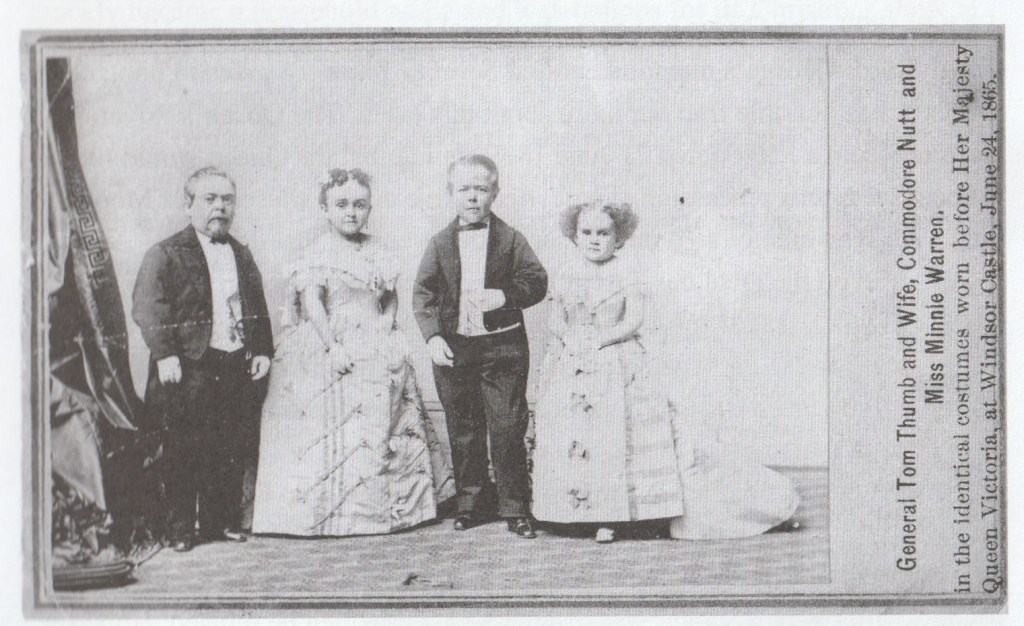
Warren in the identical costumes worn before Her Majesty Queen
Victoria at Windsor Castle, June 24th 1865.
‘Lord’ George Sanger’s Circus – Windsor – 1899
An Illustration from the Illustrated London News shows Queen Victoria watching a circus parade from her carriage (see front cover). This consisted of a delightful procession of carriages of white horses and elephants parading along Park Street, heading towards the Castle. Balanced on top of the elephants and the carriages were elaborate constructions of Indian origin. This was the circus of the great showman ‘Lord’ George Sanger, a Berkshire boy and son of a Wiltshire farmer who was born in Newbury in 1827. His father later started a touring peep show. In 1853 Sanger together with his brother established a circus which was to become one of the biggest touring circuses of the 19th century. In 1884 he sold this circus to PT Barnum – only to start another circus a year later.
The drawing in the Illustrated London News depicts the newest incarnation of Sanger’s Circus parading through the streets of Windsor on the 17 July 1899. The Circus had come by Royal Command of Queen Victoria. From ‘Lord’ George’s memoirs entitled Seventy Years a Showman published in 1910, it is possible find out more about this event. The Queen’s Private Secretary sent a letter dated 21 June 1899 stating that the Queen would like to witness the circus procession at a quarter to five on the afternoon of Monday July 17th. The memoirs go onto describe the events of that day: “So on the great day I went to Windsor and in the courtyard of the Castle paraded my show, with every adjunct I could think of, before the Sovereign I had so often longed to see and have speech with. ‘The Queen watched the spectacle from her carriage and liked it so well that she had the parade repeated.’
After this Sanger was presented to the Queen who was interested to know more about the circus and the animals, especially the elephants. He told the Queen they were called Charlie and Archie. The audience lasted for ten minutes, after which Sanger was offered payment which he refused. However a few days later he received a massive silver cigar box on the lid was engraved ‘Mr George Sanger, VRI, Windsor Castle July 17th 1899’.
Bertram Mills Circus — Datchet Road, Windsor – 1946
Bertram Mills Circus was a regular visitor to Windsor. The Big Top or circus tent was put up in the public part of the Home Park. The circus was seen as an exciting spectacle after the restrictions of World War II. Bertram Mills Circus at Windsor was even featured in a Pathé News Broadcast in 1946 showing views of the circus being set up under the shadow of Windsor Castle and more importantly both adults and children enjoying the thrills of the circus.
| remember going to the Southern Region Station (now Windsor & Eton Riverside) to welcome the circus to Windsor. All the caravans and animal trailers were loaded onto open wagons for the short trip to the Home Park. Very often the Windsor visit would be their last show before they over wintered in Ascot at their premises just over the railway bridge on the Bagshot Road.
The circus was founded by Bertram Wagstaff Mills after seeing the Wilkins and Young Circus in 1919. He made a bet with a friend that he could form a circus company as good as they were. He managed to bring it to fruition and in 1920 the Bertram Mills International Circus was born. It very quickly became a household name and was famous for its Christmas show at Olympia. By 1930 it was the best live show in England and remained so into the 1960s. Bertram Mills died in 1938 and the running of the circus was taken over by his two sons Bernard and Cyril who continued to build on its success until the early 1960s when admission figures dwindled and live entertainments such as circuses were taken over by the growth of television.
Billy Smart’s Circus — 1960
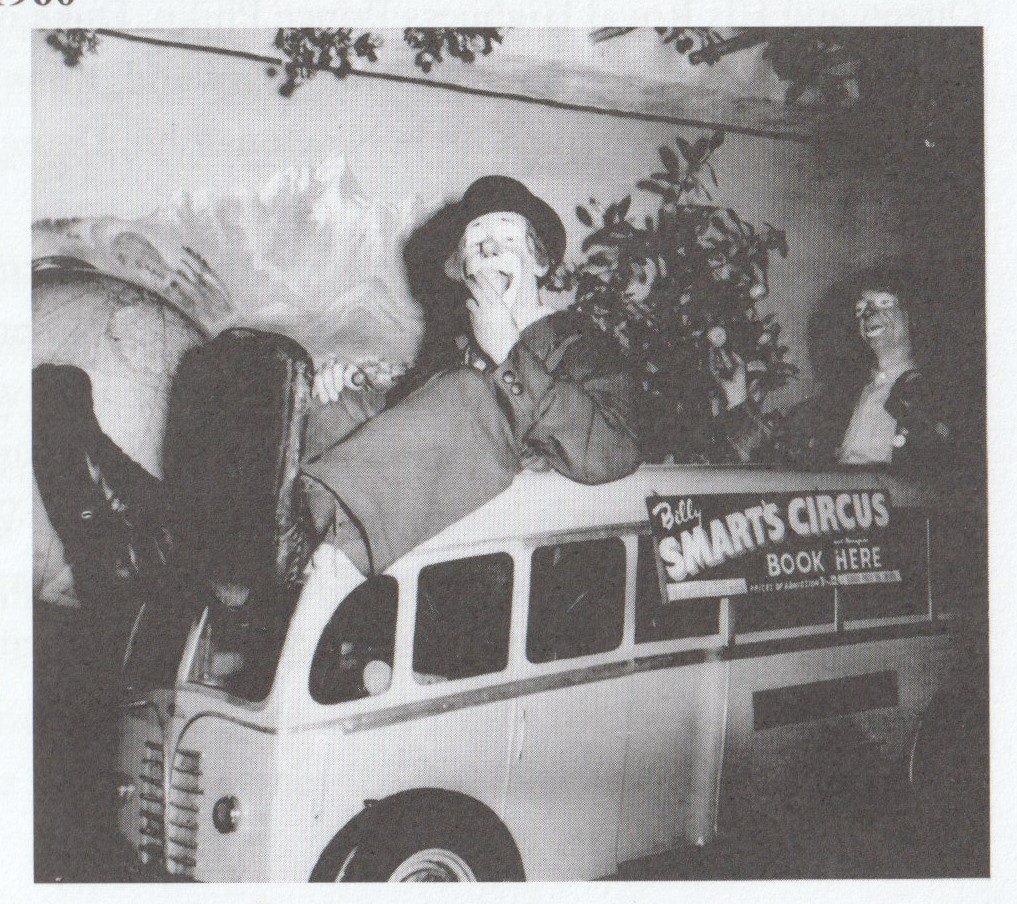
A photograph from the Windsor
Express of 1960 shows a clown sitting in the Windsorian Mini-coach advertising Billy Smarts Circus.
The Circus performed regularly at Windsor, as its home, when not touring, was in Winkfield.
The circus was founded by fairground showman Billy Smart Senior who in 1946 while out on a Sunday drive with his wife passed Harry Coady’s Circus, stopped, and bought the tent and equipment. Thus Billy Smart’s Circus was born, and in the 25 years it toured became the biggest and most splendid travelling show in the land, with the fairground rapidly becoming a thing of the family’s past.
Billy senior was a showman of ample proportions, famous for his Stetson hat and fat cigar, and became a television personality from the family’s frequent BBC programmes, one of which traditionally followed the Queen’s speech on Christmas Day and racked up record audience figures. From a family of 23 children himself, he died in 1965 at the age of 73, and his sons Ronnie, David and Billy junior continued the show. When the circus closed due to rising overheads in 1971, the three continued their television show on ITV for some years, and subsequently developed the Royal Windsor Safari Park, from an estate formerly owned by the car magnate Horace Dodge.
In 1977 The Smarts lent their new Big Top, which accommodated over 4000 people, to enable a special entertainment to take place to commemorate the Queen’s Silver Jubilee. It was specially designed in red, white and blue fire proof plastic. A magnificent Royal Circus Gala was performed at the Home Park in the gracious presence of Her Majesty the Queen and His Royal Highness Prince Philip, Duke of Edinburgh. The show included artists Bruce Forsyth, Mike Yarwood, Ronnie Corbett, Elton John, Eric Sykes, Les Dawson, Olivia Newton-John, Dame Edna Everage and Yasmine Smart.
In 1979 David Smart parted from his brothers Billy and Ronald to start his own circus, but the latter pair continued to produce their television shows for ITV until 1986 when the circus company was wound up. On 22 February, Ronnie and Billy presided over the final auction of their circus equipment at the show’s headquarters at Winkfield, Windsor. A Chaplinesque bowler hat, made for one of Billy’s elephants, was among the items sold, and an elephantine-sized telephone – ideal for trunk calls, of course – sold for £600!
Geoffrey Try
 Windsor Local History Group