
Published in Windlesora 03 (1984)
© WLHG
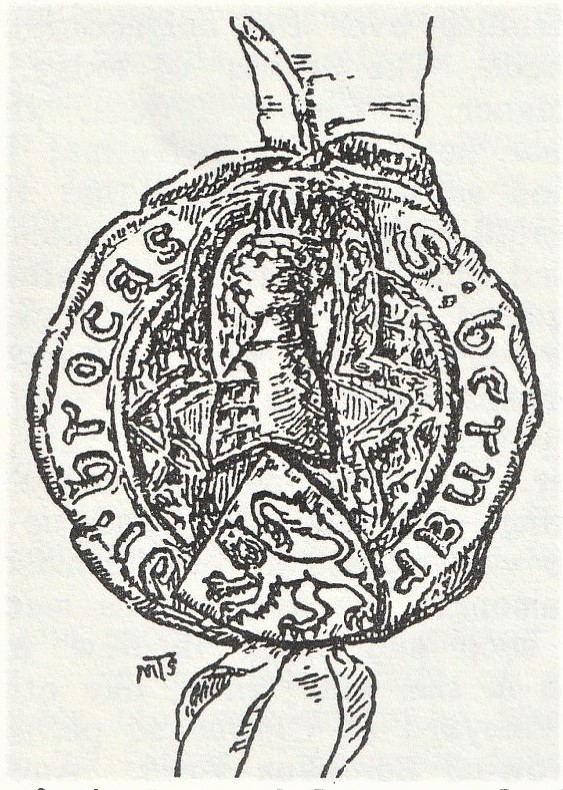
The Brocas is familiar as the name of a meadow beside the river in Eton and, in addition, there is a Brocas chapel in Clewer Parish Church. Many must have wondered at the derivation of the name.
The Brocas family was one of standing and. importance in the locality during the 14th century, and that is why their name became attached to some land they held at Eton as well as to the chantry endowed in St. Andrew’s Church, Clewer.
The family originated in Gascony in south-west France where there are two villages called Brocas, either of which may have been the early home of their ancestors, although by the 12th Century various branches of the family held estates all over that area of France. The first generation who settled in this country were known as “de Broeas” but by the third generation the prefix had been lost.
Gascony was part of Aquitaine, which had passed to England in 1152 by the marriage of Henry ll with Eleanor of Aquitaine. Before Edward I came to the throne (in 1272) he had won the loyalty of many of the Gascons when he had been sent by his father to govern Aquitaine. As Edward 1 he used Gascon officers in his Scottish wars. So, it seemed, did his son Edward Il, for Arnald de Brocas was killed in the service of the King in Scotland in 1314, probably at Bannockburn.
Arnald left three sons – John, Bernard and Arnald – who grew up under the protection of the King.
By 1314, when his father died, John was already the King’s ‘valettus’ although he was only a young man. It is not easy to give a synonym for ‘valettus’ but it was much the same as ‘esquire’ and was certainly a position filled by a gentleman.
John was to make Windsor the centre of his domestic and official life, as did his friend and fellow-countryman, the influential Oliver of Bordeaux who, amongst other appointments held, was Constable of Windsor Castle at one time. John married an English woman, Margaret, and as early as 1320 they were beginning to make small investments in land at Windsor. By 1330 these were extending over the neighbouring parishes, and he obtained possession of Etonmede, “The Brocas” of today.
He also became Lord of the Manor of Clewer Brocas, which was a subsidiary to the main Clewer Manor held by the Syfrewast family. In the Middle Ages land was not owned as we understand that term today, for it belonged to the king who granted rights over it to nobles and other great landlords. They, in turn, leased land and buildings to other tenants.
The possessions which John acquired were suitable appendages to the office of Chief Forester of Windsor Forest – our modern Ranger – which he received in 1334. He was perhaps fortunate not to suffer any ill effects from the downfall of his patron, Edward II, in 1327, but then neither did his fellow-Gascon, Oliver. Certainly he was astute enough to make himself useful to the next king – Edward II – and he eventually superintended the whole of Edward’s vast equestrian establishment.
It is of interest to note that amongst the acquisitions made by John and Margaret at this time was a shop and cellar in New Windsor and indications are that he was engaged in the wine trade, like other men of good position then. There was a vineyard at Clewer so perhaps he was concerned in some enterprise for growing Bordeaux vines. Anyway, there was a ready trade for Gascon wines in England.
John appears to have been knighted after the Battle of Sluys (1340). He was with the king during the invasion of France in 1346, where he had a large responsibility for the equipment of the English troops, and was at the siege of Calais and the Battle of Crecy. In the year following Crecy he asked permission of the king to make provision for the chaplains of Windsor Hospital which he already held by gift of the king for life. The Windsor Hospital referred to was no doubt the leper hospital of St. Peter. The exact position is not known but it must have stood near to the site of the King Edward VII Hospital in that part of Windsor still known as Spital. John asked that he might have it in fee so that he could grant rights over the lands of the hospital to “certain of the chaplains belonging to it.” This was a charitable and pious thing to do; perhaps, as Montagu Burrows suggests in “The Family of Brocas”, it was to fulfill a vow made in battle.
Sir John’s brother, Bernard, was a priest. He was rector of St. Nicholas, Guildford in 1324 and held the living until his death in 1368. He was frequently absent, first pursuing University studies and then in the service of Edward 1 for whom he seems to have been an emissary in Gascony. He was the lawyer of the family, a capable administrator and a clear-headed man of business. He became Lord of the Manor of Beaurepaire in Hampshire around 1353. It seems probable that he obtained the property with his namesake, John’s third son, specifically in mind, for only two years later it was conveyed by Bernard to his nephew. This younger Bernard was a distinguished and important man but as a third son he was unlikely to inherit from his father the possessions which would enhance his position.
Sir John’s other brother was Arnald, of whom we only know that he was sergeant to the King in 1330, at which time he was Master of the Horse to Prince John (the younger brother of Edward Il). It seems that he died young, leaving a son Arnold.
Sir John and Margaret had three sons and when Margaret died he married a lady called Isabella. They had two sons for whom they re-used the names of John and Oliver, his sons by Margaret, who by that time had died. Sir John died “in his mansion at Clyware on the Feast of St. Maur the Abbot” (15th January) 1365.
Of Sir John’s sons, the eldest John died unmarried in 1352. His father had obtained for him property in Hampshire which remained in the family.
Oliver, the second son, was named after his famous godfather, Oliver of Bordeaux. He married a lady of great fortune, Margaret de Hever. After his elder brother’s death he was his father’s heir but he died in 1363, before his father. When Sir John died, Oliver’s son, another John, was his heir but he died in 1377 unmarried.
Sir John’s third son and eventual heir was Bernard and he is the central figure in the family history. As Sir John became indispensable to Edward lll, Bernard became as close to the Black Prince, Edward’s eldest son, of whom he was a contemporary and with whom we can assume he grew up. Later on in 1382, after Richard I’s marriage to Anne of Bohemia, he became the Queen’s Chamberlain.
Bernard was married in 1354 to Agnes Vavasour. It was in this year that he took an interest in the hermitage of St. Leonard near Windsor when he bought privileges for pilgrims there by writing to the Pope pleading that:
“Whereas William the hermit, chaplain of St Leonard Loffield (Losfield), in Windsor forest, lives a solitary life and serves God alone, and whereas a multitude of people flock to the chapel, the Pope is prayed to grant an indulgence to those who visit the said chapel . . . and give alms to the fabric.”
Cal. Papal Pet. Vol. I. p.270
The request was acceded to and an Indulgence of one year and forty days was granted in 1355 to those who visited the hermitage on certain feast days and gave alms.
In 1360 Sir Bernard and Agnes were divorced and she relinquished at the divorce all the inheritance she had brought to the marriage, yet the church allowed both to re-marry, implying extenuating circumstances. It is suggested that a false report of Sir Bernard’s death came when he was away with the Black Prince, since it was, after all, a time of extremely poor communications. The position of a widow was unenviable and it would seem that when Agnes was visiting her Yorkshire estates she contracted a marriage with a neighbour, Henry de Langfield. She certainly had a son whom she called Bernard, although the putative father was de Langfield. Later she went through another marriage ceremony with him, and Sir Bernard settled the most valuable estate from her inheritance back on her and her son. It seems that in a difficult situation Sir Bernard behaved generously.
In 1361 he married a young widow, Mary de Borhunte, daughter of Sir John de Roches, who brought to him wealth from her own and from her late husband’s family. In addition, she brought him the romantic-sounding title Master of the Royal Buckhounds which was confirmed to him by the King in 1366. The pack of staghounds was kept at the Manor of Little Weldon in Northamptonshire, which lay mid-way between the royal hunting lodge at Geddington and the royal castle at Rockingham. This castle was much visited by Norman and early Plantagenet Kings, where in Rockingham Forest, they could indulge their love of the chase.
Sir Bernard had a very distinguished career in which Mary shared. It is suggested that because of the nearness of the Manor of Clewer Brocas to Windsor Castle, they lived in the manor house there and Mary was known and loved in Clewer.
In March 1380, probably just before Mary died, a chaplain, William de Northlech, who was perhaps her confessor in her last illness, made what must have been an unusual provision for one not related to him. He granted an acre of his own land in Clewer, the rent from which would pay to keep a lamp burning perpetually before the high altar in Clewer Church for the souls of “Sir Bernard and Mary his wife and of others in the Book of Clewer Church.” (The Book contained the names of those for whom endowments had been made so that prayers would be said to ensure the progress of their souls after death).Soon after Mary’s death Sir Bernard married Katherine, a widow, who seems to have been a pious and generous lady, for Sir Bernard and Katherine endowed chantries at Southwick Priory near Mary’s family home in Hampshire and at Clewer Church, and in the deeds Mary’s name is prominent.
Considerable portions of their estates endowed the chantries and the first deed we have which refers to the chantry at Clewer is dated 20th June, 1384. In it Sir Bernard obtained permission from Sir John Syfrewast, Lord of the main Manor of Clewer, to give fourteen and a half acres of land for the endowment.
On 20th November a more detailed document refers to the “newly-founded” chantry. The Foundation Deed has come down to us intact and is dated 6th February 1384 (old calendar, 1385 by our reckoning).
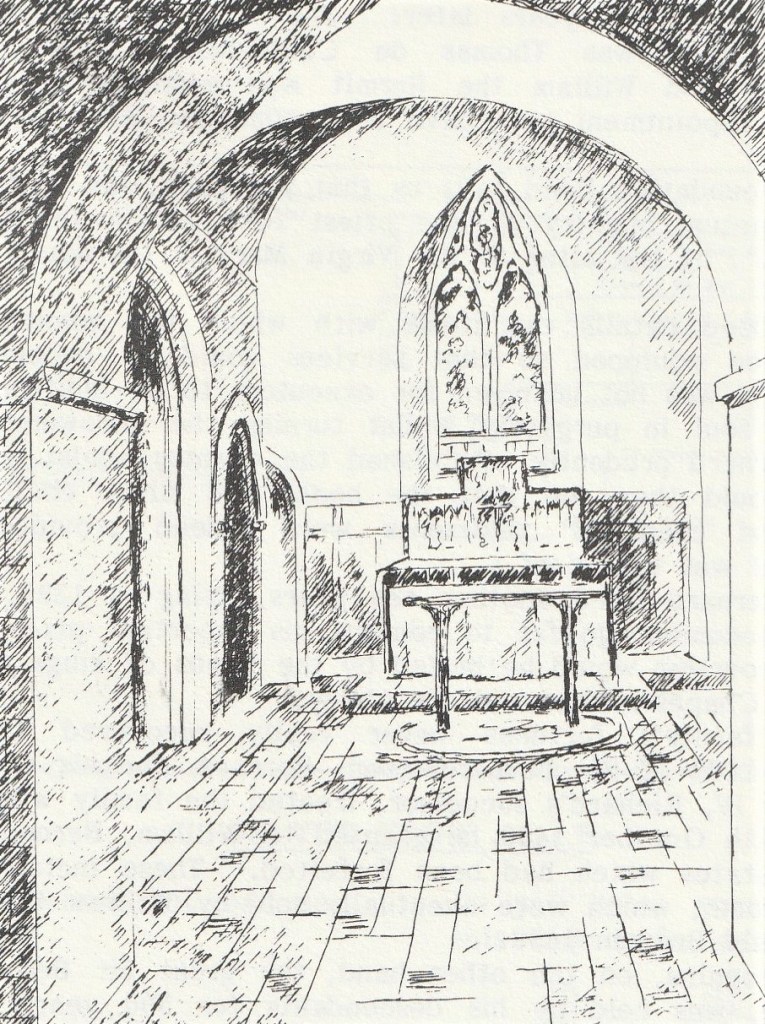
St. Andrew’s Church
Clewer
Drawn by Mary L. Johnson
This deed starts by setting out that the prayers are to be for Sir Bernard and Mary, his late wife, and their fathers and mothers. Further on this is expanded and the holy rites every day are to be for the King (i.e Richard lI) and his grandfather (Edward llI), as well as for Bernard, Katherine and Mary, their brothers, sisters, fathers, mothers and other ancestors.
One of the witnesses of the deed was “Willielmus Hermite.” When Sir Bernard had approached the Pope about the hermitage of St. Leonard, mention was made of William the Hermit, but William was one of the most commonly-used names in medieval England and it is doubtful if it was the same William thirty years later. The first chaplain appointed to the Brocas Chantry was Thomas de Colyngham but he resigned almost immediately and William the Hermit was admitted in his place. The hermitage appointment may have been combined with that of the chantry priest.
The Foundation Deed tells us that provision was made for the upkeep of a “perpetual chantry of one priest for ever in the Parish Church of Clewer . . . by the altar to the Virgin Mary in the south part of the said church.“
The deed details the items with which the chantry and its priest were to be equipped so that services could be decently and properly ordered. It was not unknown for executors to be indifferent to leaving a testator’s soul in purgatory whilst turning the endowments to their own ends! Bernard prudently established the chantry whilst he was still living and he could then see that the books and silver chalice, altar cloths, towels and chaplains’ vestments were indeed provided and that the endowment was sufficient.
Sir Bernard lived another ten years, dying in 1395, and his funeral and his monument go far to confirm his important place in society. No ordinary courtier would be buried by the tombs of kings and queens in St. Edmund’s Chapel in Westminster Abbey.

The family’s fortunes never really recovered the execution in February 1400 of Sir Bernard’s son, Bernard, for his support of Richard II. Henry IV, Richard’s successor, treated the family with great clemency and on 24th October 1400 he granted to William, Bernard’s son and heir, all the estates which had been forfeited. These included Clewer-Brocas and Dedworth, which were eventually sold by William Brocas the third to Sir Reginald Bray in 1499.
Beaurepaire, on the other hand, the great Sir Bernard’s property in Hampshire, was held by his descendants for 500 years. Many of them served in public office and were eminent men, but none matched the illustrious Sir Bernard.
Jean Kirkwood
Sources
Montague Burrows “The Family Brocas of Beaurepaire” pub. 1886.
Article by Reg Stevenson in “Time Span” January 1979, published by Middle Thames Archaeological & Historical Society.
 Windsor Local History Group