
Published in Windlesora 24 (2008)
©WLHG
A river crossing at Windsor across the Thames has existed ever since the Norman Conquest and the building of the Motte and Bailey Castle in 1086. The earlier methods of crossing would have been by ferry. The first Windsor bridge which was constructed of wood is mentioned in 1169, where the Pipe Rolls record tolls amounting to £7-0s-11(1) from vessels passing under the bridge – the Thames being a major highway for trade into the thriving Port of London.
In 1242 a new bridge was constructed when oak trees were felled from (he Forest of Windsor by permission of the King — this was repaired (like inost wooden bridges across the Thames such as the contemporary bridge at Maidenhead) at frequent intervals over the centuries. By the beginning of the nineteenth century it was in a dilapidated condition and it was decided to construct a new bridge of a more sturdy construction.(2) However, this required an Act of Parliament. In August 1818 an advertisement in the Windsor Express(3) reported that a Bill was to be presented to Parliament for the ‘ebuilding, widening and enlarging’ of the present timber bridge over the River Thames at Windsor. The works included removing some buildings to
make a new approach and also to increase the tolls for crossing the bridge and going underneath it by boat or barge.
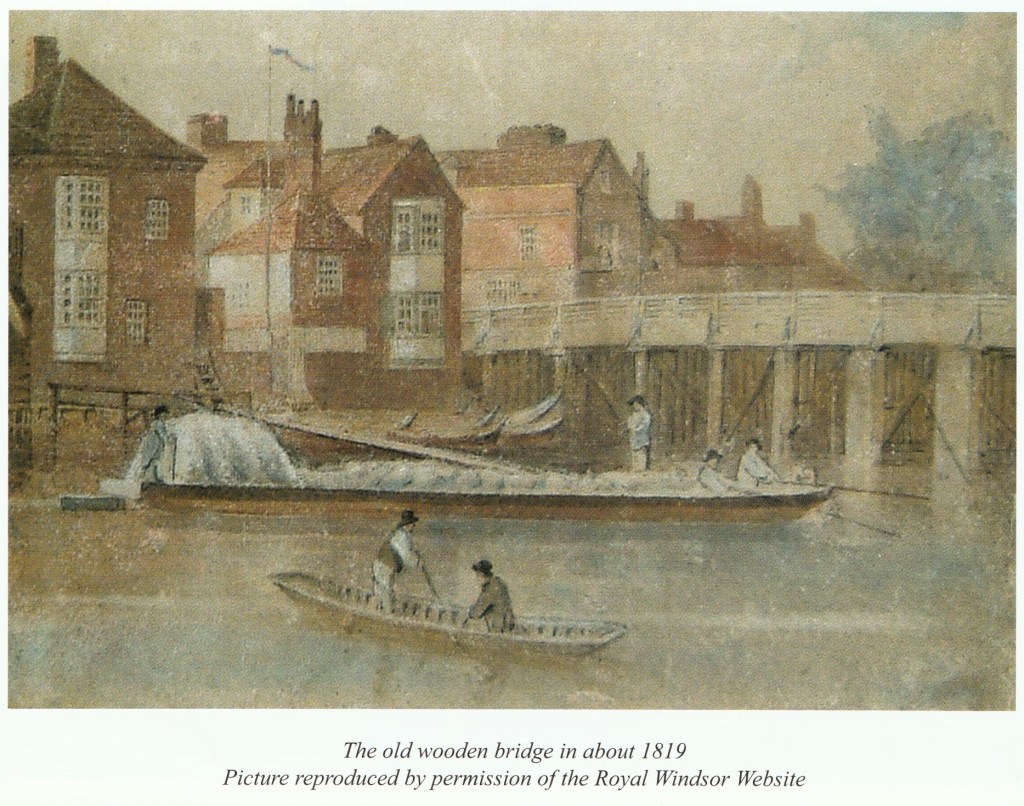
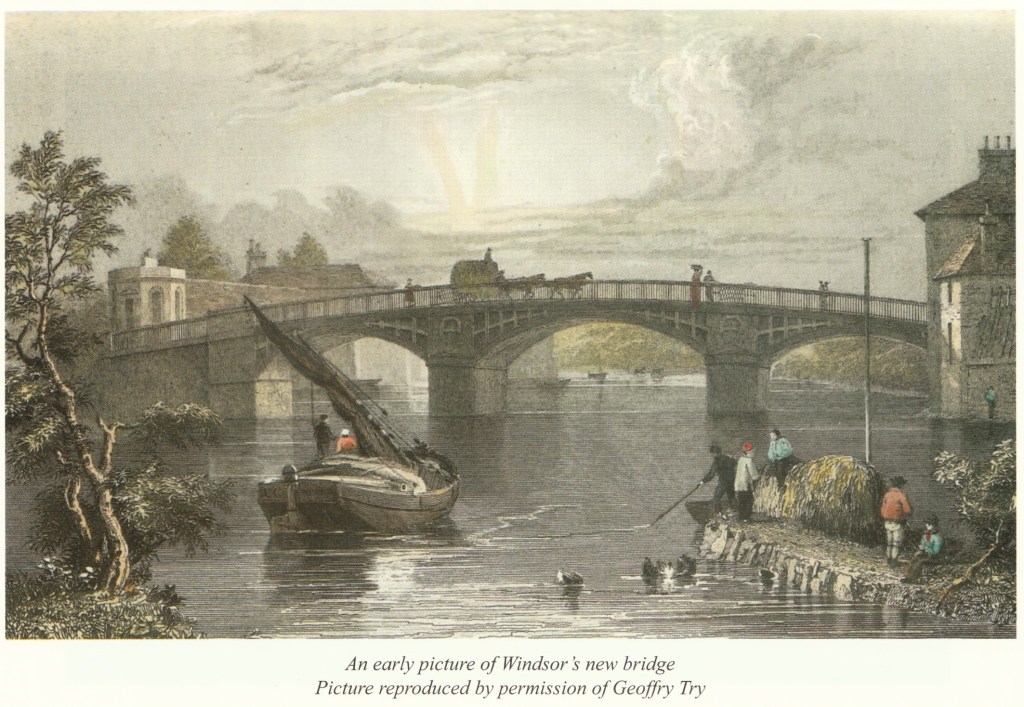
The architect chosen to carry out this work was Charles Hollis with consultation from the great engineer Thomas Telford, who was putting in a network of new roads and bridges in the North of England and Scotland. Telford was influenced by recent technological advancements, including the use of cast iron which had successfully been employed by Abraham Darby in the construction of the great iron bridge at Coalbrookdale in Shropshire. Cast iron was used to construct Windsor Bridge and had also been used successfully by Hollis in the building and construction of Windsor Parish Church (1820-22) for the pillars and roof supports.
With the granting of the Windsor Bridge Act by Parliament in 1820 construction commenced. In February 1822 the old bridge was taken down ind the materials were sold for £100. Whilst it was dismantled an iron footbridge was constructed to allow the crossing between Windsor and Eton by foot, and a temporary ferry service started to operate.(4)
During the eighteenth and nineteenth centuries, in particular, it was normal to have Masonic ceremonies celebrating the start of construction of a major public work. This also coincided with the fact that many of the members of the Windsor Corporation were Masons. The town of Windsor had already witnessed such a colourful ceremony with the laying of the cornerstone of the Parish Church in 1820.
On 10th July 1822(5) the cornerstone of the new bridge was laid with Masonic ceremony by the Duke of York who represented the Duke of Sussex, Grandmaster of the United Grand Lodge of England. The Windsor Express of 13th July 1822 chronicles the event in detail. There were great crowds, and ladies finely dressed peered out of windows on the route of the procession eager to witness this event and the chance of spotting the Duke of York. There was extremely limited accommodation to view the actual ceremony and a wooden platform was erected for the use of the Masons in the procession.
A temporary meeting of Grand Lodge was convened at the Castle Inn and culminated in the arrival of the Duke of York. A procession, which was organised by the Provincial Grandmaster of Berkshire, John Ramsbottom, and consisted of 300 masons dressed in full regalia and a mixture of all sectors of the local community, then left the inn. A cannon was sounded to mark that they had started to move from the Guildhall down the hill to the site of the bridge. The order of the procession was reproduced in full in the Windsor Express as shown below:
Order of the Procession
Beadle and the Peace Officers
Two Tylers with drawn Swords
Boys of the Charity School
Clerk and Sexton
Lodge of the First Life Guards
The Batchelors’ Committee
Visiting Brethren, Two and Two
Lodges belonging to the Province
The Overseers and Churchwardens
Gentlemen not members of the Corporation nor Masons
The Inscription Plate borne on a crimson velvet cushion by Mr W Hanson Jun.
The Offerings of Corn, Wine and Oil in silver cups carried on a silver plate by Mr H Atkins Jun.
The Coins in a silver plate borne on a crimson velvet suchion by Mr J Banister Jun.
The Builder, Mr Moore bearing a silver trowel on a Purple Velvet Cushion.
The Architect, Mr Charles Hollis bearing the plans of the bridge.
Band of the First Life Guards
Banner of the Grand Lodge
Provincial Grand Secretary
Provincial Grand Treasurer
THE BIBLE
Carried by a Master of the lodge supported by two stewards
Provincial Grand Chaplain, Mr P Pope
Officers of the Windsor Lodge
Fellows of Eton College
Canons of Windsor
Constables etc.
The Borough Colours borne by Mr Henry Adams and Mr William Jennings
The Town Clerk
The Two Bailiffs
Members of the Corporation (Juniors first)
The Justice
The Mace Bearer
The Chaplain The Recorder
The Chaplain, Rev Iasaac Gosset
THE MAYOR
The Recorder, Griffin Wilson Esq.
Officers of the Grand Lodge
H Burckhardt, Esq PSGD
WD Cummings, Esq., PSGD
B Rous, Esq., PSGD
Dr Hemming, PSGW
Sir Frederick G Fowke, Bart. PSGW
Thomas Harper, Esq. PDGM
Rev. Mr Colman, Grand Chaplain
WH White Esquire and Edw. Harper, Grand Secretaries
JR Hayward Esq., SGD
Hon. Mr Twistleton, JaW
WJ Simonds Esq, SGW
Gen. Sir John Doyle, Bart. DGM
Provincial Grand Masters
John Sweetland Esq, Gibraltar
HJ Da Costa Esq, Rutland
W Williams Esq. MP, Dorset
Sir W De Crespigny, MP, Hants
The Hon. Wm.Shirley, Warwick
Banner of the Grand Patron
Grand Sword Bearer, James Deans, Jun. Esq.
His Royal Highness the DUKE of YORK, KG. &c. &c.
Supported by
John Ramsbottom Esq, PSGW and Maj. Gen. Sir Herbert Taylor, KGH; the Two Members for the Borough
Noblemen and Gentlemen attending His Royal Highness
Earl of Harrington, Governor of Windsor Castle
Lord Langford
Lord Francis Conyngham
Lord Francis Levison Gower
Lord Bingham
Lieut.-Colonel Howard Vyse
Major-General Harcourt, CB
Sir Robert Harvey, Bart.
Sir Harvey Bathurst
James Ramsbottom Esq.
Two Stewards
Peace Officers
The ceremony opened with a speech and prayer from the Provincial Grand Chaplain. The coins were then presented to the Duke of York in a cup, ranging from a gold sovereign to a copper farthing and dated either 1821 or 1822. Also included was a Coronation Medal of 1822. The cup and a silver plate were deposited in the cornerstone. The plate was inscribed with the names of all those attending, including Charles Knight editor of the Windsor Express, the two MPs of the Borough John Ramsbottom and Major General Sir Herbert Taylor and the builder and future Mayor, James Bedborough.
Charles Hollis then presented the plans of the bridge and William Moore presented a silver trowel to the Duke of York. The Duke of York consecrated the stone with the corn, oil and wine. The band played God Save the King, followed by three cheers and a cannon was fired.
Sir John Doyle, Deputy Grandmaster of the United Grand Lodge of England, then delivered a speech apologising for the absence of the Duke of Sussex, Grandmaster, due to an unfortunate accident. The Deputy Grandmaster congratulated the crowd assembled and this was followed by a reprise of God Save the King. The procession then left the bridge and returned to the marketplace. The masons returned to the Castle Inn where the Grand Lodge was closed and the Mayor and the Corporation returned to the Guildhall. The Duke of York was introduced to the Mayor, the architect and the builder and was presented with the silver trowel used in the laying of the stone.(7) The trowel was later returned by the Duke to the Corporation of Windsor. The Duke of York sat for his portrait which was to hang in the Guildhall with the other Royal portraits. There followed a dinner at the Guildhall for over 200 guests. It was a great day for the town of Windsor but on a sadder note the article in the Windsor Express ends reporting that several people in the crowd were targeted by pickpockets who managed to escape without arrest.
The builder responsible for the actual construction of the Bridge was a William Moore.(8) The bridge was to be completed by November 1822, but Moore sadly died before the bridge was finished. The work was continued by his executor, a Mr Baldock. During the excavation for the new foundations for the bridge piers some interesting archaeological finds were unearthed, including a number of horse shoes of some antiquity and of curious shape, a seventeenth century spur, and several coins including a gold quarter noble of Edward III.? Sadly these finds no longer exist today. The final bridge pier was difficult to construct as no firm ground could be reached due to the volume of water. This was overcome, however, by using the army to help. Between 40 and 50 members of the 7th Royal Fusiliers used four chain pumps to pump out the water for a number of days and were relieved by new soldiers every four hours.(10)

The construction of the bridge was not with out disaster as an account in the Windsor Express of 25th May 1822(11) describes: James Stebbs, a labourer working on one of the piers within a coffer dam, slightly lost his balance and grabbed the pier to secure himself, but doing this dislodged part of the bridge machinery and part of the pile driver mechanism known as a ‘monkey’ fell and smashed into his right hand. He had to have three fingers amputated and was sadly unable to go back to work for quite some while. It would appear that this pile driver machinery was also responsible for causing accidents to other labourers working on the bridge. Also that year a barge called the Prince Regent, owned by a Mr Gibson of Marlow, which was carrying paper and flour, in trying to negotiate the bridgeworks crashed into an island known as the Cobler, and finally grounded on the Windsor shore and ‘received great damage’.(12)
Due to circumstances beyond the builder’s control the bridge did not open until the 1st June 1824 at a cost of £15,000. Under the terms of the Act allowing the rebuilding of Windsor Bridge, tolls were imposed on horses and carriages (apart from those used by the Royal family) though foot passengers were allowed across free. The ceremony for the opening of the bridge unlike the Masonic stone laying was a very quiet affair.(13) The Mayor was accompanied by the Borough Chaplain and the MP for Windsor, the architect Charles Hollis and the son of William Moore, together with other people who had been involved in the building of the bridge. The toll gate was closed and the architect presented the Mayor with a silver key. The Town Clerk read a proclamation declaring the bridge open, three cheers were given and the procession returned to the Swan Inn as a cannon was fired from the town wharf. In the evening a dinner was held at the Swan Inn-assembled diners were entertained by comedians and singers and ended with toasts wishing ‘prosperity to the Town of Windsor’.
The paying of bridge tolls was a way of increasing the Corporation’s revenue and this right had been exercised since medieval times-one of the more interesting tolls was the paying of six shillings for carrying a corpse over the bridge. Later the inhabitants of Windsor objected to this ‘tax’ and a number of protest meetings were held including one in 1874 in the old Theatre Royal. One of the chief objectors was Joseph Taylor of Eton who lobbied parliament for the abolition of the bridge tolls. After many years of fighting for this cause, in December 1898 the toll gates were removed from the bridge. Joseph Taylor was later instrumental in the removal of the toll gates on Maidenhead Bridge.(14)
Traffic continued to make its way across the bridge during the 20th century. By the 1930s cracks were starting to appear in the main ironwork infrastructure of the bridge and a weight limit was imposed as an attempt to stop the bridge from further deterioration-this appears to have been ignored during the war years as heavy military vehicles often crossed the bridge. By the late 1960s only single file traffic was allowed to cross the bridge and was controlled by traffic lights. Finally on 10th April 1970 at 4pm, a car crossed the bridge forw the final time, thus ending almost 150 years of transportation across Windsor’s town bridge.
Elias Kupfermann
References
- Victoria County History (VCH) of Berkshire (1923), Vol.3 p.57 (n)- for documentary ref. see Pipe Rolls 16 Hen II published by the Pipe Roll Society
- Windsor Express 26th Jul – 6th August 1818 p.4
- Ibid.
- Windsor Express, 23rd February 1822 p.4
- Windsor Express, 13th July 1822 p.4
- Lodge of Truth No. 590 was composed of the 1st Lifeguards Regiment (Source: Library and Museum of Freemasonry)
- The trowel is now preserved in the Windsor and Royal Borough Museum.
- Windsor Express, 23rd – 30th September 1821 p.4
- Windsor Express, 17th August p.4
- Windsor Express, 2nd August 1823 p.4
- Windsor Express, 25th May 1822 p.4
- Windsor Express, 30th November 1822 p.4
- Windsor Express, 5th June 1824 p4
- History of Maidenhead (1931), JW Walker p.18
 Windsor Local History Group