
Published in Windlesora 35
© WLHG 2019
Sir William Carter was one of the most well-known and popular Mayors of Windsor in the 20th century and served for a record 13 times between 1908 and 1928. He was born on 25 May 1848 at Marlow, where he was educated at the local elementary school. After leaving school at the age of 12, he worked as a painter and decorator for a few months before becoming a gardener. While working in the garden of Sir George Du Pre in Beaconsfield, he met his future wife, Rebecca Newson, who was employed in the house. They married in February 1871, but as the gardening job and its accommodation was for a single man, he had to leave Sir George’s employ.
He then worked for the Prudential Assurance Company at their offices in Marlow, Maidenhead, and Windsor. Carter became superintendent of the Windsor office in 1879 at the age of 31, and remained there until he retired, aged 60, in 1908. Carter had taken an interest in local politics before his retirement. He was elected to Windsor Town Council in November 1902, and then elected Mayor six years later.
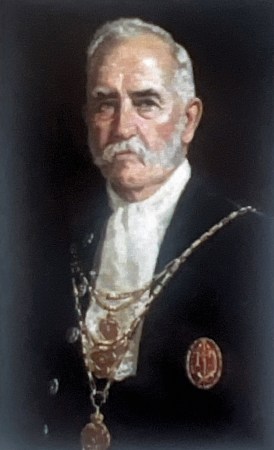
In 1913, he was elected for a further term and served as Mayor throughout the Great War, his fellow councillor felt that, as he was the Mayor when the war started, he should hold this position when the war ended and be the one to announce the end of hostilities. During the war Carter was a tireless fund-raiser, served on many committees, and he arranged for wounded soldiers to visit Windsor and to be entertained to tea at the Guildhall. When conscription was introduced in 1916, he chaired the weekly Military Tribunals that dealt with claims for exemption from military service.
Unlike many of his predecessors, Carter was not a wealthy man and came from a humble background. He relied on his bicycle to get him around town and to council meetings. In August 1916, during a spate of bicycle thefts in Windsor, his bicycle was stolen from outside the Guildhall. At the next council meeting, he was presented with a new bicycle by his colleagues and it was noted that ‘the gift was a very acceptable one, as his Worship depended greatly on his iron horse to carry out his multifarious engagements’. He was often mentioned, with great affection, in letters from the front; Pte Jack Angell wrote: ‘I am glad the Mayor has been presented with a new ‘horse’ and I hope he is well.
He was knighted for ‘public and local services’ in the 1920 New Year Honours and presented with a grandfather clock and an illuminated address by the townspeople of Windsor. Sir William Carter became an Alderman in November 1922, and in 1925, he received the Freedom of the Borough. In February 1928, the Prince of Wales, High Steward of Windsor, was the chief guest at the annual corporation dinner and made a speech in which he paid tribute to Sir William and noted his service as Mayor throughout the war:
So, having steered Windsor safely through the War, with the same skill and energy with which he still steers his own bicycle up the High Street, he came back to fill his high office once more; and having found that he was a good deal younger than he thought, he has gone on filling it till he has now entered on his 13th term.
In February 1920, he was appointed a Justice of the Peace for the Royal Borough and in April the same year, appointed for the Windsor Division of the County. He was a regular attendant on the Magistrates’ Bench. Sir William was also connected with many organisations in the town. He was a member of the Windsor Education Committee, the General Committee of King Edward VII Hospital, and a director of the Windsor and Eton Bowling Green Company. In addition, he was Vice President and Chairman of the Windsor, Eton and District Chrysanthemum and Horticultural Society, as well as a member of the Committee of the Windsor, Eton and District Rose and Horticultural Society. In his spare time Sir William was a keen gardener and beekeeper and was a successful exhibitor at local shows.
When Sir William and Lady Carter celebrated their diamond wedding anniversary in 1931, they received congratulations from King George V and Queen Mary, and the Prince of Wales.
He died aged 84 at his home in Suffolk Lodge, Bolton Avenue, on 14 October 1932. In its obituary of Sir William, The Times noted that ‘he was greatly esteemed by all who knew him and was locally known as Windsor’s Grand Old Man’. A Windsor, Slough & Eton Express editorial noted that:
It can also be said of him that during the whole of his period of service he retained the highest respect of his colleagues for his devotion to duty and for the thoroughness with which he carried out every task to which he put his hand. […] His familiar figure is sadly missed by all in the town, and, in the words of the Royal message to Lady Carter, his name will be gratefully remembered for many a day.
His funeral was held on 17 October at Holy Trinity Church, where Sir William was a churchwarden, and the service was officiated by the Bishop of Buckingham and the Rector of Holy Trinity Church. He was buried in Windsor Cemetery. His gravestone is a Celtic cross standing on two plinths; the inscription on the top plinth reads:
ALDERMAN SIR WILLIAM CARTER JP
MAYOR OF WINDSOR
1908, 1913-19, 1921, 1923-1927
DIED 14 OCTOBER 1932 AGED 84
The inscription on the lower plinth reads:
ALSO TO THE MEMORY OF REBECCA
HIS DEVOTED WIFE
DIED 1 MARCH 1935 AGED 85 YEARS
Over the years, the ground around the grave subsided and the gravestone tilted at a dangerous angle. Thanks to the efforts of the then Mayor, Cllr John Lenton, the gravestone was re-positioned in 2017.
Derek Hunt
Sources
The Times
Windsor, Slough & Eton Express
Windsor in the Great War by Derek Hunt & Dr Brigitte Mitchell, 2014
 Windsor Local History Group