
(1862 – 1937)
Published in Windlesora 34
© WLHG 2018
Sir Dhunjibhoy Bomanji purchased The Willows on the outskirts of Windsor sometime after 1914 and before 1920. The Estate by the end of 1922 included The Willows mansion house and associated buildings, taking in the current day Riverside Park, Squire’s Garden Centre, which was the kitchen garden, Sutherland Grange and The Hatch.
Born in India in 1862, Sir Dhunjibhoy was a very wealthy Parsee, a member of a religious group who followed the teachings of the Persian prophet Zoroaster. He controlled the docks and shipping lines in Bombay, current day Mumbai. The visit of King George V to India in 1911 resulted in riots in Bombay when the Parsee community wanted to welcome the King despite a general boycott of the event. Sir Dhunjibhoy personally rallied his labour force and other Parsees to guard the Fire Temples which were thus spared from harm. During the visit of the Prince of Wales (later King Edward VIII) in November 1921, he was again to organise the protection of the Fire Temples, when Mahatma Gandhi had called for a boycott of the Prince’s visit. The Parsee community had again wished to welcome a Royal visitor.
The year before, on 5th November 1920, the then Mr Dhunjibhoy Bomanji and his second wife, Mrs Frainy Bomanji hosted a party at The Willows. The event was reported in The Windsor Express and images of the day were included in a photograph album sold by White Fox Rare Books a few years ago. The lunch guests included Her Royal Highness Princess Alice and the Earl of Athlone, Field Marshal Earl Haig and Countess Haig, Captain Donald Simson, Colonel Hanford, Lady Mary Crichton, Lady Campbell, General Carteret-Carey and Mrs Carteret-Carey. As an aside, Mrs Carteret-Carey became the first female Mayor of Windsor in 1937, having served as a Councillor during the 1930s.
Some 650 guests, including wounded servicemen, war widows and orphans, were bussed from Bachelors’ Acre in Windsor to The Willows for the party in 1920. Oliver Brooks, VC, was amongst those who paraded from The Willows to The Hatch for tea, provided by Denny’s of Windsor. After the tea, each wounded serviceman received £1, widows, 10 shillings and the orphans 2s 6d each from Mrs Bomanji.

At the The Hatch, Mr Bomanji handed a cheque for £5,000 to Field Marshal Earl Haig for his general fund supporting the work of the British Legion. Years later, Sir Dhunjibhoy gifted an impressive bronze statue of Earl Haig to the City of Edinburgh. The statue is now located in Edinburgh Castle. A second cheque for the same amount was presented to HRH Princess Alice, and the money used to build the Windsor Ex- Servicemen’s Club in St Leonard’s Road. The Club served the town well for many years but has now been demolished.
Following the party, The Slough Eton and Windsor Observer on 27th November 1920 reported that Mrs Dhunjibhoy Bomanji was departing for India the following week and leaving behind a gold purse containing one hundred sovereigns to help the work of Dr Barnardo’s Homes. It was hoped that Princess Mary would accept the purse on behalf of the charity. The departure and arrival of the family at The Willows was frequently covered by announcements in the local press. One such announcement in the Windsor Express in February 1922 describes the couple’s return to The Willows:
At the main entrance a triumphal arch, lighted by electricity, had been erected, and at this point a large crowd of local people had assembled to give Sir Dhunjibhoy and Lady Bomanji a hearty welcome home. As their car drove into the grounds, the British Legion Band played a tune of welcome.
From this article we also learn that the couple had donated £5,000 to the King Edward VII Hospital in Windsor.
On 21st March 1922, Sir Dhunjibhoy hosted a party at the Ritz Hotel in Piccadilly, London, for The Parsee Association of Europe. At an earlier event at the Ritz Hotel in 1907, he is said to have given each of the ladies present a gift of a gold bracelet inset with rubies and pearls. One suggestion is that the gifts were to mark the visit by the Prince and Princess of Wales (later King George V and Queen Mary) to India and Burma, between November 1905 to March 1906, when he had played a role in welcoming the couple to Bombay.
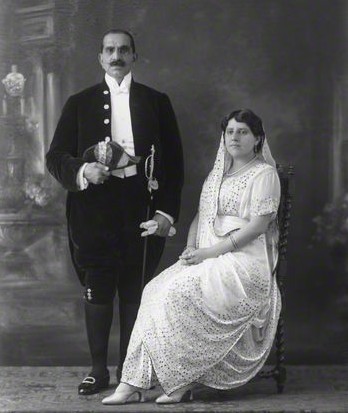
It is believed that his knighthood in 1922 was in recognition of his generous support of the Great War effort and ex-servicemen and widows. Portraits of Sir Dhunjibhoy and Lady Bomanji in the National Portrait Gallery collection, dated 24th June 1922, probably mark this event.
A contemporary article from 1927 shows Sir Dhunjibhoy and Lady Bomanji at The Willows, under the heading: ‘Arabian Nights’ Luxury in a Bombay Merchant’s English Home. His bedroom is shown, furnished ‘in French Style‘. All the bedrooms were apparently fitted with marble wash-basins. The statement ‘every tap, bracket and hat-peg is made of solid gold’ was maybe an exaggeration. The gardens are mentioned as being ‘elaborately ornamented with marble statuary’. A miniature railway track ran through the gardens, with a pony racing track by the river. The couple also owned a steam launch called The Lady Frainy, which was used to entertain visitors on the River Thames.
In the same year, Sir Dhunjibhoy purchased a mansion house called Pineheath, in Harrogate. Over the following years the family seem to have settled into a routine of spending the summer in Windsor, the autumn in Harrogate and then six months in India, between Poona and Bombay. Mehroo, born 1915, the daughter of Sir Dhunjibhoy and Lady Bomanji, was presented at one of the May Courts of 1933 by Lady Maude Hoare. The couple also had two sons, Philli born in 1910, and Sohrab born in 1919.
Sir Dhunjibhoy Bomanji’s obituary in The Times, 2nd April 1937 states that he was due to return to England in March 1937 when he was taken ill and died on 1st April 1937 at his home, Marble Villa, Bombay. He left his widow £49,514 12s 2d from his interests in England. Lady Bomanji was to make Harrogate her main home, and doesn’t appear to have lived at The Willows after her husband’s death.
The press reported that in October 1939 Lady Bomanji presented ‘two Rolls Royce cars to the Mayor of Windsor for ARP work during the war’. It is believed that the house was used by evacuated families during the early years of the Second World War, and later occupied by servicemen.
The main house and contents were auctioned in the late 1940s. Passing through a couple of hands, and with several plans put forward for its use, the main mansion house was divided into five homes by the Roxy Trading Company Ltd. Other properties on the Estate were also developed and sold. A memoir written by Captain Arthur Linklater, who was appointed the Manager for The Willows in April 1929, discusses the disposal of the Estate.
Lady Frainy Bomanji, known affectionately as ‘The Lady in the Sari’, died in Harrogate in 1986 just two years after being awarded the Honorary Freemanship of Harrogate, at that time a rare honour for a woman. Her daughter Mehroo continued to live at Pineheath until her death in 2012, when the house was auctioned.
Catherine Sutton
Sources
- The Windsor Express, November 1920, 3 February 1922
- Slough, Eton & Windsor Observer, 27 November 1920, 12 May 1923
- The Times, 2 April 1937
- Reading Mercury, 7 October 1939
- Linklater, A Memoir – quivis.co.uk
 Windsor Local History Group