
Published in Windlesora 23 (2007)
© WLHG
Windsor has always been one of my favourite places and in 1961 I was really looking forward to moving to the town and into my new house on the Laing Estate in west Windsor. However once settled in, the excitement faded and I felt isolated from what I thought of as Windsor, namely the Castle, the river and the town centre. My husband worked in the city and left home early. I had a five-month-old baby and I did not have any neighbours for the first winter. Although most afternoons I went out with the pram and often went shopping in Dedworth Road, it was not the same as shopping in the High Street or Peascod Street with the hustle and bustle of a busy town. Dedworth at that time did have quite a wide selection of shops though. There were branches of Budgens and Darvilles, a butcher, baker and greengrocer’s us well as a post office, so everyday needs were well catered for. However I looked forward to Saturday mornings when I could leave my daughter, Alison, at home with my husband and catch the Moore’s Brown Bus into the centre of town.
On arrival in the High Street I would ‘pop in’ to Caley’s as there was usually something I wanted to buy, such as a reel of cotton or a paper pattern, maybe just to look at the fashions. I would then turn into Peascod Street and would probably visit Ginger’s to buy something for tea. In 1960 this shop was described in Kelly’s Directory as a ham and beef store (but within a few years it moved with the times and became a delicatessen).
In those days the choice of all types of food shops was large. There were seven butchers in Peascod Street, Sydney Place and Oxford Road; seven greengrocers; nine grocers, including some household names that have disappeared such as International, Lipton’s, Home and Colonial Stores and David Greig’s. This last had a separate butchery department as well as comprehensive grocery counters and occupied 74, 75 and 76 Peascod Street. Another of these grocers was Tesco’s which was in two small shops near the then Star Hotel, a far cry from today’s superstore on the Dedworth Road.
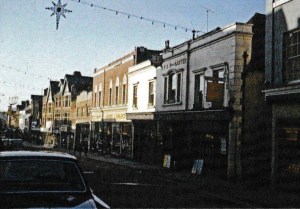
Today most of us have cars and can use them for getting all of our purchases home, but in the 60’s a lot of shops provided a delivery service (not a new concept as today’s superstores would have us believe). For instance, if one left an order with International Stores on a Tuesday, it would be made up and delivered on the Thursday. I used to buy my meat from Salway’s who were then in Sydney Place, which was where the entrance to King Edward Court is today. I would put in an order for the coming week and it would be delivered without fail on the appropriate day. From the very first week, the staff would remember me and give me a cheery greeting each Saturday which did a lot to make me feel at home in the town.
Windsor was very well served with bakers at that time. I particularly remember Dexter’s and Denney’s who both had many tempting delicacies for sale, especially lardy cakes which seem to have largely disappeared probably because they are not what today would be called healthy eating, but delicious all the same.
It was not only food shops that Windsor was well served with. The Singer Sewing Machine Company had a shop in Peascod Street for many years and there were several sweet shops, tobacconists, tailors, dyers and cleaners, and as of today many dress shops and shoe shops. Woolworth’s and Marks and Spencer were in the same positions as today, as was the W.J Daniel Department Store which seemed to sell everything. I well remember several occasions when if other shops such as Caley’s did not have something I needed, being told to try Daniel’s and I nearly always managed to find exactly what I wanted. Bill Bryson in Notes from a Small Island describes Daniel’s as ‘the most interesting department store in Britain’. This was before the modern store we see today and he describes the store as ‘the most extraordinary place with low ceilings, tiny obscure departments selling the oddest assortment of items.’ He wrote that it ‘felt as if many different buildings with slightly different floor levels had previously occupied the space’. This is actually what did happen. W. J. Daniel & Co Ltd came to Windsor in 1918 when Charles, the son of the founder, Walter Daniel, who had opened his first shop in Ealing in 1901, acquired a shop at 120 Peascod Street for his sister Mabel to run. The original store was then extended as adjoining shops became vacant and when King Edward Court was built, Daniel’s was eventually developed into the modern store of today.
Leisure was well catered for with nine public houses including the Star and Garter. This establishment had a gym where many well-known boxers trained. In 1951 it was the centre of the dreadful unsolved murder of seven-year-old Christine Butcher at the time of the visit of the middleweight champion of the world, Sugar Ray Robinson and his entourage. In 1960 there was still a cinema, the Regal, in Peascod Street where I remember seeing the film Tom Jones.
Things began to change within a few years, as the top part of Oxford Road was knocked down, together with many of the old Victorian streets, to make way for the Ward Royal development. Four of the shops that were displaced were housed in Nissan huts in a temporary car park behind Peascod Street until Ward Royal was built. These included a butcher, an off-licence, a greengrocer and a baker. During the 60s the nature of the shops began to change although there were still many food shops; TV rental outlets started to appear along with two turf accountants or bookies and several public houses disappeared.
On my shopping trips in the 60s though, this was all in the future. Then after an enjoyable progress down Peascod Street I would turn into Oxford Road. There I would usually need to pop into the Windsor and Eton Dairies’ shop and perhaps the greengrocers, Oxford House, to make some last purchases. Then I would catch the bus outside the dairy and be home in time for lunch tired but happy.
Barbara Mitch
Sources
Kelly’s Directories of 1960, 1967/1968/1969 and 1970.
Bill Bryson, Notes from a Small Island.
 Windsor Local History Group