
“SRS Windsor”
Published in Windlesora 21 (2005)
© WLHG
Ranger Guides are the older girls in the Girl Guide Movement. Sea Rangers, like Sea Scouts, did all the usual guiding and scouting activities (camping, going on expeditions, learning first aid, how to deal with emergencies etc) and also enjoyed ‘messing about in boats’, and did some of their training in the water.
The Windsor Sea Ranger Crew was started towards the end of WW2 by Miss Stickland. After the war she returned to London and Mrs Joyce Waltham became Sea Ranger Skipper, and asked me to help as the Mate. I had been a Sea Ranger in Hampshire during the war while working for the Admiralty near Portsmouth, and later took over the crew with Beatrice Wren to help me.
The Sea Rangers were encouraged to name their crews after famous ships. In Maidenhead we had Ark Royal and in Reading were Achilles and Euryalus. The Royal Borough of New Windsor already had links with the destroyer HMS Windsor and it seemed sensible to name ours Sea Ranger Ship Windsor. Unfortunately HMS Windsor was decommissioned at the end of the war and our link was lost.
At first the Sea Rangers met at Upton House School, but we needed our own headquarters, and with the aid of parents, numerous whist drives and jumble sales were held and we raised enough money to buy a hut, and this was built in Charles Street, near the Scout Hut. At this time we had very friendly links with the Rover Scout Crew, joining them in many activities. Very soon though a new road was to be built and the hut had to be moved to its present position in St Leonard’s Road, near the Gardener’s Hall, and is now known as the Windsor Guide Headquarters. Next we needed money to buy or own boats, which meant more whist drives and jumble sales!
We had been hiring skiffs from Eton College boathouse and were lucky enough to have some coaching from Vic Woods of the Wraysbury Skiff and Punting Club. We did well in the Sea Ranger regattas organised by the county. But the other Berkshire crews had their own boats and several of the crews had beautiful 6-oared pulling gigs designed by Peter Freebody when he was an apprentice at Wootons Boatyard at Cookham. He is now a famous restorer of wooden boats with his own firm at Hurley. At last, in 1955 our new boat was ready, and we travelled to Wootons by road, and a crew of Sea Rangers augmented by several of the Rover Crew rowed our beautiful new boat down to Windsor.
One boat was not really enough for us, and in the Ranger Hut we built our own canvas canoe, and with the aid of a friend a Gull sailing dinghy was built from a kit. Our supporters in the weekly whist drives were convinced we would never be able to get the dinghy out of the door. It was a very tight fit, but turned on her side, it was just possible. We also purchased a Thames Skiff from a firm in Reading and rowed her down to Windsor. We did this on an Easter weekend, camping on the way. This was one of the coldest nights in camp I remember. There was ice on the water bucket in the morning.
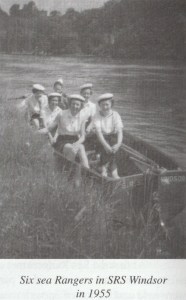
Each summer we competed in rowing regattas. Those we enjoyed most were the Berkshire County Sea Ranger ones, usually held in Reading. Here it was possible to run along the river bank cheering your own crew on. Winners from the Berkshire regatta went on to represent the county at the Thames Sea Ranger Association regatta, held at Ravens Ait, an island at Kingston, which was the headquarters of the Sea Cadets. This was usually a weekend affair, with the regatta on Saturday afternoon and training in all manner of boats on the Sunday. We were also invited to com pete in the Bucks Sea Rangers’ regattas. The first one was held on a Sunday and after a Six sea Rangers in SRS Windsor service in Bray church a flotilla of boats, with in 1955 Lady Burnham in the first one, proceeded up the river to Maidenhead, each boat flying its crew’s burgee flag. It was a grand sight. Later in Windsor we were reprimanded for taking part in a regatta on a Sunday! Things have changed since then.
Crews were encouraged to embroider their own burgee flags with the appropriately designed heraldic device signifying their crew. Ours had a castle on it, similar to the one on HMS Windsor’s crest. One of our rangers, Dorothy Cooper, did most of the work on the burgee, advised by Mrs Landfear who was the tester for the guide’s needlewoman badge.
Besides our boating activities, our programme included things as various as studying fashion and architecture, and we visited the fire station and the Magistrates courts. We went to the ballet, tried Chinese meals and cooked some in the hut. Some people worked for their Duke of Edinburgh Award. In 1947 our boating training stood us in good stead when several of us helped by rowing round the flooded area of the town and delivering food and messages to people marooned in their houses.
Although we did most of our boating on the River Thames we also went sailing with the Ocean Youth Club, and canoed down the River Wye and spent several weeks aboard a former motor torpedo boat moored at Dartmouth and used by Sea Rangers as a training ship. Here on the beautiful river Dart we could row and sail on tidal waters and swim and explore the nearby lovely Devon countryside. One of the boats we could use was the beautiful little dinghy named Duchess which was one of the boats that Princess Elizabeth and Princess Margaret had used when they were Sea Rangers.
Some of the WRNS stationed at Eton during the war had been Sea Rangers and wanted to continue, and started a crew SRS President III. This became the Princess’s crew and was later named SRS Duke of York and met in Windsor Castle. They boated on the lake at Frogmore and one of the boats they used was the dinghy Duchess. In 1946 their crew travelled to Dartmouth and spent five days aboard the motor torpedo boat, the princesses taking part in all the activities including those such as scrubbing the decks and helping in the galley.
In the Home Park on the Datchet reach of the Thames there is a boat house. It had been built to house a Royal Barge which had been moved to the Maritime Museum at Greenwich so the boat house was empty. The Windsor Sea Rangers were able to store their boats there and on most Friday evenings in the summer the crew would be seen boat training on the river.
Even stored under cover each year the boats needed to be cleaned, rubbed down and re-varnished. It takes an incredibly long time because a 20ft clinker-built gig has overlapping planks. We usually started at Easter, and by Whitsun we were ready to go up river for a weekend camp with our tents stored in the boats.
Most years we also got away for a week’s camp in the summer, sometimes helping to run the Guide camp. We camped in Scotland, on the Isle of Wight, in Cornwall, on the Isles of Scilly and at the guides “Our Chalet” in Switzerland where we could make international friends, climb mountains, and ski in the winter. While we were camping there in 1978 I found my legs would no longer climb mountains. It was time to give up and I resigned.
Things had already changed, for in about 1970 Guide Headquarters had decided that there would no longer be three sorts of Rangers – land, sea and air, but all would be Ranger Guides. No longer would Sea Rangers specialise in boating, and they would lose their smart uniform of white shirt and WRNS-style hat. All Rangers would wear an aquamarine coloured shirt and a forage cap. (The uniform has changed again since then.) Sea Rangers protested hard against the change and many crews voted to leave the Girl Guide Association and join the newly formed Sea Ranger Association. The Windsor Rangers narrowly voted to stay in the Guide Association. There was a new programme of activities, but we were still allowed to keep our boat. Things went on as usual, but it did not feel the same.
By 1980, Margaret Long, one of the ex-Sea Rangers, had restarted the Rangers, now known as Windsor Ranger Guide Unit. (Somehow a unit does not sound as friendly as a crew). As an ex-Sea Ranger she was keen to keep the boating side of the programme going. In 1989 the gig had been completely restored and a new generation of girls were enjoying the experience of rowing in her. Under Margaret the Rangers enjoyed several trips to events abroad including Norway, Belgium and Switzerland and I was invited to go boating with them from time to time, and was included in some trips abroad.
After the second Wings Windsor International Guide and Scout Camp held in 1998, Margaret too thought it was time for her to resign and the Ranger Guide Unit was closed, and now our much-loved boat, the SRS Windsor gig has been sold, back to Peter Freebody.
My link with the Sea Rangers lasted from 1945 when we celebrated the first 25 years of Sea Rangering and had a service in St Georges Chapel and Princess Elizabeth, as our Sea Ranger Commodore spoke to us from the steps of the West Door. In 1970 we celebrated 50 years by travelling by boat from Westminster to Greenwich for a march-past and a service in the beautiful chapel there. Sea Rangering has given me the opportunity to explore the Thames from Abingdon to Teddington and to get to know and love our beautiful river.
 Windsor Local History Group