
Published in Windlesora 07 (1988)
© WLHG
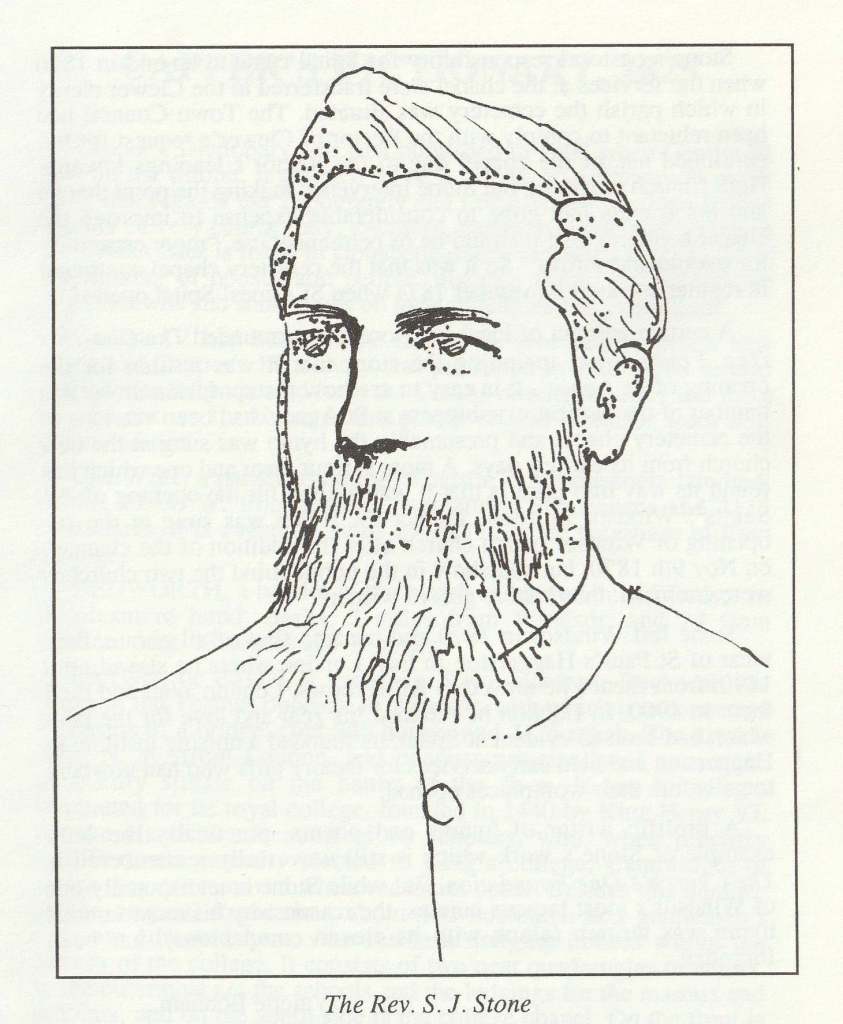
Samuel John Stone, hymn-writer extraordinary, was one of the most famous curates to serve in the parish of Windsor, but an otherwise little-known episode underlies the writing of his most famous hymn, The Church’s One Foundation.
Both the Vicar of Windsor, (the Revd Henry J. Ellison), and the Rector of Clewer, (the Revd T. T. Carter), were deeply concerned that the high cost of renting pews at both parish churches prohibited the poor from attending Sunday worship. This eventually led both clergy to build new daughter churches where the seats were free: All Saints’ in Windsor parish, and St Stephen and St Agnes’ churches in Clewer parish. But for various reasons, chiefly financial ones, this took time, and in the early 1850’s there seemed no immediate solution to the problem.
However, a series of devastating cholera epidemics had raised the question nation-wide of over-crowded graveyards and the consequent threat to public health. Windsor had not escaped this scourge which had visited the town in 1849. Thus it was that the Cemetery Acts of 1852 and 1853 empowered local Councils to create new borough cemeteries on the outskirts of towns, and accordingly the parish churchyards of Old and New Windsor, the burial ground on Bachelors Acre, and the William Street Chapel were closed, but not Clewer churchyard which remained outside the Borough until 1920. After much deliberating the Windsor Town Council purchased five acres of land at Spital on the western outskirts of the town for the new cemetery which was consecrated in 1858.
Ever mindful of the plight of his poor parishioners, Mr. Ellison applied to the Town Council for the use of the Anglican chapel at the Spital cemetery for Sunday worship, and perhaps surprisingly, the Council complied with this unusual request. By 1860 weekly Evensong at 3 p. m. was well attended. Not only were the seats free from pew rents, but also this chapel provided the only Anglican place of worship in the district, the parish churches of Windsor and Clewer both being at a considerable distance.
In 1862 the Revd S. J. Stone took up his first curacy at Windsor parish and soon after was put in charge of services at the cemetery chapel. Residing at Weston Cottage on Bachelor’s Acre, Stone found himself at some distance from Spital, but nevertheless threw himself into his duties with great enthusiasm. Indeed so great was his zeal for those in his care that towards the end of 1864 he wrote to the Mayor with a list of improvements which he deemed necessary in order to make the chapel more akin to a regular place of worship. These included a stove and chimney, harmonium, kneeling hassocks, floor-coverings, lights, and some omamentation for the walls. The Council was somewhat taken aback and, possibly fearing High Church practices, declined to assist except for the provision of stove and chimney and to stop the draughts from the ‘ill-fitting windows‘. Stone was told in no uncertain terms that if he wished for further improvements he must carry them out at his own expense: quite undeterred, he proceeded to do so.
Meanwhile in the wider Church a great controversy was raging around the supposedly heretical writings of John Colenso, Bishop of Natal. The whole issue shook the Anglican Communion to its very core and many churchmen, both clerical and lay, were moved to expound the Christian faith in the light of what they saw as an assault from within. Hymnologists tell us that Stone was no exception, and that it was for this reason that he set about writing a series of hymns to illustrate the Apostles Creed. There were twelve in all, and they were published in 1866 under the title Lyra Fidelium. Of the twelve only one has found its way into modern hymn books: The Church’s One Foundation which illustrates the clause, “I believe in the Holy Catholic Church.”
Oddly, Stone does not mention the Colenso controversy in the preface to Lyra Fidelium but rather states that, “Most clergymen are aware how many of their parishioners among the poor especially, say the Creed in their private prayers. . . and this excellent use is too often accompanied by a very meagre comprehension of the breadth and depth of meaning. . . Such a feeling first suggested to the author the probable usefulness of a simple explanation of the Creed in a popular form of a series of hymns, such as might be sung or said in private devotion, at family prayer, or in public worship. . . To this end the author set about the composition of the following hymns.” So it would seem that the poor, and in particular the poor of Spital, to whom Stone was actively ministering, were well to the fore when he conceived the idea.
S. S. Wesley’s rather dreary tune, Aurelia which is always associated with Stone’s hymn was not used for it until 1872 when it was specially chosen for the thanksgiving service in St Paul’s Cathedral to mark the Prince of Wales’ recovery from serious illness.
Until then the tune Ewing had been used which is now usually associated with Jerusalem the Golden: and just to confuse things it might be added that until 1872 Aurelia was used with this latter hymn!
Stone’s pastoral responsibility for Spital came to an end in 1866 when the services at the chapel were transferred to the Clewer clergy in which parish the cemetery was situated. The Town Council had been reluctant to comply with the Rector of Clewer’s request for the continued use of the chapel due to the Rector’s leanings towards High Church practices, but Stone intervened making the point that he and his friends had gone to considerable expense to improve the chapel believing that it would be of permanent use, “more especially for the old and infirm.” So it was that the cemetery chapel continued in regular use until November 1874 when St Agnes’ Spital opened.
A certain amount of local folk-lore has surrounded The Church’s One Foundation, including the story that it was written for the opening of St Agnes’. It is easy to see how the confusion arose as a number of the earliest worshippers at St Agnes’ had been veterans of the cemetery chapel and presumably the hymn was sung at the new church from its earliest days. A more serious error and one which has found its way into print is that it was written for the opening of All Saints’, Windsor in 1864. In fact the hymn was sung at the re-opening of Windsor parish church after the addition of the chancel, on Nov 9th 1870, but somehow in the public mind the two churches were confused: thus history gets re-written!
Stone left Windsor in 1870 and became first of all curate, then vicar of St Paul’s Haggerston in East London where he stayed until 1890; from thence he moved to All Hallows, London Wall and died there in 1900. In London he retained his zeal and love for the poor which had been so evident at Spital; he founded a nursing institute in Haggerston and held early services for factory girls who had nowhere to go before their workplaces opened.
A prolific writer of hymns and poems, practically the only example of Stone’s work which is still universally remembered is The Church’s One Foundation. But while Stone is undisputedly one of Windsor’s most famous curates, the reason why his most famous hymn was written (along with its eleven companions), has been forgotten.
Valerie Bonham
Further reading: The full story of the cemetery chapel and Stone’s work there, together with the correspondence can be found in: BONHAM, Valerie In the Midst of the People 1983 (Out of print but copies are available for loan in Windsor Public Library).
 Windsor Local History Group