
– the early years of the Clewer Sisters
Published in Windlesora 03 (1984)
© WLHG
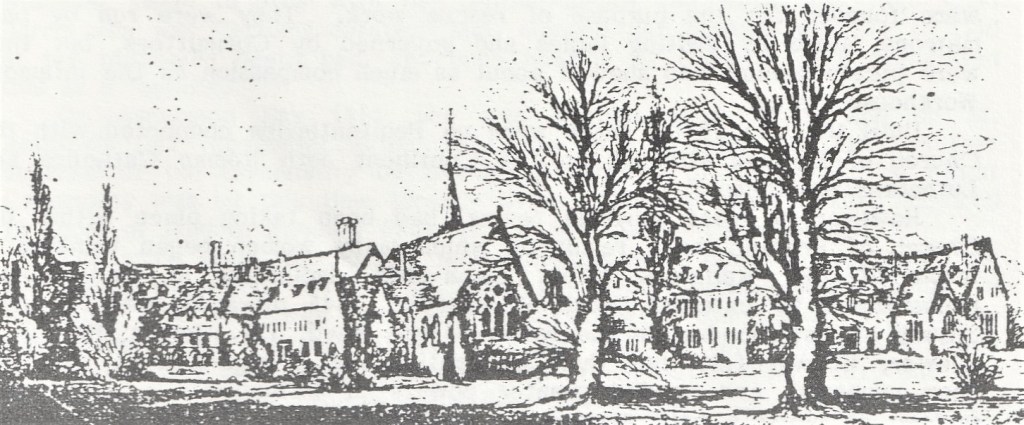
The stranger passing along Hatch Lane in west Windsor might well cast a questioning glance at the range of Victorian red brick buildings which dominate this otherwise ordinary residential area. Windsorians know that this is the home of the Clewer Sisters (the Community of St. John the Baptist), and indeed, these black habited nuns are familiar figures in the town. The altar bread and the beautifully embroidered vestments made in the Convent workrooms are world famous; and many visitors come to the retreats and conferences organised as part of the Sisters’ modern work. The Sisters have adapted to a changing world, but their original work was of a quite different nature – the rescuing of ‘fallen’ women.
It is very easy nowadays to smile at the Victorian view of morality, especially when we remember the double standards which were prevalent. However, we cannot escape the fact that in most towns and cities there was gross overcrowding among the poorer classes, and no privacy of any kind so that these people lived in perpetual moral danger. In a garrison town like Windsor the problem was even more acute. Within half a mile of the residence of the Grandmother of Europe were beer houses and brothels. As late as 1860 the Rector of Holy Trinity, Windsor (the Revd. H.C. Hawtrey) was to write:
“Where two regiments of Household Troops are quartered a large amount of evil exists in the shape of beer houses and houses of ill fame . . . In one lane alone (Clewer Lane), of about 60 houses, there are 7 beer houses and at least 4 houses of ill fame – vice and immorality are rampant in broad day.“
Revd. H.C. Hawtrey, 1860
In this moral climate many young women became enmeshed in this web of vice. With no education, and little chance of obtaining any, prostitution was for many the only means of earning a living. Parents often turned a blind eye to their daughters’ means of helping to support a large family. There were one or two ‘Penitentiaries’ in London which were founded for the purpose of rescue work. They were run by paid matrons, aided by visiting ladies and governed by Committees, but they were purely secular and showed about as much compassion as the infamous Workhouse system.
Until the late 1840’s there were no Penitentiaries connected with the Church of England although on the Continent both Roman Catholics and Lutherans ran them.
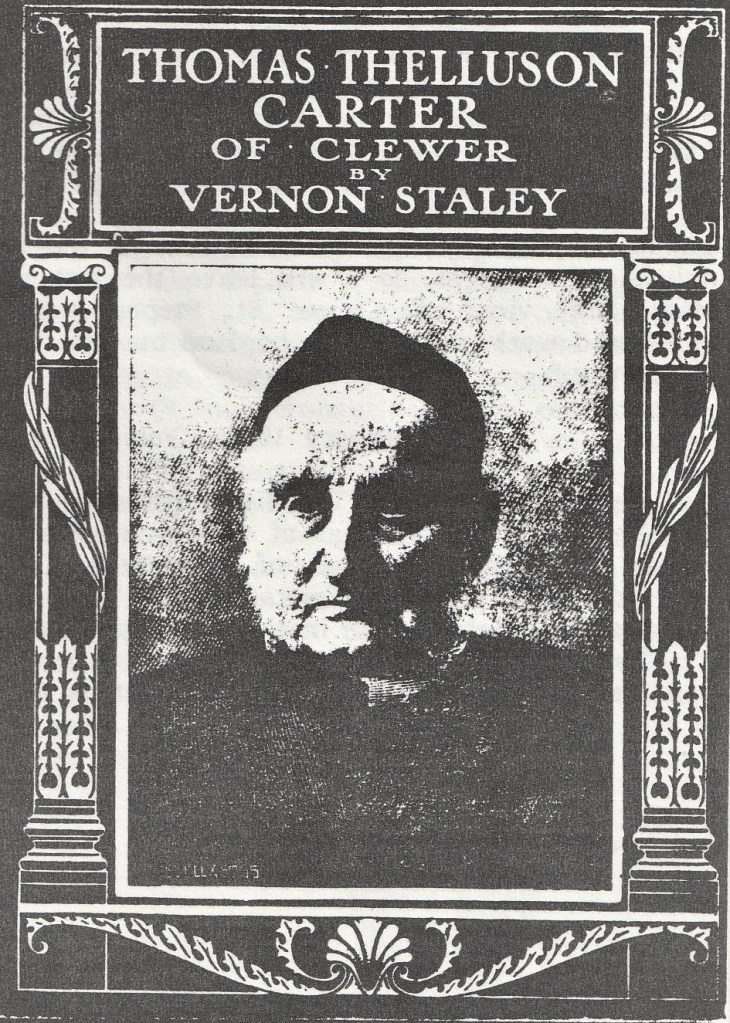
However, a great spiritual revival had been taking place within the Church of England, as a result of which many women began thinking in terms of the ‘Religious Life‘ i.e. a life dedicated to God usually accompanied by external ‘work of mercy‘. 1845 onwards saw the rapid growth of Sisterhoods. In the words of the Revd. T.T. Carter, Rector of Clewer, “It was felt that their restoration was a higher work than had been supposed, and needed greater powers of influence . . . and that instead of being a paid service, it should be carried on as a religious work for Christ’s sake”.
Many young women flocked to join these early Sisterhoods, and, alarmed partly by the prospect of losing their daughters, and partly by the fear of Rome, many Evangelical Churches condemned the movement. In order to combat these objections and to put the matter into the right perspective, Carter wrote a tract called “Is it well to institute Sisterhoods in the Church of England for the care of female penitents?” This was published in 1853.
On June 19th 1849, Mrs. Mariquita Tennant, the Spanish widow of an English clergyman, began the work which eventually grew into the Community of St. John the Baptist. On that day, Mrs. Tennant took into her home a girl who wished to lead a new way of life.
Within 3 months there were 18 girls at Mrs. Tennant’s temporary residence, ‘The Limes‘ near Clewer Church. Poor health forced Mrs. Tennant to give up the work in 1851, and the Revd. T.T. Carter resolved to continue it in the form of a Sisterhood. But who was to run it?
It was at this time that Harriet Monsell, having recently been widowed, came to stay with her brother-in-law, the Revd. the Hon. C.A. Harris, who was Carter’s curate. Mrs. Monsell had pledged her life to God at her husband’s death bed, and upon hearing of Carter’s plan recognised this as a ‘calling.’
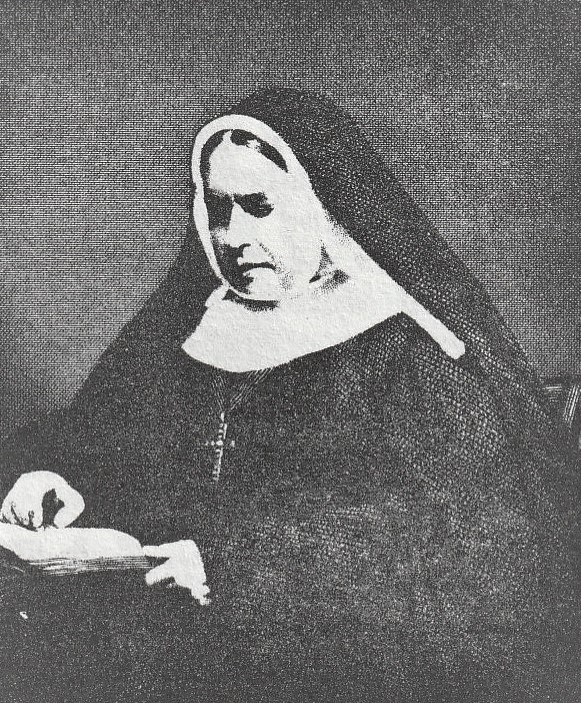
On Ascension Day 1851, she was clothed as a Sister and on St. Andrew’s Day (November 30th), 1852, she was installed as First Mother Superior of the Community by Bishop Wilberforce of Oxford. The infant Community was by this time already living in Hatch Lane, having acquired 15 acres of land in February 1851 before Mrs. Tennant’s withdrawal.
The work grew rapidly, and new buildings soon became necessary. The first stone of which was laid in 1854, the first buildings were opened in November 1855, and three years later, the rest were completed. The chapel was dedicated on July 1st, 1858. This was not the splendid edifice which still graces the west Windsor skyline and which dates from 1881, but was the smaller, plainer chapel nowadays known as the Chapel of the Forerunner. The architect for all these was Henry Woodyer, former pupil of the famous William Butterfield.
By 1857, the Sisterhood had 11 members and an average of 38 penitents, although it was hoped to increase the latter to 50. Since June 1849, 177 penitents had been received of whom “59 are doing well (and are alive); 8 died with good hope; 16 were middling and 12 doubtful (some of these are married); 21 bad; 9 ran away’ 16 stayed less than a month; and 36 are still in the house.” These contemporary statistics are interesting inasmuch as they do not attempt to conceal the fairly high failure rate.
The girls were taken into the House of Mercy as it was called, and were thence known as ‘Penitents‘. Not all came voluntarily, and some even resented the prospect of a reformed way of life; indeed, some did not wish to reform, but for many it gave a ray of hope, something hitherto unknown. The Penitents lived separately from the Sisters, but, we are told, “it is a rule that the Penitents should never be left without a Sister being present.” There was no fixed limit governing a Penitent’s stay, “the average is about a year and a half. Some remain beyond two years. We are never satisfied to let them go till they become settled Communicants.“
Their daily work consisted of “manual labour – all the work of the House – kitchen, dairy, laundry, needlework, housework.” There were also lessons, religious instruction, and invariably a good deal of attendance in chapel. The regime was strict but compassionate. Upon leaving, most went into domestic service.
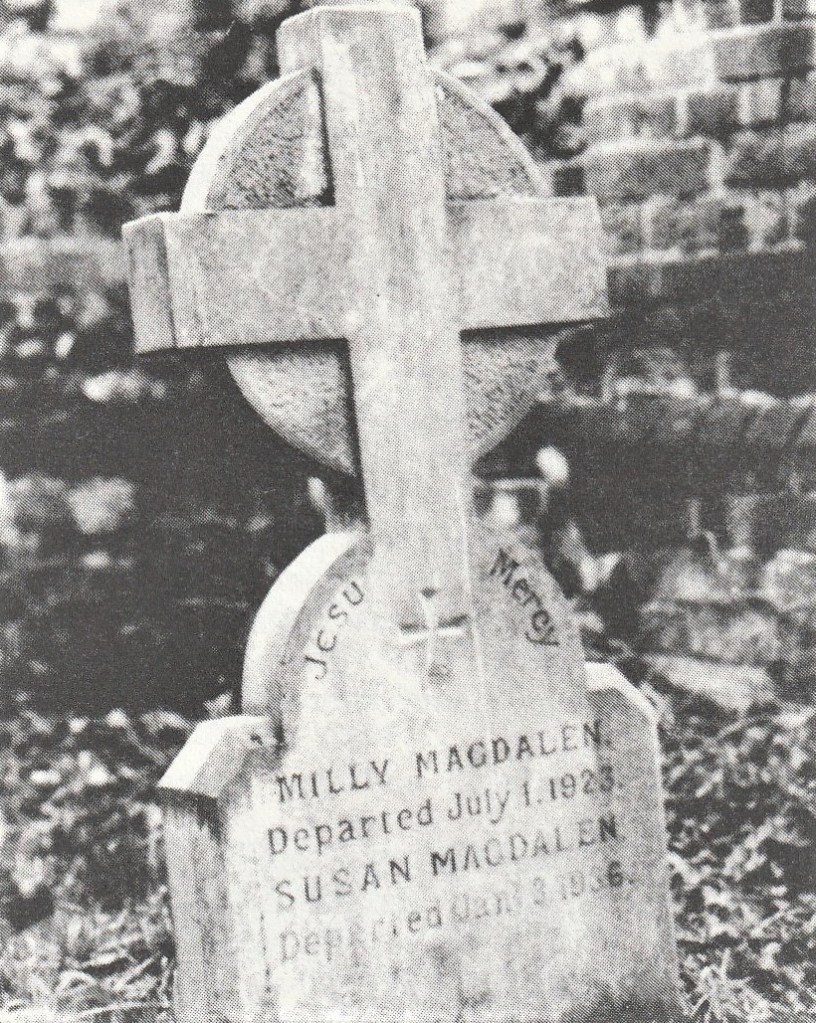
There were, however, some Penitents who instead of leaving the House of Mercy, wished to remain there to lead dedicated lives. These became Magdalens, in the words of T.T. Carter, “a dedication in a different way from that of a Sister of Mercy, yet having a beauty of its own, as a rose differs from a lily.” These women adopted ‘Magdalen‘ as their common surname, and the gravestones of Milly Magdalen and a number of her companions in Christ may be seen in Clewer churchyard.
The Sisters themselves were described as “ladies of the Church of England“, many came from wealthy homes, and indeed some had borne titles before joining the Sisterhood. At first the Sisters did not make vows; Bishop Wilberforce, who as well as being Diocesan Bishop was also Visitor to the Community, disapproved of vows because he felt they smacked of Romanism. He noted in his diary certain restraints which he had placed on the Community so that it should not become “a nest of Puseyites.” Gradually, the Sisters felt an increasing need to make vows but they were not adopted until the 1890’s when William Burge was Diocesan Bishop and Visitor. There was also a second order of the Community consisting of ladies who spent part of the year with the Community and the rest pursuing their ordinary lives.
Finally, the Associates were (and still are) people living in the world who support the Sisters by their prayers. During the early years both Mrs. Gladstone and Mrs. Tait, wife of the Archbishop of Canterbury, were Associates.
The Community grew rapidly; between 1849 and 1881, 227 novices (or Sister Probationers as they were called) were admitted, although in the early years there were a fair number of withdrawals. When the new chapel was consecrated in 1881, 104 Sisters were present and the whole Community numbered 180 including branch houses.
By the time of Canon Carter’s death in 1901 the worldwide Community numbered over 300, with more than 40 branch houses.
As a result of the increase in numbers, the Community was able to widen its sphere of work. Space will only permit a brief mention of some of the more local work undertaken from the 1850’s. 1858 St. John’s Home for the Girls was opened in Hatch Lane. The girls were orphans over 12 years, “the children of respectable parents. Illegitimate children are not admissible.” The first stone of St. Andrew’s Convalescent Hospital was laid in 1865 and the building was extended about 10 years later.
In the early 1860’s a Ragged School was begun in Clewer Fields, the slum area from whence Mrs. Tennant’s first penitents came. This work grew into the new parish of Clewer St. Stephen. July 1871 saw the opening of the chancel of the new church, and on December 22nd 1874, the completed church of Clewer St. Stephen was consecrated. The Community branch house at St. Stephen’s thereafter concentrated on private education for young ladies in the form of St. Stephen’s College (1874) and High School (1882). All these buildings were designed by Woodyer, some of them have since been demolished, the greatest loss being St. Andrew’s Hospital in Hatch Lane.
It is impossible to do justice to the many aspects of the work of the Clewer Sisters in just a few pages, so I will leave the last word to the Revd. G.D. Nicholas, first vicar of Clewer St. Stephen, who reflected that, “a great and blessed work, not only in England but the Colonies, has been done of their agency.“
Valerie Bonham, January 1984.
Acknowledgements:
Revd. A.M. Allchin ‘The Silent Rebellion’.
Revd. J.N. Scott, Vicar of Clewer St. Stephen for use of the private journal of the Revd. G.D. Nicholas from which the final quotation was taken.
Oxford Diocesan MSS in the Bodliean Library.
Pusey House, Oxford.
The Community of St. John the Baptist, Clewer.
 Windsor Local History Group