
(1889 – 1923)
Published in Windlesora 34
©2018, WLHG
The history of the Harte and Garter Hotel resounds with connotations of Shakespeare and his world. In his time, these were two separate yet adjacent inns, The Harte and The Garter. The latter is synonymous with Shakespeare’s Garter Inn, mentioned in his play, The Merry Wives of Windsor.
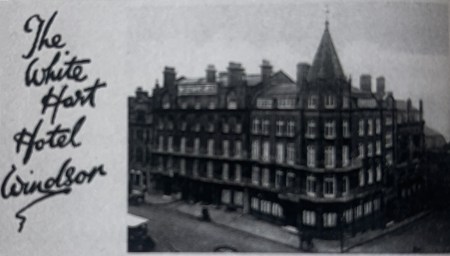
Post Shakespeare, history chronicles a fire in 1681 which destroyed one inn and left the other fire-damaged. It was rebuilt in 1689 and renamed the White Hart. The inn survived in its late seventeenth-century form, with additions to its façade in the eighteenth century, until it was demolished and complete rebuilt in 1889.

Mr R. Robson was responsible for designing the new White Hart Hotel in 1889 for Frederick Martin, the proprietor. This probably refers to Edward Robert Robson (1836- 1917), who started his career in Durham and Liverpool. In 1871 he was appointed chief architect of the School Board of London. During his years here, Robson designed several hundred schools. He was responsible for the design of Cheltenham Ladies College and the Jewish Free School at Spitalfields. Alternatively, the design of the White Hart Hotel could have been executed by his son Philip Appleby Robson ( 1871-1951), who worked with his father later in his career.
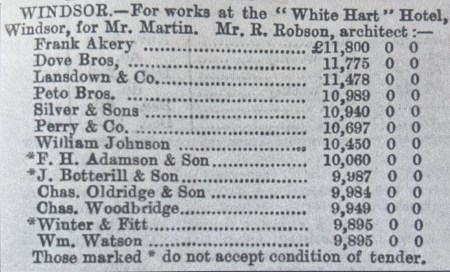
The Builder Magazine of November 1889 shows details of the tenders: the majority of companies were well-known London firms, including Dove Brothers of Islington, who had built churches and public buildings. Another is Peto Brothers, the sons of Sir Samuel Morton Peto the great mid-Victorian public works contractor. Local builders included Charles Oldridge and Son of Kingston, as well as two Maidenhead firms, Silver and Sons of Tittle Row, and Charles Woodbridge who was responsible for building most of Victorian Maidenhead. Although the list of tenders was published, it is not known which builder was selected.
By May 1890 an article in the London Daily News announced that the White Hart at Windsor was a First-Class hotel which had been entirely rebuilt and greatly enlarged. The hotel had electric light and every modern convenience. The hotel also boasted excellent cuisine and wines and had rooms which could cater for large banquets such as the Shakespearian Banqueting Room. There were also carriages for hire to take their guests to Ascot and Virginia Water. By May 1891 the Windsor and Eton Express reported that the White Hart Hotel now had a brand new stable block that had been rebuilt over the winter. It could accommodate 70 horses, both hunters and racing horses, and was lit by electric light. The hotel was also able to accommodate wedding breakfasts, balls and banquets.

The hotel also boasted a number of state-of-the-art machines to help the hotel operate more efficiently. These included a new top-of-the-range boiler for heating and providing hot water. There was also a separate engine used to drive the hotel’s laundry equipment. The other major improvement was the provision of electricity, with Patterson and Cooper carrying out most of the wiring and Windsor and Eton Electric responsible for the installation of 60 new lights. By September 1895, the hotel had its own telephone number, one of the earliest in the town, Windsor 6.
By the end of 1895, the hotel had been sold by Martin & Co. to Henry George Lake and his son John Charles Lake for £41,000. John Lake was made responsible for the day-to-day running of the hotel, he was also recorded as a Director of the Windsor Electrical Installation Company. The hotel was frequented by the aristocracy and royalty, including the German Emperor.
In August 1899, it was found that the hotel was again in need of improvement. George Lake had purchased three shops on the corner of High Street and Station Approach in 1896. They were the sites of two earlier inns, the Garter and the George. Plans were submitted in April 1898 to extend the White Hart Hotel, which included those to demolish these shops. The designs for the new extension were drawn up by the London-based firm of Treadwell and Martin, the partners of which were Leonard Martin (born 1869) and Henry John Treadwell (1861-1910). Most of their work was confined to London and this is borne out by the Grade II listing for the White Hart Hotel which describes it as being built ‘very much in the London manner’, especially in the style of the buildings of Gloucester Road and Harrington Road.


The new extension was completed by April 1899, and the hotel now boasted a frontage of 170 feet. It had been extended to a total of 21,746 square feet. It included space for a further 30 sitting rooms and bedrooms, bringing the total number of available rooms up to 100. These rooms now included state-of-the-art sanitation and ventilation. The coffee room was enlarged to provide a new restaurant with its own separate entrance. A new billiard room and smoking lounge, and new state-of-the-art steam laundry were created. A new private room known as the Victoria Banqueting Hall was also built, which could accommodate up to 200 people. The first banquet held there was to celebrate Queen Victoria’s 80th birthday and was organised by the Warrant Holders of Windsor.
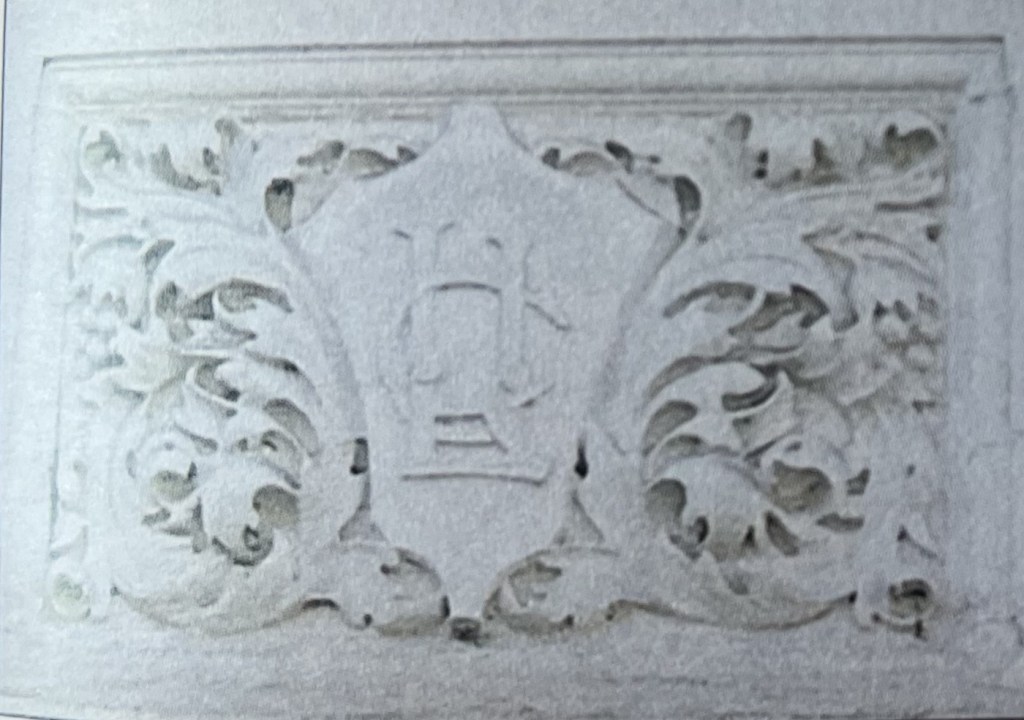
When the extension was finished, carved date and monogram stones were put up above the new restaurant door. The date shown is 1895 the year that the hotel was purchased by the Lake family and the monogram bears the initials of Henry George Lake, the owner of the hotel.
In 1900, shares in the hotel were offered, with the enterprise valued at £104,400. The hotel’s business began to increase with net profits for that year being £7,005 15s 9d, with a turnover of £19,611 12s 3d.

By 1905, the hotel had a new Managing Director, John Slocombe Hall, who had purchased 60% of the shares in the White Hart. Hall was born in Truro, Cornwall and also owned the Gaiety Restaurant, on the Strand in London’s West End. In 1909, the hotel had a new sideline of hiring out carriages. A newspaper advertisement records that, for a price, carriages could be obtained from the hotel. These included carriages for visiting, wedding carriages, funeral carriages and even private omnibuses. The carriage hire was a success.
In 1914, there were further alterations to the stables and the outbuildings at the side and rear of the hotel. Further work was carried out at the White Hart Hotel in 1921, where a ‘visitor’s showroom‘ was transformed into a new snack bar with a new bronze and granite frontage. The design for the conversion was by the Windsor architects Edgington & Spink.
The rebuilding of the White Hart Hotel laid the foundations for a popular hotel to flourish and survive.

Elias Kupfermanan
Resources and Acknowledgements
- Windsor and Eton Express
- Windsor Borough Surveyor’s Building Control Plans, Berkshire Record Office
I am indebted to the Librarians of the RIBA, to David Lewis for the early history of the White Hart, and to the Berkshire Record Office for permitting the reproduction of the hotel elevations.
 Windsor Local History Group