
Published in Windlesora 35
© WLHG 2019
In November 2018, the nation commemorated the centenary of the ending of the First World War and remembered the sacrifices of those who died in the ‘war to end all wars’. Although the fighting ceased on 11 November 1918-Armistice Day-the first of the many peace treaties was not signed until over seven months later in June 1919, which is why some war memorials bear the dates 1914-1919.
The Paris Peace Conference began on 18 January 1919, and after a lot of hard negotiating on both sides, a peace treaty with Germany was agreed (the other Central Powers agreed separate peace treaties). The Treaty of Versailles was signed on 28 June 1919, exactly five years after the assassination of Archduke Franz Ferdinand, the event that led to the start of the First World War.
News of the long-awaited signing of the peace treaty was received in Windsor the same day. The Windsor, Eton & Slough Express reported in its edition of 5 July 1919:
Considering its momentous nature the inhabitants received the intelligence in a quiet and philosophical manner probably because, for the most part, it was in the minds of the majority that the capitulation of the enemy was a foregone conclusion. There was no demonstration or outburst of public enthusiasm, but in the streets, which were crowded, and especially in and near the neighbourhood of Peascod Street, little knots of people gathered and discussed the welcome announcement.
Windsor, Eton & Slough Express ; 5 July 1919
The Government designated Saturday, 19 July 1919, as Peace Day and throughout Great Britain, events were organised to mark this historic occasion. In Windsor, a Peace Day Committee was formed to arrange a programme of events for the day. Peace Day was a bank holiday and most of the shops in Windsor closed so that their staffs could join in the celebrations.
London, of course, was the centre of the celebrations. King George V witnessed a Victory March by British, Allied and Dominion troops through London and later attended a firework display in Hyde Park. Windsor also celebrated Peace Day in style. The main streets were garlanded with flags and bunting, and Caleys in the High Street had an impressive illuminated display based on royal flags and mottoes. The White Hart Hotel was also decked with flags. During the day, bells rang out in celebration from St George’s Chapel and the Parish Church.
In the morning, there was a parade of demobilised servicemen and war workers, including hospital nurses and land workers in their working uniforms. Representatives from various women’s organisations, including Queen Mary’s Army Auxiliary Corps, the Voluntary Aid Detachments and the newly formed Women’s Royal Air Force, also took part. They were followed by youth groups that carried out war duties, including the 1st Windsor Troop of the Girl Guides and several Windsor and Eton troops of the Boy Scouts. Afterwards, all the marchers were given commemorative badges. A party of disabled ex-servicemen travelled in motor cars.
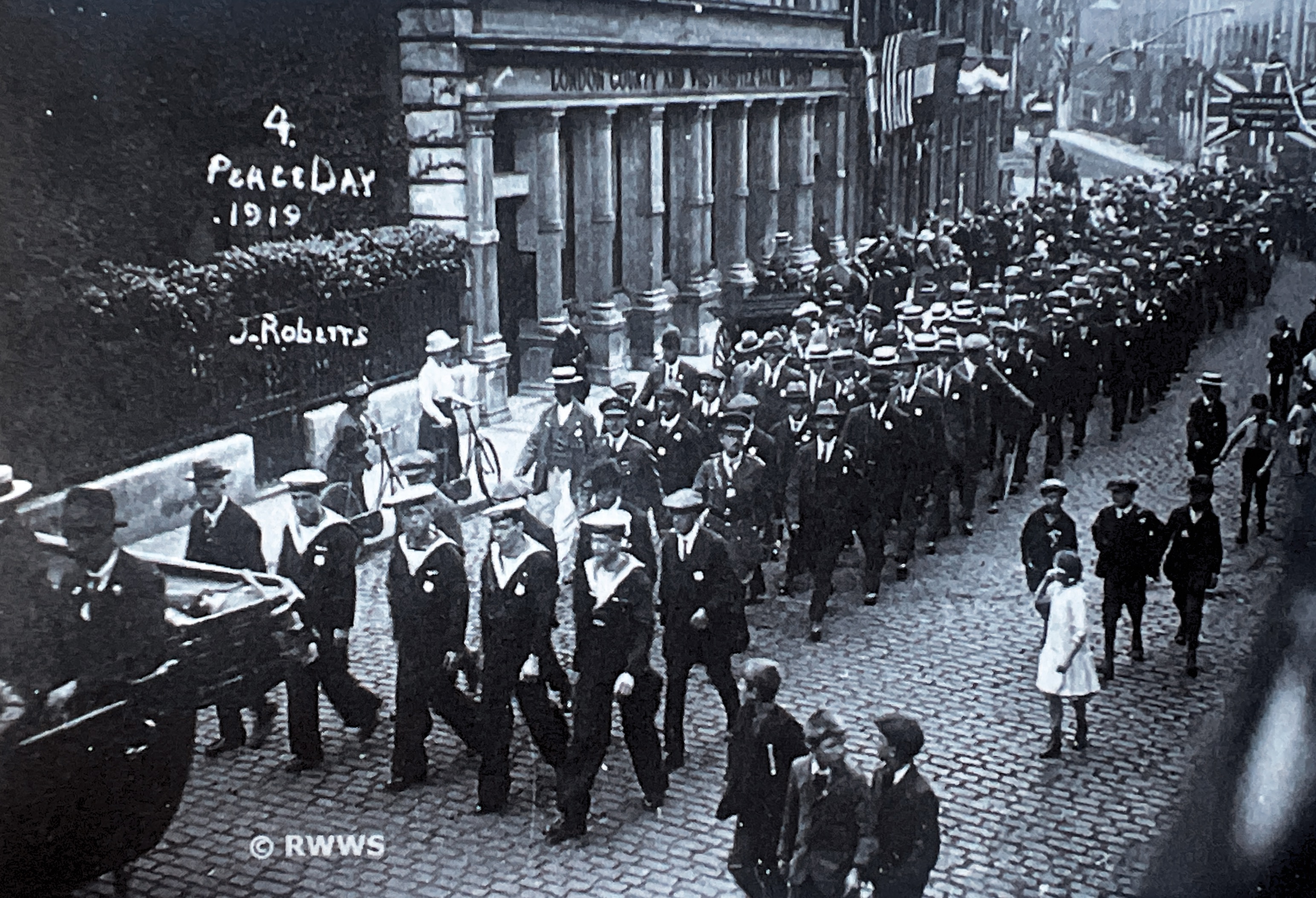
The procession was led by Major R Whitbread of the 2nd Battalion Coldstream Guards, stationed at Victoria Barracks, and followed by the band of the 2nd Life Guards. At 11.00am the procession started and the route took them from Bachelors Acre, through High Street and over Eton Bridge to the Burning Bush, where they were met by Colonel C Corkran representing the Eton College Officers’ Training Corps.
When the procession, still led by Major Whitbread on horseback, returned to Bachelors Acre it was met by the Mayor, Cllr William Carter (who had been Mayor throughout the War), who read a personal message from HM The King. Part of this message read:
I desire you to express my admiration of the courage and endurance displayed by the sailors, soldiers and airmen of your county during the past five years of war. I am grateful to all the brave men and women of the County of Berkshire for their devoted and patriotic service…
The King
The Vicar of Windsor, Rev EM Blackie, then delivered his address. There was a short period of silence in memory of those who had given their lives in the War, and the Coldstream Guards sounded Last Post, followed by Reveille, and played the National Anthem.
Military and athletic sports were held in the afternoon at the Imperial Services College grounds in Alma Road, with funds being raised through the sale of programmes. After all the races were run the Life Guards performed a musical ride, which was very well attended. This section of the day was concluded with the Mayoress presenting the prizes.
There was dancing in Alexandra Gardens in the early evening. The surrounding area by the river was still full of spectators from a regatta held earlier. At 7.30 pm the Windsor branch of the Comrades of the Great War organised a carnival procession. A large number of decorated cars carrying the ex-servicemen in fancy dress drove through the streets of Windsor and Eton, starting from their headquarters in William Street.
Former Coldstream Guards war hero Oliver Brooks, who had been awarded the Victoria Cross near Loos in France in 1915, was seated on a throne dressed in majestic robes in one of the leading cars; other ex-servicemen were dressed as knights in armour and figures from history. including Napoleon. The day finished with a torchlight procession starting at Barry Avenue, Windsor, going to Eton and back. Appropriately, it was organized by Windsor Fire Brigade and, in addition to 80 local firemen, the Coldstream Guards were among those who marched behind the Mayor’s carriage.
When the procession had returned to Windsor, the Eton College boys, some 1,000 of whom had lined the streets of Eton, formed their own torchlight parade to School Yard. Despite the huge crowds, everyone was good-natured, and there were no incidents or arrests. Such was the joy that the peace treaty had been signed at last that the day proved very successful. Even the weather was favourable, and rain did not set in until towards the end of the day.
The King gave a party at Frogmore to Royal employees and their families: the King was in London all day but Princess Alice of Athlone attended.
The celebrations, however, were not confined to Britain: newspaper reports showed that the day was observed with the same patriotic fervour throughout the Empire.
A forward-looking editorial in the Windsor, Eton & Slough Express of 26 July 1919 noted:
Now that our rejoicings are over, we at Windsor, with the rest of the Empire, must settle down again to hard work. We have celebrated a victory which will rank forever in the great events of the World’s History. Let us one and all strive to help our nation to prove herself worthy.
Windsor, Eton & Slough Express; 26 July 1919
Although very popular at the time, Peace Day is largely forgotten now and, tragically, the peace was to last only 20 years.
Derek Hunt
Sources
Windsor, Eton & Slough Express (various dates)
Navigation
| ◄ Previous | Windlesora 35 | Next ► |
 Windsor Local History Group