
Heroism on the Windsor Express
Published in Windlesora 26 (2010)
© WLHG
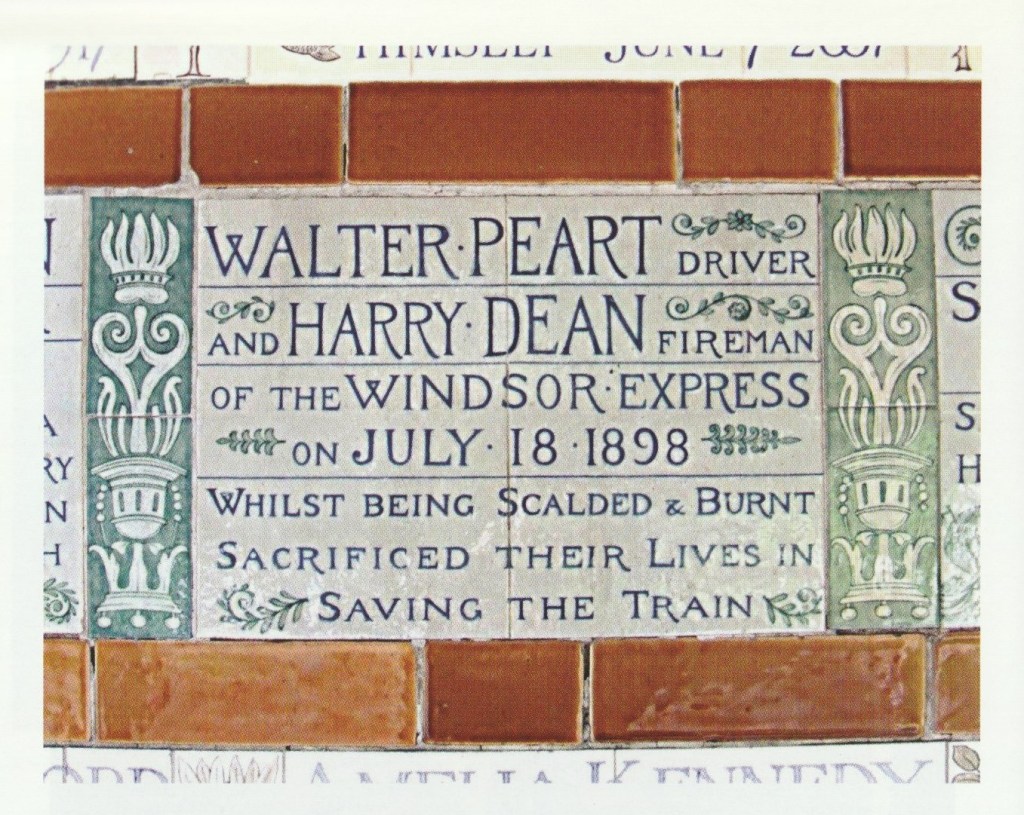
On Monday 18 July 1898, at a time when the Great Western Railway ran trains directly from Windsor to Paddington, the 4.15 pulled out normally from Windsor Central Station. The driver was 43-year-old Walter Peart, the fireman 25-year-old Henry Dean.
The train was approaching Acton when suddenly the connecting-rod of the engine shattered. A piece was driven through the casing of the boiler, There was a violent explosion, the train was enveloped in steam and ash, and in the cab piping, fire and cinders were driven into the two men’s faces. They staggered back, but knew that the train was still running and that if it could not be stopped there would be a catastrophic crash. The driver forced himself forward into the inferno to apply the vacuum brake and the train came to a standstill.
On his way to hospital, Peart asked after his ‘poor mate’, who was in a bad way. He himself was not much better, but he made light of his condition saying proudly, ‘’Never mind – I saved the train.” Both men died the next day in St Mary’s Hospital Paddington.
At the inquest the jury criticised the GWR for their use that day of an engine which only normally pulled goods trains; it was not, in their opinion, ‘fit and proper … for drawing express trains’. But they praised the men’s courage in averting ‘a serious catastrophe’. The Daily Telegraph started a fund to help their families – both were married and Peart had five children, and the Windsor Express records that there were many local donations, including a number from the officers of the 2nd Scots Guards, who were stationed at Victoria Barracks.

As the Times noted recently, Peart and Dean’s bravery is still remembered on a memorial in the tiny Postman’s Park, tucked away behind St Paul’s Cathedral. It was the brainchild of the artist George Frederick Watts, who proposed it as a way of recording acts of self-sacrifice, not by soldiers on the battlefield, but by ordinary men, women and children going about their daily lives. He collected cuttings from newspapers and the first names appeared in 1900, including Peart’s and Dean’s. They were inscribed on tile panels designed by William de Morgan and made by Royal Doulton. The citation reads that ‘whilst being scalded & burnt [they] sacrificed their lives in saving the train’.
Hester Davenport
‘The youngest person commemorated is an eight-year-old boy who, when his sister’s clothes caught fire, pulled them off, saving her but at the cost of his own life.’
References
Windsor Express, 23 and 30 July, 1898.
The Times, 12 June 2009.
 Windsor Local History Group