
Published in Windlesora 34
©2018, WLHG
WJ Daniel & Co opened their Windsor store on Saturday 12th October 1918, a month before the end of the Great War. Walter James Daniel was born at Clapham, London, in September 1872. He trained as a draper and established the family-run business in 1901 and by 1918 had a general drapery shop at Ealing. The opportunity to open a shop in Windsor came after April 1918, when the drapery business of Soundy and Farmer closed following the death of Charles Farmer.
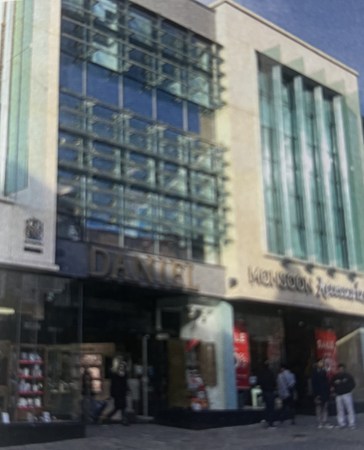
Charles Farmer was born in October 1870 at Biggleswade, and at the time of the 1891 Census, he was 20, employed as an assistant draper to Sir John Soundy, and living over the shop at 124 Peascod Street. Farmer went into partnership with Soundy in about 1895 with the Peascod Street business. As well as being a draper, Soundy was also a Justice of the Peace, a local councillor, and Mayor of Windsor in 1898. When Sir John retired, Farmer became the sole proprietor but retained the name of Soundy and Farmer.
A pre-war trade directory records that in addition to drapery, the shop also sold dresses, millinery, and ladies’ underclothing, and had mantle showrooms. More surprising, perhaps, was that Alfred Bond, ‘carpenter, undertaker, etc, by appointment to the Chapel Royal St George’s’ also shared the same premises. The 1911 Census records his occupation was shown as ‘Master Draper’. He died, aged only 47, at his home on 25th April 1918, one of the hidden casualties of the Great War. For a number of years, he had been subjected to considerable stress trying to run the business without adequate staff support. The Windsor, Eton & Slough Express (Windsor Express) noted in his obituary on 27th April 1918:
…Mr Farmer had been considerably worried over business matters of late. He had lost ten members of his staff, three of whom had been killed in the war. The consequence was that he had to work longer hours than usual, which imposed a great strain upon him, and told upon his constitution…He had been in rather weak health for some time past, but felt that he must ‘carry on.’ On Friday he was in business, but on going home in the evening he felt unwell, and during the night he became so ill that Dr Hathaway was sent for…he found that {Farmer} was suffering from pleurisy, which afterwards developed into pneumonia… he passed away in the early hours of Tuesday morning.
His widow Frances was in no position to take over the running of the drapery business, so with four children to support, she sold it to W.J. Daniel, including the property at 124 – 125 Peascod Street, and prepared to reopen his new store whilst still running the drapers’ shop at Ealing. An important consideration before reopening would have been to ensure the new owners had sufficient staff to avoid facing the problems encountered by Charles Farmer.
Opening a new business in wartime Windsor was not quite as risky a venture as might first appear. Daniel already had experience of running the Ealing store, and drapery goods were not subject to rationing. The war had been going well for the Allies since the summer of 1918, and by the end of September, the heavily fortified Hindenburg Line had been breached. A small advertisement on page two in the 5th October edition of the Windsor Express announced the forthcoming reopening, although it gave no date for this historic event. The following week, another advertisement in the Windsor Express gave more details (figure 1).
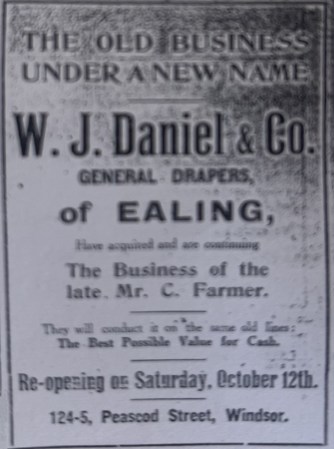
Continuity was important to shoppers, and Daniel & Co. were keen to stress that it was business as usual, though under a new name, and that the reopened store would be selling many of the goods previously sold by the late Charles Farmer. His obituary noted that: ‘He was much esteemed and respected by all with whom he came into contact, and news of his death came as a shock to the whole town. Britain was still at war at the time, and throughout the conflict, consumers were urged to support their local shops.
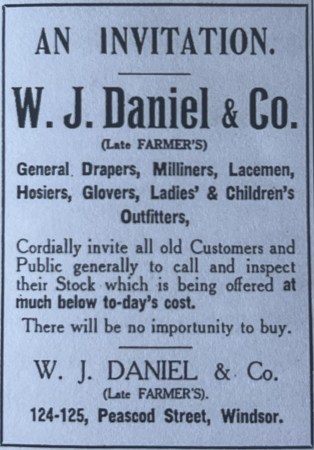
The re-opening was a success, although there was no mention of it in the local press the following week; the big story at the time was the German peace proposal and the hope that the war would be over soon. On 19th October, in a Windsor Express advertisement, an invitation was issued (figure 2).
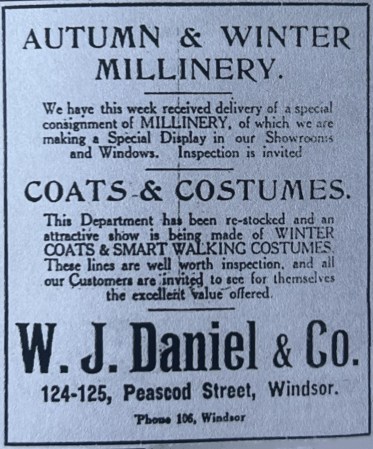
Thereafter, Daniel & Co advertised every week in the local newspaper alongside competitors such as Caleys and Creak’s Stores (both now closed). Daniel’s advertisements were different every week and reflected what new stock was available and, in the early days, often made reference to ‘the Late Mr Farmer’s Stock‘. On 26th October, the emphasis was on autumn and winter outfits (figure 3).
The next two weeks saw advertisements promoting the store’s first sale (figure 4).

When the war ended, stores were gradually able to restock imported and other items that had been unavailable. Caleys announced the ‘Revival of Dancing‘, linking this to receipt of ‘some dainty dance frocks’. The Editorial in the Windsor Express on 9th November 1918, two days before the Armistice, stated:
The week we are passing through is one of the most momentous in history… History is being made every day, and the maps of Europe will all have to be reprinted as the result of what is talong place now… When peace is declared there will be an outburst of pent-up feelings…
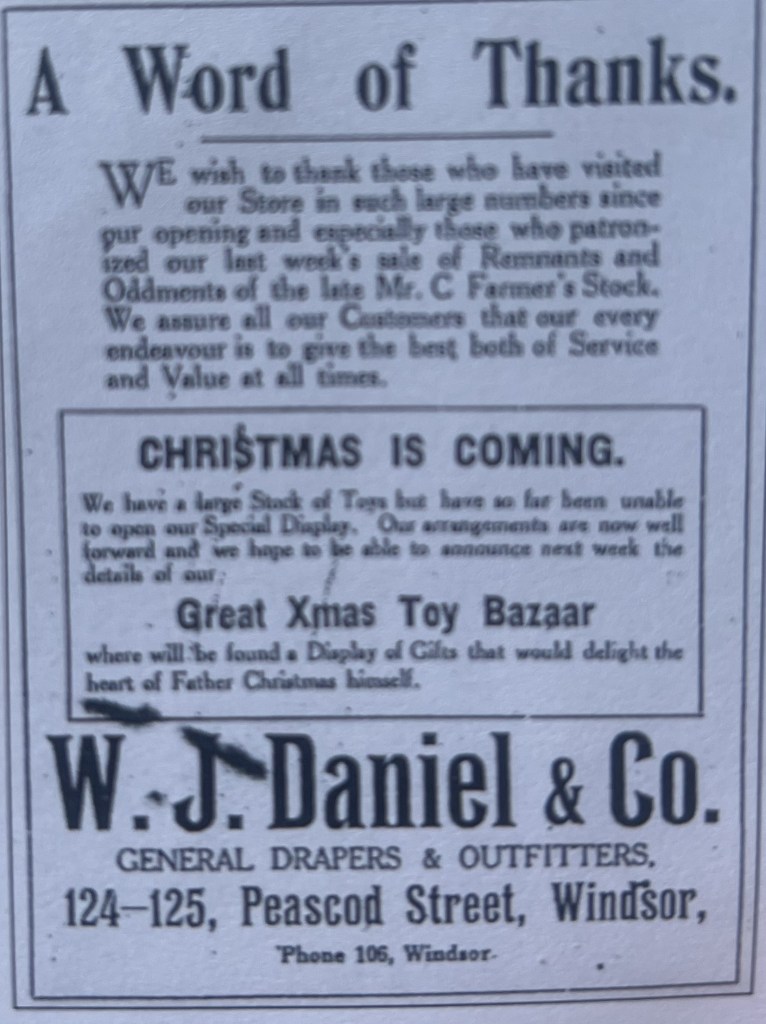
Many stores paid for advertisements to thank their customers The Windsor Express of 23rd November carried the following advertisement from Daniel & Co (figure 5). The advertisement also advised customers that Christmas is coming, and they have a toy bazaar. The next Windsor Express advertisement of 30th November 1918, was mainly about handkerchiefs, although it also covered Christmas gifts (figure 6). With the war finally over and the important Christmas market secured, Daniel & Co was now well-established in Windsor and has continued to provide a wide variety of goods and excellent service over the last 100 years.

 Windsor Local History Group