
why it was built
Published in Windlesora 24 (2008)
© WLHG
At the beginning of the 19th century Windsor and Clewer had two churches, the Parish Church of St John the Baptist with seating for 1,654 worshippers, of which 868 were paid pews, and the Clewer Parish Church of St Andrew’s with seating for 500. There were usually three services on a Sunday; this would provide seating for 6,462 churchgoers.
Theoretically there should have been a seat for almost every local person in 1811, when the population of Windsor and Clewer was 6,436, but one must not forget that many ardent Christians attended more than one service on a Sunday, and paid pews remained empty when the occupants did not attend. Furthermore, there were between 1,000 and 1,500 soldiers of the Staffordshire Militia stationed in the Infantry Barracks, and between 400 and 500 troopers of the Royal Horse Guards in the Cavalry Barracks.
It must have been well-known that many, especially the poorer inhabitants of Windsor could not, or did not choose to attend church and if they did, it would have been standing room only, but clearly this information did not reach the higher echelons of the established church. In fact, an ecclesiastical census of March 1851 shocked the establishment out of their belief that everybody attended church on Sunday. Church attendance around the country was only 57%, in Windsor it was even lower at 51%.(1) It was this that prompted the frantic church building of the second half of the 19th century, but the ecclesiastical census was never repeated.
Many, especially the working and lower classes lost touch with the established church and drifted away towards Methodist, Baptist and Congregational churches. By 1838 Windsor had acquired the following dissenting churches:
Independent Chapel in High Street with 350 seats.
Congregational Chapel in William Street with 400 seats.
Wesleyan Methodist Chapel in Peascod Street with 200 seats.
Primitive Methodist Chapel in Spital with 150 seats.
Baptist Chapel in Victoria Street with 450 seats.
Catholic Chapel in Hermitage Lane with 180 seats.
But even these additional pews did not provide sufficient seating for everyone in Windsor, as the population had grown to 10,660 by 1841.
In April 1840 a subscription was started to raise funds to build a much needed new church in Windsor which was to serve not only the poorer parishioners but also the soldiers stationed in the town. In April 1842 the
Windsor and Eton Express reported:
Our readers in this immediate vicinity are aware that it has long been a matter of complaint that there was not a sufficient accommodation in the parish church for those who desired to go there and in consequence a public subscription was set on foot for the erection of a new church in the field adjoining Clarence Crescent, not only for the parishioners, but the two regiments in Windsor.(2)
The paper was in fact reporting on the laying of the foundation-stone for the new Holy Trinity Garrison Church. Everybody of rank and name in Windsor had paid into the subscription fund; the Queen had given £210, Prince Albert £105, there was even a collection from the soldiers of the two barracks, and almost £5,000 had been raised which would cover 2/3 of the building cost.(3) Mr Bedborough had donated the land, but, with a proviso that his son would get the building contract.
In attendance during the opening ceremony were the schools of the established church, the National School with 180 girls and 190 boys, the Royal Free School, the Lady Harcourt School with 54 boys and 48 girls, and the two garrison schools of the Royal Horse Guards with 54 boys and 48 girls and the 72nd Highlander school with 49 boys and girls. The children of the military schools regularly attended church parades with their regiments once the church was consecrated on 25th July 1844.
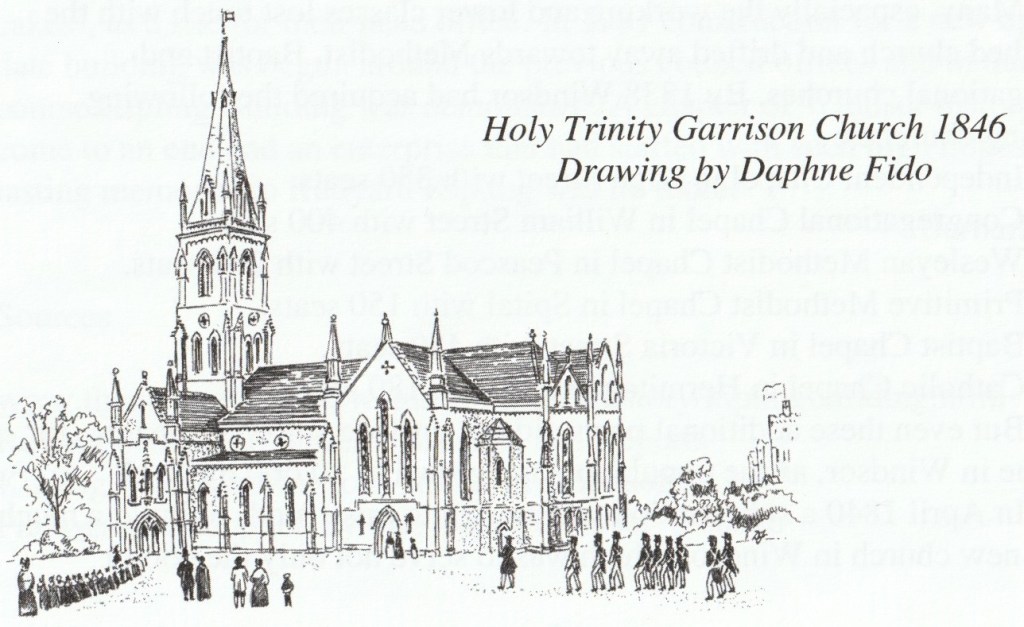
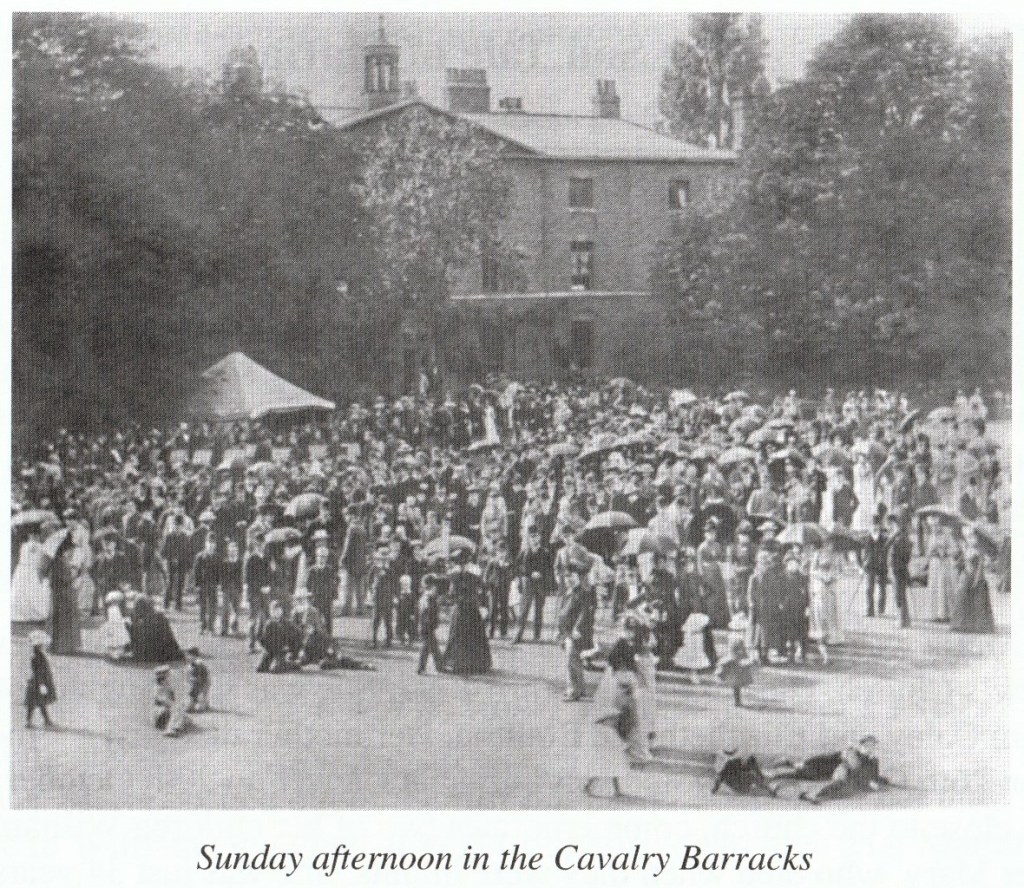
The Holy Trinity Garrison Church soon became the fashionable church in Windsor, rivalling the parish church in attendance numbers. The reason might be the entertainment provided by the military, the military parades and bands and not least the impromptu band concerts in the barracks after church services, to which all townspeople were invited. The garrison church also provided a religious focus for soldiers in Windsor, and a place where they could display allegiance to their regiments. In 1849 the soldiers of the 2nd Life Guards gave the Rev. Stephen Hawtrey a ‘handsome piece of plate’ and the officers presented a painted glass window ‘in gratitude for all the work he has done for the regiment not only in the church, but at their homes, at the barracks and their hospital.(4)
This was only one of many gifts to the church, which today is festooned with mementoes of pride and loyalty of the regiments regularly stationed in Windsor.
Brigitte Mitchell
References
- Ecclesiastical Census Returns, 30th March 1851, HO 129 131
- Windsor and Eton Express 9th April 1842
- WEE 7th November 1840 and 2nd January 1841
- WEE 14th July 1849
 Windsor Local History Group