
Published in Windlesora 23 (2007)
© WLHG
A little known area of collecting which is becoming popular again is Goss and other crested china. These are small china objects decorated with the coat of arms of a city or town, such as Windsor, in which they were sold. They were produced in large numbers from the 1880s until the 1920s. The last piece of crested, or heraldic, china produced by WH Goss, the originator of this miniature art form, was made over 65 years ago in 1940.
During Victorian and Edwardian times, when mass tourism was being established, visitors to seaside resorts or other holiday destinations would want to bring back an inexpensive souvenir of their visit. William Henry Goss had set up a porcelain factory in Stoke-on-Trent and by the late 1880s was producing mementoes for holiday makers. His idea was that a tourist would go to Windsor, for example, and bring back a small vase or perhaps a miniature Round Tower, each bearing the Windsor coat of arms. These hand painted items would only be available in Windsor and so they were ideal souvenirs and proof of a visit to the town. As well as historic buildings, WH Goss produced miniature animals, chairs, bottles, shoes and a host of other shapes — all bearing the coat of arms of the place they were sold.
Because of the rapid spread of the railways across the country more and more holiday destinations became linked by train, and collecting Goss china soon became a popular pastime for holiday makers and collectors of heraldic china.
Each town, resort or city had one official outlet where Goss items with the local coat of arms could be purchased. China with the Windsor coat of arms could not be bought from an official outlet in, for example, Bournemouth and vice versa. All Goss china had the local agent’s name hand painted on the bottom of the piece.
The agent for Windsor was Dyson & Sons of 9 Thames Street. It was established in 1752 and described in Marshall’s Directory of 1902 as ‘Dyson, Messrs, practical Watch Makers, Jewellers, Silver & Goldsmiths. Agent for Goss’s China’. A full page advertisement in the same directory described the firm as Dyson & Sons. In 1898 they advertised the ‘arms of the Royal Borough and Eton College painted on Ivory Porcelain from one shilling’. Four years later, no doubt responding to local competition from other manufacturers, their price had dropped to nine pence.
Rather confusingly, there were two businesses trading under the same name. Next door to the jeweller’s shop, at 10 Thames Street, was Dyson & Sons (from Broadwood’s, Kirkman’s and Brinsmead’s) by special appointment to His Majesty the King and the Princess Christian, Music and Pianoforte Show Rooms. Both shops continued using the same name until the music shop closed in the early 1960s. The jeweller’s shop advertised itself as: The firm with the clock in the pavement. When the business closed in 1986, the glass clock face was removed from outside the premises and replaced with a circular metal plate. This has since been covered with tarmac, but the whereabouts of the clock is unknown. The shop has had many owners in the past 20 years and is now the Little Italy Ristorante.
In addition to the items specific to a particular town there was a wide range of other objects, from animals to buildings, all with the local crest. WH Goss alone produced over 2,500 different pieces. Other china manufacturers, also based around Stoke-on-Trent, quickly followed the collecting trend and established their own souvenir crested china. These were usually cheaper items of inferior quality—none could match the high standards of the Goss factory. Rivals such as Arcadian, Carlton, Pearl Arms China and Willow Art China had their own distributors across the country.
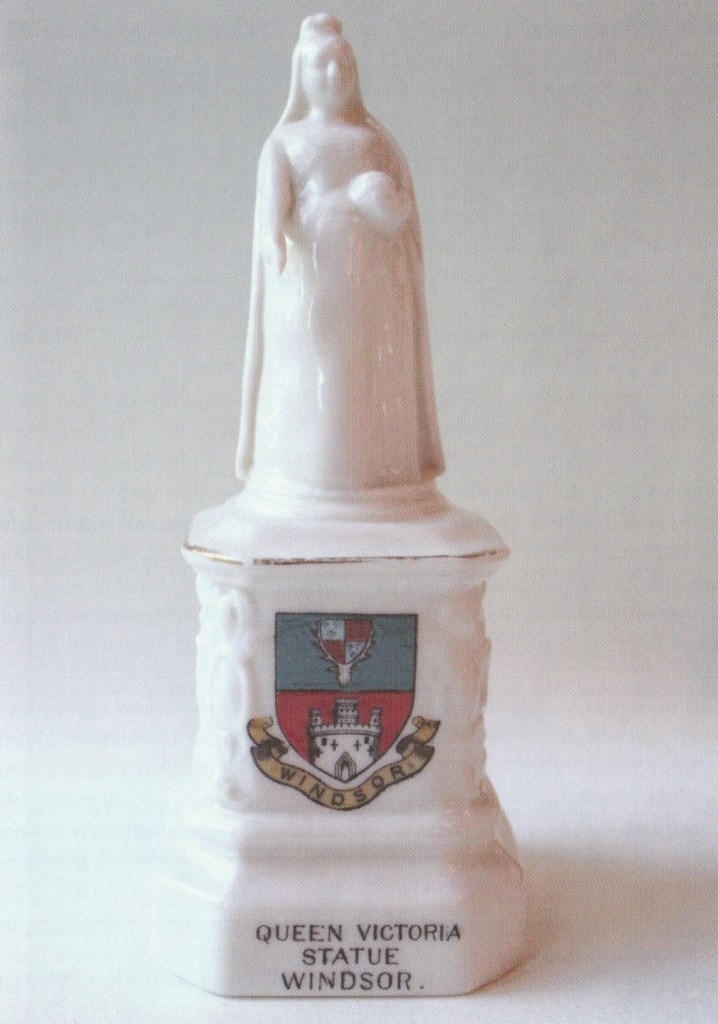
Goss china minature replica of the Queen Victoria statue.
R Brodie, printer and stationer, of 49 High Street, Windsor was the local agent for Arcadian. The shop, near the Guildhall, is now Dillons Crafts & Woollens, a souvenir and gift shop. Brooks Stores, hardware dealers in Windsor, sold several other makes.
Although production continued until 1940, the First World War had effectively ended the trade in crested china. Tourism ceased, the factory employees went off to war, and there was not the demand or the money available after the war was over. A military range, including tanks and battleships, was introduced in 1914 and was popular at the time, but the golden age of collecting was over.
The hobby was very popular in Victorian and Edwardian times and peaked just before WW1. When production of crested china ceased, collecting became something of a Cinderella hobby and has only become popular again within the last 30 years, with a renewed interest in Victoriana.
One of the many items connected with Windsor, other than the Castle, was the famous Windsor Urn, based on an urn found at Old Windsor. from an original in museum. Although hundreds of other coats of arms are known to have been applied to the urn, only the Windsor arms are considered authentic and this is reflected in the prices of these items. The
been applied to the urn, only the Windsor arms are considered authentic and this is reflected in the prices of these items. The Windsor arms were also used on items with no connection with Windsor, such as Reading Minster and Micklegate Bar, York, as well as numerous other things from clogs to Noah’s Arks.
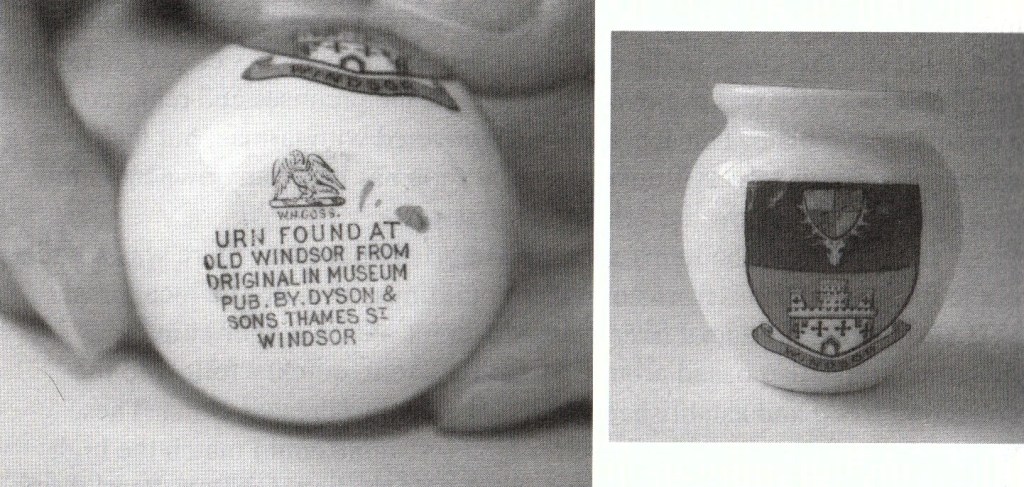
A Genuine Windsor Urn
There were many versions of Windsor Castle and the Round Tower, in different sizes, and a miniature replica of the famous statue of Queen Victoria facing Peascod Street, with her back to the Castle. Prices of these items continue to rise, reflecting the increased interest in collecting Goss and crested china, although use of the internet has had a depressing effect on prices in recent years. A Pearl Arms Round Tower (80mm), for example, is currently (2006) valued at £20, a Willow Art Windsor Castle (72mm high, 120mm long) at £25 and a Willow Art statue of Queen Victoria (155mm) at £50. Smaller pieces such as a Goss Windsor Urn (45mm) can be purchased for as little as £8.
Derek Hunt
For further information on collecting Goss and other crested china please contact The Goss and Crested China Club, 62 Murray Road, Horndean, Waterlooville, Hampshire, PO8 9JL. Their assistance with this article is much appreciated. Readers sending a Ist class stamp to Lynda Pine at this address will receive a free catalogue valued at £2.
 Windsor Local History Group