
Published in Windlesora 11 (1992)
© WLHG
I was born at 21 Albert Street, Windsor. There is no remembrance of living at this address, although I note from a directory of that period that it was the home of Mr and Mrs. Noakes and I went to school with their son ‘Snooky’ Noakes.
The next address was 81 Arthur Road and I have vivid memories of our stay there. On the opposite side of the road was a lock-up provisions shop which belonged to Mr. Borlase whom we children called Mr. “Bootlace“. Next to his shop was Thomas, Scrap Merchants and we were able to earn some pocket money by searching the area for old clothes and bottles. Adjacent to these premises was the Borough Bus Service. The vehicles were painted with the familiar Royal Borough colours, red and green, as also worn by the football team. Mr. Bunce carried on his cycle repair business in the adjoining premises; I never saw him out of his plus-fours.
My job on Saturdays was to push my wheelbarrow to the gasworks. The vehicle was a Tate and Lyle wooden sugar box on two pram wheels. The object of the journey was to collect coke, the main domestic fuel in those days. I would at times also collect logs from McCleans who had a wood yard underneath the Goswells arches.
Then there were the visits to granny and grandpa in Edward Square. Invariably I had to run an errand to Darvilles in Peascod Street for three pennyworth of ‘bits of rashers’ for granny to make a bacon pudding. Grandpa smoked a clay pipe and would occasionally use the spittoon placed on the floor in front of him. A ritual regularly took place on Friday mornings when the Windsor and Eton Express arrived. Granny could not read nor write, so the request was made to “Read me the deaths”, and grandpa would read out the obituaries.
We lived adjacent to Alma Road. Just around the corner at no. 10 lived the Camm family and I often watched the sons fly their model aircraft. On one occasion an aircraft landed on top of the arches and there was no hesitation in rescuing it from off the railway lines and one of the boys clambered up the viaduct.
My schooldays commenced at Clewer St Stephens in Vansittart Road. The infants’ schoolroom was a corrugated iron hut situated in the playground and the teacher was Miss Bennett. I can remember little of these infant days but just two things come to mind: we had a beaker of Horlicks each day, and afternoons were spent sleeping on canvas beds.
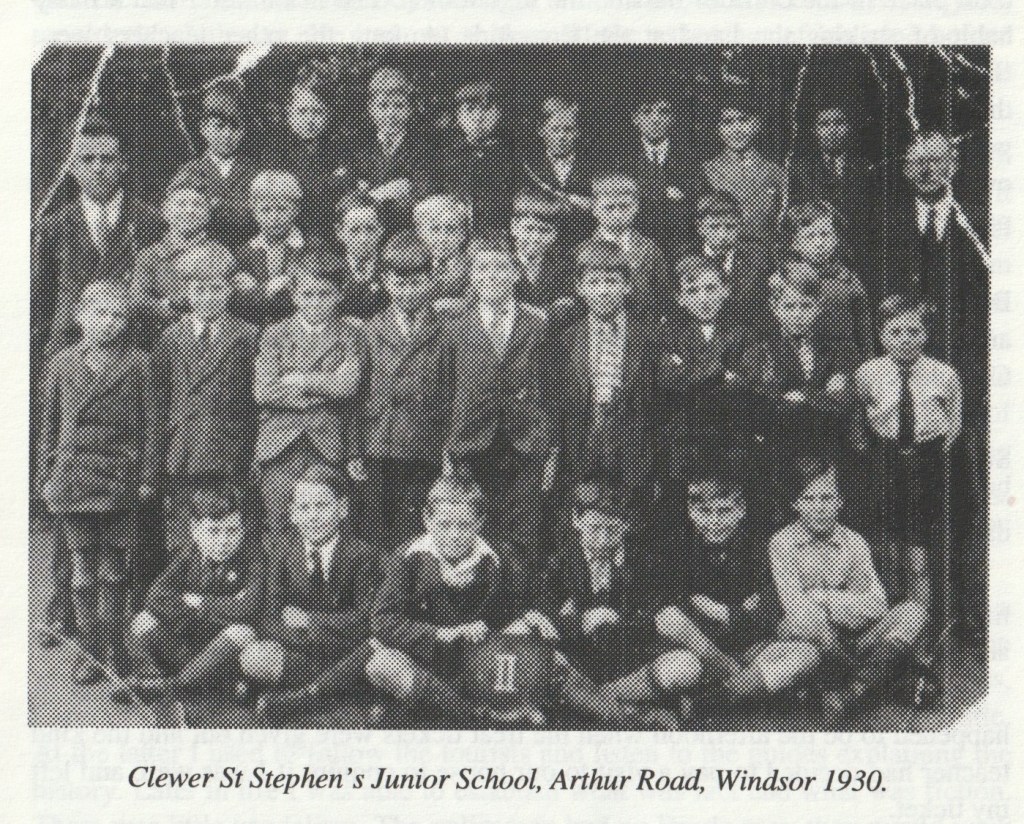
Where are they now?
Top Row Left to Right: Anstiss, Gray, Odell, Agent, Fowler, Buffery, Williams, Dyer
2nd Row. Jarrett, Dyke, Pullen, Skinner, Pike, Johnson, Bowley, Allen
3rd Row: Boyce, Thompson, Cole, Noakes, Fuzzens, Cairney, Wise, Gilbert, Stevens
Front: Harman, Beasley, Keating, Whitty, Whiter, Reading
The teacher on the left is Mr. Byard and the Headmaster on the right is Mr. Beaumont.
Next move was to the Junior School in Arthur Road. The headmaster was Mr. Beaumont — ‘Boney’ who was also choirmaster and organist at nearby St Stephens Church. ‘Boney’ kept a very short cane for punishments and these took place in the corridor outside the classrooms. The headmaster had a nasty habit of striking the hand at the fingertips. Among the other teachers were ‘Baggy’ Marsh and ‘Jerry’ Forman, who was a local sportsman. We had a lad in the class we called ‘Mucker’ because he continually covered his written work with blots, and ‘Jerry’ would get so exasperated that he would kick the books over a curtain rail that was positioned across the classroom, thus showing his prowess at converting a try.
Truancy was in the control of Mr. Henry Chipchase. I believe he resided in Beaumont road and though he had only one arm, was very adept at mounting and dismounting his bicycle. Nothing seemed to escape the eagle eye of Henry Chipchase, he made many a capture of truants on the streets.
I had one aversion at school. This was periodically attending the church, as St Stephens was a dark and gloomy place. Whilst we were sitting waiting for the service to commence there was the rear view of a nun tolling the bell. The worst days were when incense was used. I attended the Methodist Sunday School in Alma Road and learned early in life the text ‘Be sure your sins will find you out’. One afternoon I decided to absent myself and on returning home my parents asked where I had been. “Sunday School.” I replied. But they had proof that I had not attended. It happened to be the afternoon when the treat tickets were given out and the kind teacher had decided to pay a visit to our house to enquire if I was well, and left my ticket.
The treat was the only holiday that some of us children had during the year. It consisted of a trip to Burnham Beeches on a cart. The local traders used to make their vehicles and horses available for the day. The coal-carts would have been well scrubbed out. Along the way we would sing “We’re going to Burnham Beeches! We’re going to Burnham Beeches and so say all of us!” and ate the sandwiches that were meant for lunch. We played in the amusement park and ran round the trees until it was time for tea at Wingroves.
My next step up in the religious world was to become a choirboy at All Saints, Frances Road. George Godliman was top boy and I was next. We sang the duet ‘For God so loved the world’ from the Crucifixion by John Stainer — one of my favourite pieces. Our choir-mistress was Mrs. Surplice who was always full of praise for the way I sang the psalms and promised me a prize. I never received it as she passed away shortly afterwards. I really loved the lady and had special permission from school to attend the funeral. One incident that we choirboys thought was hilarious concerned Mr Sayers, an elderly choirman. He had not shaken all the ashes out of his pipe before placing it in his jacket pocket and as a result there was quite a blaze in the vestry during the service.
Having reached the age for a senior school, I was transferred to the Modern School (now Trevelyan) in Clarence Road. I found this a miserable place as it did not exude the warmth of Clewer St Stephens. I was a poor scholar and just could not bear the atmosphere of the place. I have visited it in adult life and am always glad to make an exit. There were just two teachers that I had affection for, Miss Gover and ‘Josher’ Wheatley, the woodwork master. If one made a mistake it was certain that ‘Josher’ would call you a ‘little Mary’. Such an incident occurred during the hubbub of a class. Suddenly there was a shout of “Stop!” then ‘Josher’ asked one boy to lift up the piece of wood that was being sawed. Underneath was a steel rule. Above the noise of the class ‘Josher’ had heard the sound of steel against steel and out came the phrase “Come here you little Mary!”
It was mother that had the difficulty of caring for the family at home —I had a brother and sister. Father was fully occupied with the Labour Party, Trade Union work and being a Councillor and then Alderman. We saw him mostly at weekends. I spent my spare time in Windsor Great Park, the riverside and Windsor Castle. At the latter I used to follow the tourists and listen to the guides explaining the history. Later in life I was able to establish what was fact and what was fiction. There was little vandalism. The policemen had no Panda cars, they would walk the beat. One put on the best behaviour when ‘Lofty’ was seen approaching. I believe I have enjoyed adult life far greater than schooldays, and have learned a lot more.
Fred Fuzzens
 Windsor Local History Group