
Published in Windlesora 21 (2005)
© WLHG
There has been rowing on the river Thames at Windsor for many centuries but the oldest recorded boat club is dated 2nd January 1826 when ten young men residing in or about Eton organised themselves into a club for ‘aquatic excursions in the summer season’ and agreed rules and regulations. These stipulated inter alia that each member should pay sixpence weekly to the treasurer or stewards and that Tuesdays and Fridays be appointed for training and members absent at 8 o’clock to be fined 2d. Expenses for the first season amounted to £17.3s.3d and included £5 for hire of boat; £1. 5s. for straw hats; £3.3s.3d for striped shirts and trousers; £1.5s for checked shirts; 10s. for waterman and £5. for expenses at Clifton, Maidenhead, Monkey Island, Surly Hall etc; and £1 for supper at the finish. Fines totalled 10s.
By 1839 the founding of Henley Regatta introduced a more serious note into the rowing world and a local race in that year between two skiffs resulted in the decision to form an amateur boat club to admit ‘gentlemen of Eton and Windsor and the vicinity’. This club was founded on 30th May 1840 and local people subscribed to its funds. In 1851, the year of the Great Exhibition, the club amalgamated with the Windsor Albert Club and was renamed Eton Excelsior Rowing Club. The club celebrated its centenary in the festival year 1951 with a dinner at the White Hart Hotel on 22nd September. To quote from an historical note prepared for this event ‘over thecentury the name of the club and its members have been engraved on challenge trophies at Reading, Henley, Marlow Maidenhead, Staines, Walton, Molesey, Kingston and the Tideway’. Club photographs dating back to 1869 were displayed together with ‘a great array of silver cups including six won this season, and, four Windsor and Eton Regatta cups not seen since the fixture was abandoned in August 1914’.
Whilst EERC records prior to 1870 were lost in a fire, lists of Presidents, Vice-Presidents and Club Officials for the period 1870-1951 were prepared to celebrate the 1951 centenary. As a reflection of the importance of the club in local life it is interesting to note that in the period 1870-1918 three MPs, R Richardson-Gardner, Francis Tress Barry and JF Mason were successively Presidents of the club. Many others who were active in the community became Vice-Presidents. The lists of officials reveal a remarkable continuity within families, many of whom were associated with business interests in Windsor and Eton. Frank V Radnor, Hon. Secretary in 1951 was the fourth generation of his family to be a club member. His great-grandfather G Radnor was one of the 1826 signatories. Four members if the Dyson family are mentioned in the club records. CF Dyson was the Hon Secretary 1878-90 and Hon Treasurer 1891-2. AH Dyson, born 1861 joined the club in 1882 and in 1889 rowed in the four which won the Ruthven Cup, presented to the club by Lord Gowrie’s father in1872. He was Chairman of the building committee which sought to raise funds to build a new clubhouse on Dead Water Eyot, and President 1936-48. His son CD Dyson was Captain 1930-2, Hon Secretary 1933-48 and President 1949. Mrs CD Dyson presented the Dyson Challenge Cup for ladies fours in 1949. Geoffrey Dyson, their son, stroked the winning four for the Kings Cup which marked the end of the 1946 season and in the words of the Windsor and Eton Express was ‘the club’s most successful oarsman in the recent Regatta’. He won the Herbert Points Cup the following year and became Hon Secretary 1949-50. Two families with business interests in Eton who were associated with the club were Bayley of Ganes and WV Brown (FC Bayley and GW Bayley) and Goddard. FE Goddard (Captain 1913-17) was a builder in Eton and Captain of Eton Fire Brigade. His grandson Robin Jackson, who joined the club in 1948, recently presented the Goddard-Jackson trophy for scratch fours to commemorate the family connection.
No reference to personalities associated with EERC in the twentieth century would be complete without the name of VH Hobbs. Vic, who had a dental practice in Windsor, lived and breathed rowing. His interest was aroused when, as an Eton College chorister, he served as cox. He was Captain of the club 1933-45 and again in 1951. In 1936, with the Captain of Mortlake RC, he presented the Captain’s Cup, which was competed for annually on the Tideway by junior fours, junior senior eights and senior fours. The outbreak of WW2 resulted in the bulk of the members being drawn into the forces and the 1945 annual report listed 38 serving members. A Roll of Honour in the new clubhouse lists the nine members who lost their lives in WW1 and eight members in WW2. There were no regattas in WW2 but in 1943 a Rag Regatta was held as part of Windsor’s Stay at Home Week and ‘ladies came into their own as so many members were away’. Pat Holliday, Vic’s daughter, recalls that although her father was opposed to women rowing on the grounds that it made them ‘big and beefy’, in the absence of male members he recruited her and a number of her friends to form a four. They did not use EERC facilities but rowed from Eton College rafts. In 1944, the club AGM report said ‘Vic Hobbs, our Captain, is still rowing and manages to get up an eight or four and strokes them up to Monkey Island on Saturday afternoons.’ On 7th March 1948 Vic, at the age of 55, in preparation for the annual Head of the River race from Putney to Mortlake, stroked one of two EERC eights from Windsor to Chiswick in a day-long row. He was the only member of either crew to have achieved the journey before – in 1935. In 1955, Vic was presented with the Desborough Award for services to rowing. He retired to Devon and there, up to the age of 70 he coached crews from the Royal Naval Engineering College.
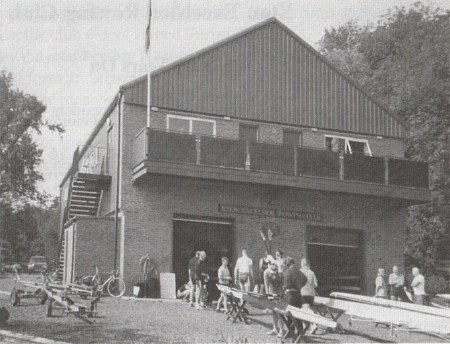
In October 1996 EERC vacated the premises in King Stable Street, Eton, which had been its base for many years. Rowing from 1826 was based on local commercial boathouses from which boats were hired and the committee usually met in a pub. Early in 1880s, the club was able to rent a small wharf in King Stable Street from Eton College, and first a boathouse and then a clubhouse were built. Space was limited and the facilities by modern standards were primitive. Only a small number of boats could be stored and this effectively prevented any progressive growth of the club. Moreover, its site below Windsor Bridge presented particular difficulties. As the first appeal in 1929 to raise funds for a new boathouse stated, ‘the approach leaves everything to be desired’. It was proposed to lease the island known as Dead Water Eyot above the bridge and opposite the Brocas from the Borough and to erect premises at an estimated cost of £1,500, which would provide accommodation for three eights and about a dozen best boats, skiffs, punts, etc. A second appeal was launched in February 1930 but it seems to have failed to raise the necessary funds. Meanwhile rowing continued between April and September when the club closed and the paid boatman was laid off until next April. The winter brought particular hazards. The club raft was towed each year to the opposite bank where it was better protected from the winter streams. However it was reported in December 1950 that only prompt action by Sellers, the boatman, had saved it from being swept away. Such rowing as there was, usually scratch eights, was only possible on Sunday mornings using boats stored at the College Masters Boathouse at Black Potts. Many members of the EERC were also members of the Windsor Rugby Football Club and at the 92nd Annual Regatta held on 13th August 1949 an eight-oar race between the two clubs was arranged which would correspond with the annual inter-club rugby match held on Boxing Day. A shield had been presented by J Lawson and AE Sharratt for these events and would be competed for annually. The course from Clewer Point to the Enclosure was longer than the regatta course.
The annual regatta at the Eton College rafts was an important event in the town, and reports of this event, together with the AGM and annual dinner, took up several columns in the Windsor and Eton Express. However, with the social changes which started in the 1960s the club’s environment changed, its members became more transient and regattas became increasingly more competitive. The club responded positively. A new raft had been installed in 1955 and the clubhouse was twice rebuilt and modernised, and new equipment purchased. Crews regularly competed in the various Thames regattas; ladies were admitted as full members and in 1967 a coxless four did very well at Henley. However membership remained small due to the constraints of the site and the gradual increase in traffic below Boveney Lock.
Early in 1996, Eton College gained planning permission from the Royal Borough to develop the King Stable Street site, and the club had to give up its tenancy. Whilst members were sad to leave a site with so many historic associations, they recognised it was far from ideal in size and location. Boats and equipment were transferred to Andrews Boathouse, owned by Eton College, on Dorney Reach. In 2001, the club was able to purchase a freehold site next to Windsor Marina. With substantial help from the National Lottery, supplemented by grants from the Borough Council, Eton College, and the Foundation for Sport and the Arts, and with funds raised by the members, a new commodious boathouse with clubhouse above was erected. Boats and equipment were transferred from Andrews to a boathouse at least four times the size of the one in King Stable Street. There is direct access to a much safer, less crowded and reasonably straight piece of water. Dorney Lake is also close by and can be used by crews who need experience of a modern multi-lane course or who cannot use the river when in flood.
In the three years since moving to the new boathouse, membership has more than doubled to 180; more than half are men, although in the active membership, the women are slightly in the majority. It takes time to build up a large membership with a range of ages and abilities, but already members and crews are competing at regattas up to and including the national level. Members are competing in veteran events, and others enjoy recreational rowing. Now there is safer water and the right equipment, junior rowing is expanding, and there is a squad of about 35 boys and girls. Sculling has also expanded, particularly since members’ own boats, 40 at the last count, can be racked up at the club. Rowing is now an all-year sport. Activity is naturally greatest between March and September, but even in the short evenings of autumn and winter, the club is busy, particularly with various forms of land training.
The Olympics in 2000 and 2004 gave a great boost to rowing, and the future of EERC looks bright.
 Windsor Local History Group