
Published in Windlesora 35
© WLHG 2019
Miss Doris Mellor MBE is well-known in Windsor as the ‘little old lady’ who campaigned to register Bachelors Acre as a Town Green, thereby preventing its development as a multi-storey car park, though she was involved in many other planning issues, within the Windsor and Eton Society, from the 1960s through to the 1980s.
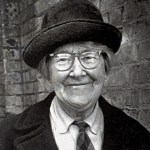
Doris Mellor is remembered in Mellor Walk, which links Bachelors Acre to Sun Passage, and in Mellor House at 84-86 Peascod Street with a plaque by Sheena Lane showing her as an elderly lady. Of course, she wasn’t always elderly, in fact she had a very long and distinguished career. It is not generally known that she was born in Windsor, and developed the love of her home-town during a fairly idyllic childhood.
Her story starts at 33 St Mark’s Road, in about 1890, with a young couple, Albert and Elizabeth Mellor. This was the Mellor family home for almost 100 years. The couple arrived here from Derbyshire for Albert to take up an appointment as a music master at Eton College. Over the next ten years, they had three daughters – Edith, Doris Evelyn, and Berta Clara Rosalind. Doris was the second of the three sisters, born in 1894, and her childhood covered the late Victorian and Edwardian periods. There are many photographs from that era, so it’s possible to picture the town where she grew up in. The father and son photographers, Thomas Cochrane Senior and Junior, lived nearby in Queen’s Road. Initially, there were no cars, only horses and carts and bicycles. She would have walked the short distance along Alma Road to her first school, Holy Trinity church school. The building still exists, but it was developed into houses some years ago as Hunters Mews.
Her family were regular church-goers and attended Holy Trinity church, as well as the Parish church in the High Street, where Albert Mellor was the organist. Doris would have seen the regular church parades of the Life Guards marching between Holy Trinity and Combermere Barracks, along Alma Road and St Leonard’s Road, and would probably have joined other children, dressed in their Sunday best, walking alongside the band.
She was seven years old when Queen Victoria died and would have been aware of the funeral taking place in the town, as well as the military pomp and pageantry that accompanied such events. She almost certainly took part in the annual Empire Day parade in May, in which all of the town’s children formed up on Bachelors Acre, then proceeded up Sheet Street, with bands playing, along the High Street, and down Thames Street to the Home Park. Here, they took part in a Sports Day, followed by tea. Prizes were presented by a member of the Royal Family, such as Princess Christian, for example.
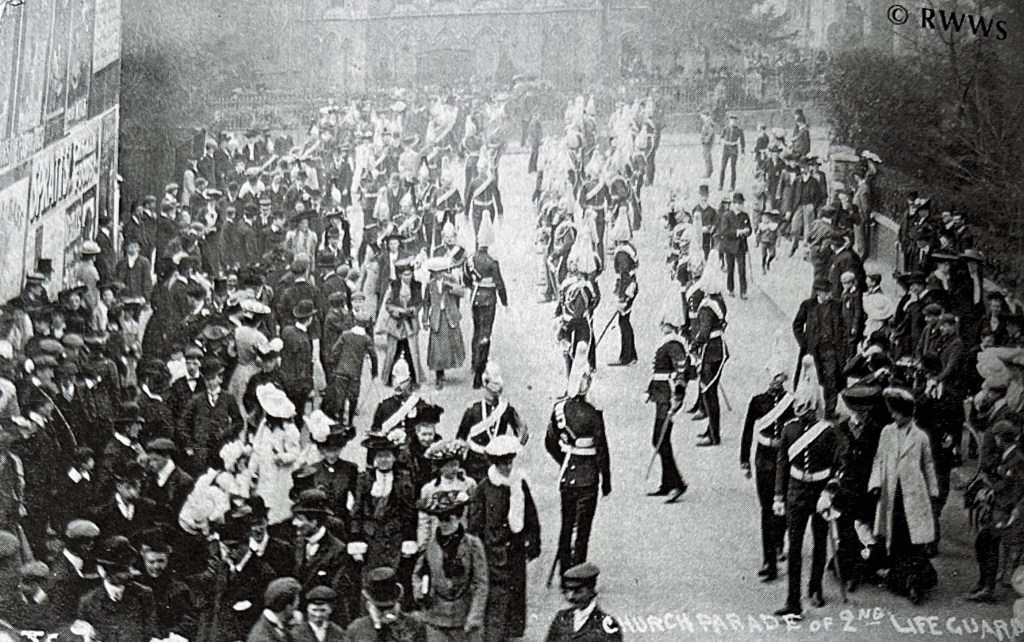
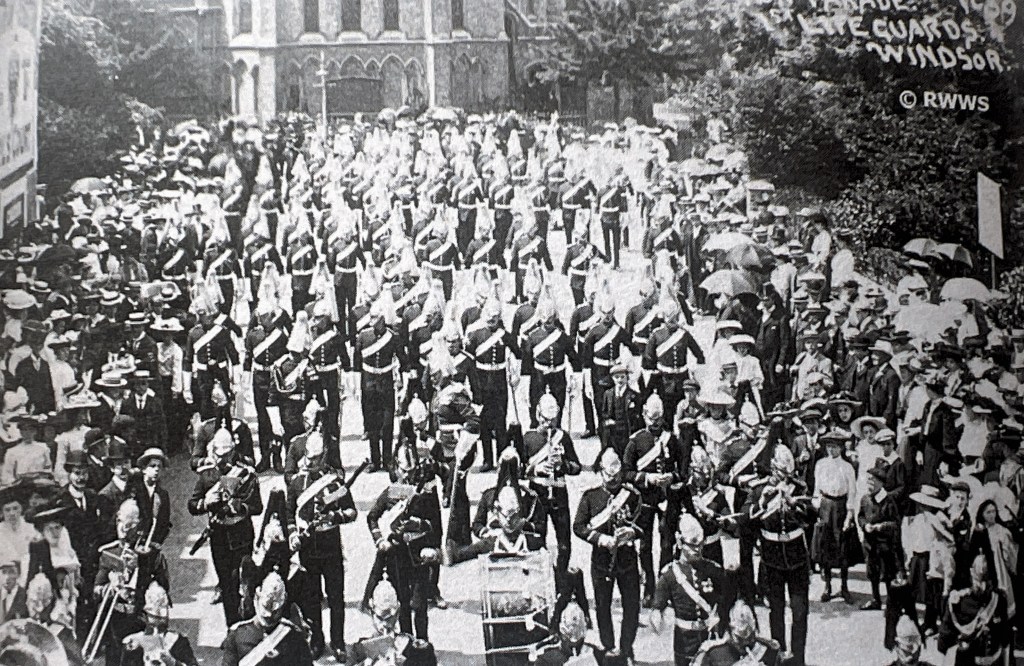
Church parades of the 1st and 2nd Lifeguards at Holy Trinity Church, in 1906 by Thomas Cochrane, Being accompanied on their march by crowds of people, including children, was a common occurrence. © RWWS.
Each year, the Windsor Express carried detailed information about the event. It was organised by the Mayor, and nearly 3000 children were involved. A Royal Pavilion and other tents were erected on the Home Park by the Lord Chamberlain’s department of Windsor Castle, and at least one member of the Royal Family was in attendance. All the schools in Windsor, Clewer, Datchet, and Windsor Great Park took part in the procession, and the scholars had coloured badges to represent their school. When they entered the Home Park by the private lodge gates, they assembled at flagstaffs bearing banners of the same colour.
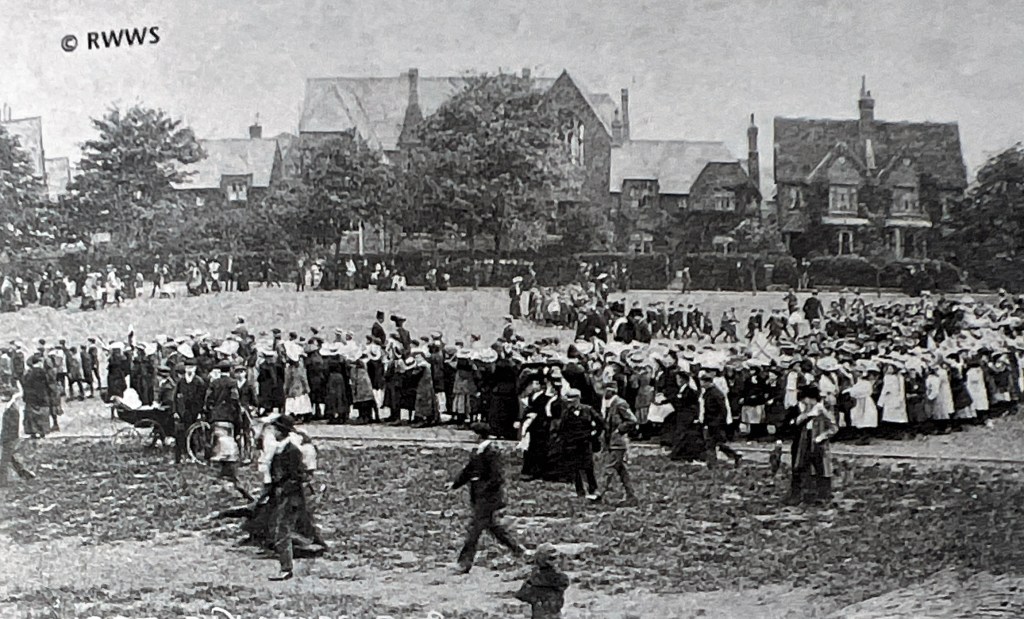
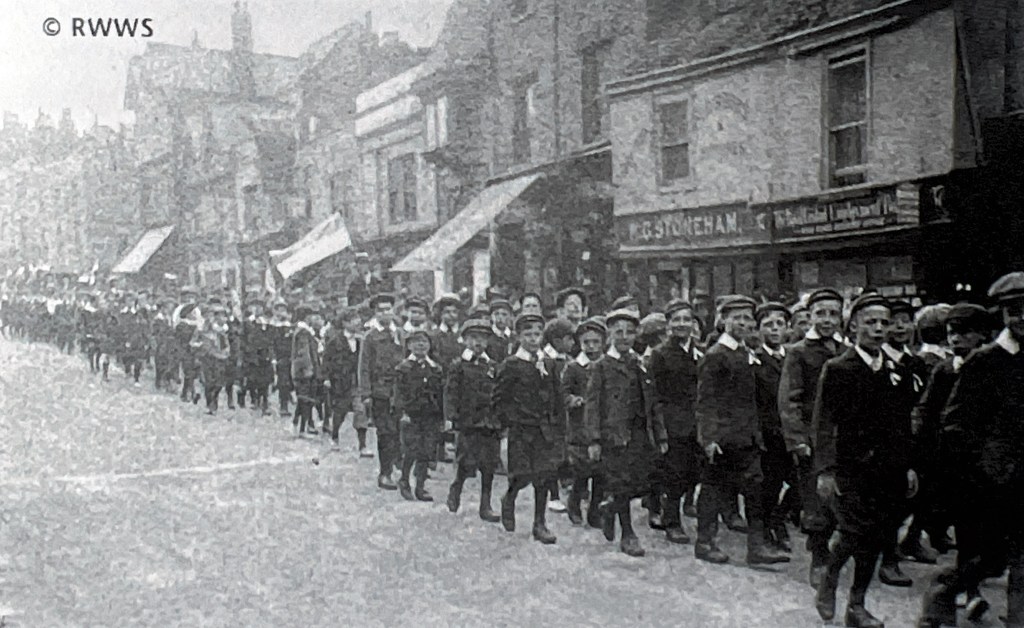
Windsor’s schoolchildren gathered on Batchelors’ Acre for the annual Empire Day parade, 24th May, and then move es down Thames Street towards the Home Park. © RWWS.
Following the Sports Day and prize-giving, the tea of cakes, buns and milk, was enjoyed, being donated by local businesses.
Doris Mellor and her sisters were all pupils at St Stephen’s Girls’ High School in Vansittart Road, which at that time was a private school, and were taught by Sisters from St John’s Convent in Hatch Lane. With her school friends she would walk down Vansittart Road for swimming lessons in the river at Baths Island. If they needed any medical treatment, it was carried out at the Windsor Infirmary in Victoria Street, on the corner of Bachelors Acre. In 1907, there were plans to extend the infirmary further onto the Acre, but these were turned down and the new King Edward VII Hospital was built further from the town centre on the site of a former nursery. Other building projects which were taking place at that time were the construction of the promenade along Barry Avenue, together with the Thames Hotel (now Brown’s), and the laying out of Alexandra Gardens in the former riverside meadows. Closer to home for the young Doris was the huge project on the corner of St Mark’s Road and St Leonard’s Road, which became the Fire Station, Police Station and Magistrates’ Court.
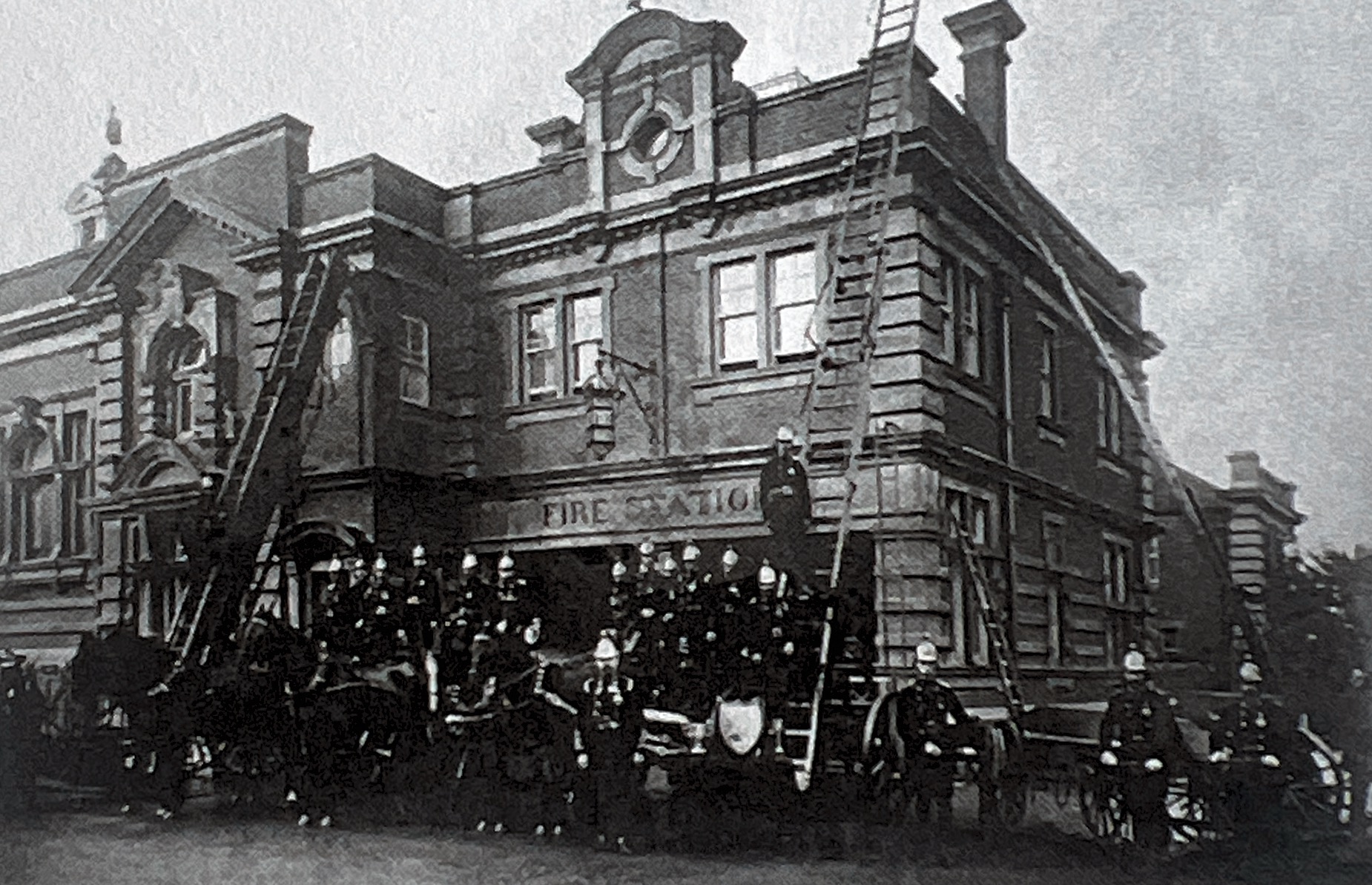
Windsor Fire Station and Men, 1907 Windsor and Royal Borough Museum
Throughout her teenage years, music and drama probably played a major part as she attended concerts, plays and lectures at Eton College and at the Royal Albert Institute in Sheet Street, and saw the first moving pictures. The People’s Electric Theatre in Victoria old Windsor Infirmary building, which had been vacated after the opening Street was part of the of King Edward VII Hospital. As reported in the Windsor Express of 26 March 1910, it opened on Easter Bank Holiday Monday of that year, with a programme of about eight items, including The Oxford and Cambridge Boat Race. The prices were 6d and 3d (children half price). A week later, the Royal Albert Institute was also showing ‘singing, talking and laughing pictures’ for the first time in Windsor.
Doris excelled at school and then became one of the very few girls of her generation to go to university. She took a degree in History at London University, and many years later, colleagues remembered that her knowledge of history and religions of the world was outstanding. She also took an active part in staging Shakespeare plays during her thirty-year teaching career in South Africa. She returned to Windsor in 1950, and so began her second career, as described in Windlesora 25 (2009).
 Windsor Local History Group