
Published in Windlesora 20 (2003)
© WLHG
In 1950 Dedworth was largely a rural area consisting of farms and small cottages. By 1960 it was well on the way to becoming the busy residential area we know today.
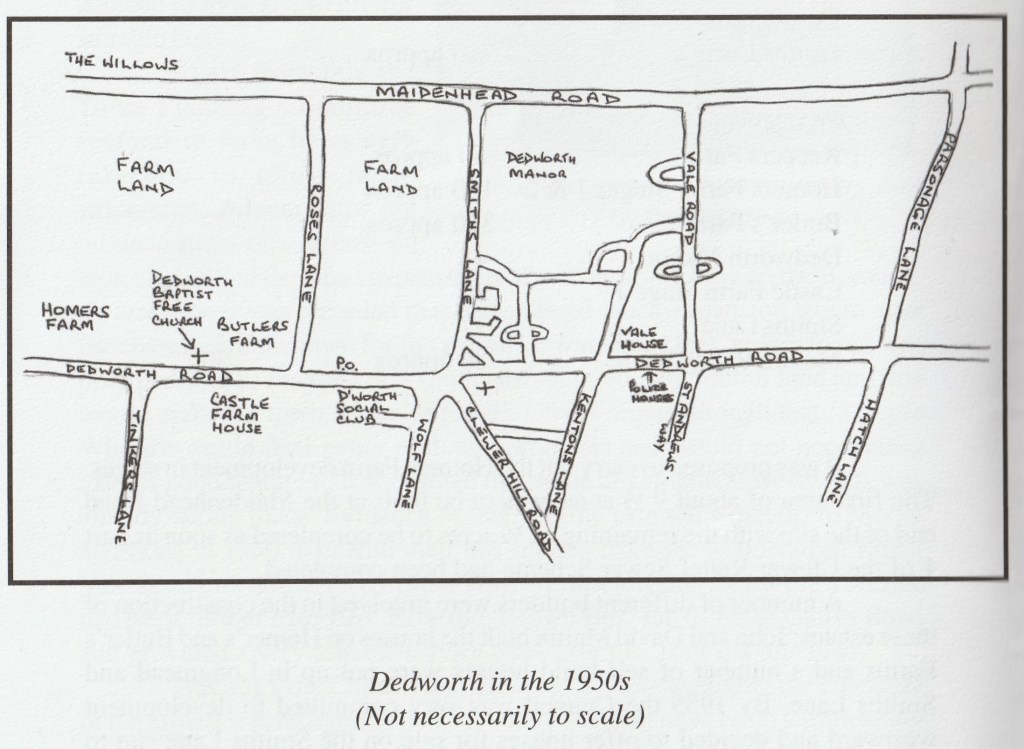
Kellys Directory of 1950 describes Dedworth as ‘a hamlet of Clewer with an area of 347 acres’ and All Saints Church in Dedworth Road as ‘a chapel of ease with 200 seats’. Beyond Smiths Lane there were only a handful of cottages and the public houses we see today. There was a post office but at that time it was on the opposite side of the road to where it is now and Dedworth Green Baptist church was not in Smiths Lane but in Dedworth Road. In 1950 there was not even an electricity supply to the houses beyond the post office. A deputation of residents led by Commander Ryder MP of Castle Farm House attended the meeting of the Town Planning Committee on 3rd January 1951 to support the Southern Electricity Board’s application to put in an overhead supply to the road. At the time these houses depended on gas and oil, and the Gas Board had condemned the supply to some of the houses. The Council however, although they stressed they were not against the supply in principle thought the posts and cables would be unsightly and once erected would become a permanent feature. They wanted SEB to put the supply underground which would have been a great deal more expensive. The Council eventually gave in when SEB decided to take the matter to appeal and approval was granted in July 1951.
Both the Dedworth and Maidenhead Roads were narrow in the Dedworth area with no footpaths. Proposals to widen the Dedworth Road beyond Bell Parade had been turned down with a proviso that parking space should be provided at the County police houses with a standing bay for buses on the north side of Dedworth Road by Vale House. This house stood on the site of the flats opposite Kentons Lane. At one time it was proposed to develop a new shopping centre in the area of Vale House, including a cinema, a clinic, a community centre, a nursery school and a playing field. This scheme was never proceeded with although a baby clinic was held in the house until the present clinic was built in Smiths Lane in the 1960s.
Debate on possible sites for housing development had been going on for some years and land to the west of Smiths Lane had been suggested as a possibility. The northern area of this land however was prone to flooding and indeed had flooded to a depth of one foot in 1947. In 1949 the Minister of Health did approve in principle the proposal to acquire the site and the District Valuer was asked to negotiate with the owner, Mr G R Valli of Homers Farm. A few months later, the District Valuer reported that Mr Valli refused to discuss the matter on the grounds that the remainder of his land would not be large enough to be economic. The Council then advised against compulsory purchase by the Ministry of Agriculture and Fisheries and decided to look elsewhere for suitable land.
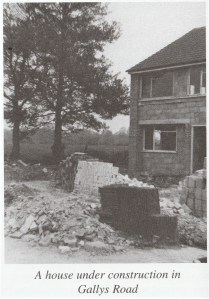
Apart from this the Town Planning Committee seemed to have been very reluctant to allow much expansion. A year later the minutes show that discussion took place about the effect expansion of the town would have on the Borough. At that time it was recorded that some feared ‘such expansion would alter the character of the town for the worse’. It was stated that ‘enlargement was only possible to the west and southwest on good agricultural land and this would make the town very elongated’. Others argued though that ‘a larger Windsor would deal better with any problems and would not necessarily lose its good features’. It was noted that some development westwards was already taking place. Evidence of this was the Council’s request to Moore and Sons in 1950 to extend their bus service from the Maidenhead Road/ Vale Road junction as far as Tudor Way. By the early 60s the Moore’s service had been further extended. Now the ‘Brown Bus’ ran as far as Gallys Road and provided a very reliable service three times an hour into the town.
Although the Council had these fears about changing the character of the town it was recognised that any future building must be on a sufficiently large scale so that adequate facilities in the way of shops and schools could be provided in the area. There was obviously an increasing need for estates to re-house people made homeless through proposed clearances in the centre of the town and the Town Development Act 1952 put pressure on councils to provide more homes in their areas. The aims and objectives of this act, which came into force on 1st August 1952, were to ‘encourage residential development in one county district to the relief of congested or over populated areas elsewhere’. The effects of this act were far-reaching, and Windsor Council from then on seemed to look more favourably on development to the west for both private and council schemes. Mr Valli of Homers Farm had also had a change of heart, as in 1953 he appealed against the Council’s refusal to allow him to develop his land.
By January 1953 a number of housing developments had been approved:
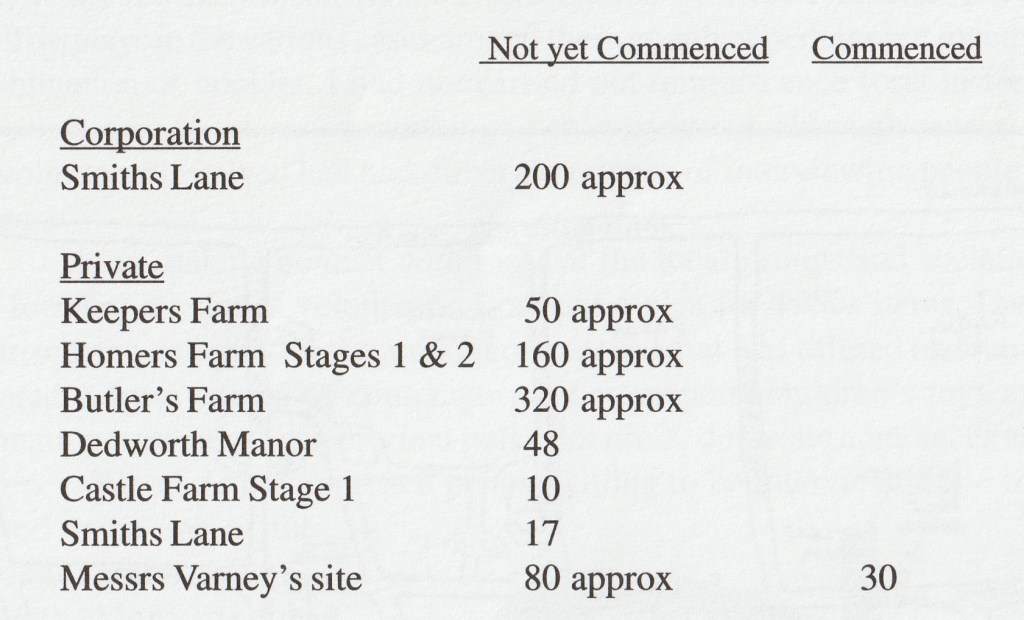
It was proposed to carry out the Homers Farm development in stages. The first area of about 9 1/2 acres was to be built at the Maidenhead Road end of the site with the remaining 12 1/2 acres to be completed as soon as part 1 of the Clewer Relief Sewer Scheme had been completed.
A number of different builders were involved in the construction of these estates; John and David Martin built the houses on Homer’s and Butler’s Farms and a number of self-build houses were put up in Longmead and Smiths Lane. By 1955 the Council was very committed to development westward and decided to offer houses for sale on the Smiths Lane site to council tenants and those on the housing waiting list. Together with the house building, Dedworth Green Infant, Junior and Senior Schools were opened in Smiths Lane, to be followed later in the 1960s by Homers Farm School in Testwood Road. Large supermarkets, such as Tesco’s had not been thought of, but a number of small parades were built along the Dedworth Road with a good selection of shops to provide for the everyday needs of the many families moving in to the area. From a sleepy rural area at the start of the 50s, by the end of the decade Dedworth was developing into a pleasant, well-served residential part of the town of Windsor.
Barbara Mitch
 Windsor Local History Group