
(Windsor Cemetery series)
Published in Windlesora 34
©2018, WLHG
When researching in cemeteries, the amount of information available on headstones is of a variable quantity. Some graves give nothing but the name of the person buried there and the dates of birth and death, while others provide a lot more biographical detail. Take, for example, the grave of Colonel Dunbar Douglas Muter; his headstone in Windsor Cemetery contains the following information worthy of a Who’s Who entry:
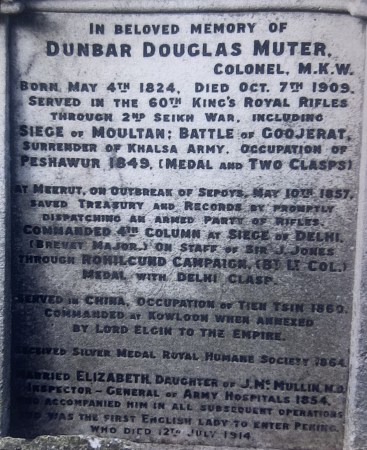
Dunbar Douglas Muter was born at Douglas, Isle of Man, on 4th May 1824 and was a career soldier. He was commissioned as an ensign (2nd lieutenant) in April 1843, before purchasing promotion to lieutenant in January 1845.
By 1854, he had been promoted to captain and was serving with the 1st Battalion 60th (King’s Royal Rifles) Regiment in India. He served in the Punjab Campaign and was stationed at Meerut, where the Indian Mutiny started, on the day the first shots of rebellion were fired.
There had been widespread unrest among the Indian population for many years and the infamous greased rifle cartridges proved a flash point for the mutiny within the Sepoy ranks. To load the new Enfield rifles soldiers had to bite the end off the greased paper cartridge. The grease was said to be the fat from cows and pigs; this was an insult to both Hindu and Muslim soldiers. Native troops in the Bengal Army rose against their British officers at Meerut on 10th May 1857 and the rebellion quickly spread across northern and central India.
The British troops at the Meerut cantonment were initially slow to react but, as Muter’s headstone testifies, his prompt action saved the Treasury and its records. Muter served throughout the Indian Mutiny and took part in the siege of Delhi, a rebel stronghold. He received two brevet’ promotions in India, to major and lieutenant colonel.
His last promotion, to major, was by purchase in July 1860, and later he transferred to the 51st (2nd Yorkshire, West Riding) The King’s Own Light Infantry Regiment. After India he served in China and New Zealand and was accompanied by his wife Elizabeth again. She wrote several books describing her travels of which two are:
Travels and Adventures of an Officer’s Wife in India, China, and New Zealand published in 1864
My Recollections of the Sepoy Revolt (1857-58) published in 1911.
In 1864, Muter was awarded the silver medal of the Royal Humane Society for rescuing a man from drowning in the sea at Dover. He retired from the Army in March 1865, with the honorary rank of Colonel, and was appointed a Military Knight of Windsor in 1899. The Military Knights are retired officers of long service who perform certain ceremonial duties in return for accommodation in Windsor Castle. He was appointed to the Lower Foundation in March 1899 and to the Royal (Upper) Foundation in July 1901.
Colonel Muter died at his home in Windsor Castle on 7th October 1909, aged 85. His funeral was held on 12th October, with the service taking place in St George’s Chapel and the interment at Windsor Cemetery. There was a full turn-out by the Military Knights and the 2nd Battalion Scots Guards formed the funeral party. After a service by the Dean of Windsor, the funeral procession marched to the cemetery where Colonel Muter was buried with full military honours. The memorial headstone containing his life story was placed on the grave five months later.
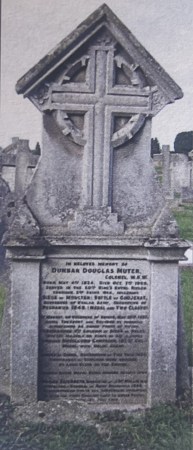
Colonel Dunbar Douglas Muter’s grave lies just yards from the grave of Colonel Francis Cornwallis Maude VC, another Indian Mutiny veteran and fellow Military Knight of Windsor. Maude was awarded the Victoria Cross for action in India, but that is another story.
Derek Hunt
Reference
- A brevet promotion entitled a commissioned officer to hold temporarily a higher military rank, but without the appropriate pay and allowances.
Sources
- Moore, Richard & Jennifer, The Military Knights of Windsor 1348 to 2011
- Hart’s Army Lists, various dates
- Windsor & Eton Express, various dates
- Findmypast.com newspaper library
 Windsor Local History Group