
Published in Windlesora 12 (1993)
© WLHG
When I caught a glimpse of the Waterloo Chamber during the scenes of devastation shown on the early evening news in the day of the Windsor Castle fire, it seemed improbable that the rather incongruous highly coloured ‘pantomime’ decorations which had been revealed by the disaster could have survived for some fifty years behind the solemn Sir Thomas Lawrence portraits, and still be in such good condition. But it seemed even more improbable that a young schoolboy could have been let loose to decorate such a grand location.
It didn’t seem at all strange at the time!
I had been evacuated from London with my school at the beginning of the war and was billeted with a lovely family called the Camms who lived on the edge of Windsor forest. Mr Harry Camm was a carpenter on the Royal estate, and he was a marvellous craftsmen. Among other things he made the Royal Pew and Choir Stalls in the Chapel at Royal Lodge in Windsor Great Park. The family and other tenants and employees on the Royal estate would go to church there on Sunday mornings, and the new ‘members of the family’, the evacuees, would go too. Eventually I joined the choir there. Most of the other choirboys went to the estate school, which was run by a most unusual Headmaster, Mr Hubert Tanner. I think he had a secret wish to have been on the stage because he was always organising shows and entertainments.
The Princesses were themselves evacuated to Royal Lodge, and were very friendly with Mr and Mrs Tanner and apparently often visited them at the school. Somehow it became the tradition for the Princeses to perform a pantomime with the pupils from this little school, written and directed by Mr Tanner (who also played a starring role in the production).
The performances were given at Windsor Castle in the Waterloo Chamber – an imposing room, normally decorated with portraits of statesmen and soldiers. These, like most other paintings in the Castle, had been removed for the duration of the war, leaving very rough untreated wooden planks behind the empty frames – in stark contrast to the elaborate decoration of the rest of the chamber.
I do not know who actually had the idea (probably Mr Tanner!) but it was suggested that these blank spaces could be decorated in some way to make a more cheerful setting for the pantomime, and somebody (probably Mr Tanner again) realised that they had a tame designer on tap and suggested that I produce a series of nursery characters.
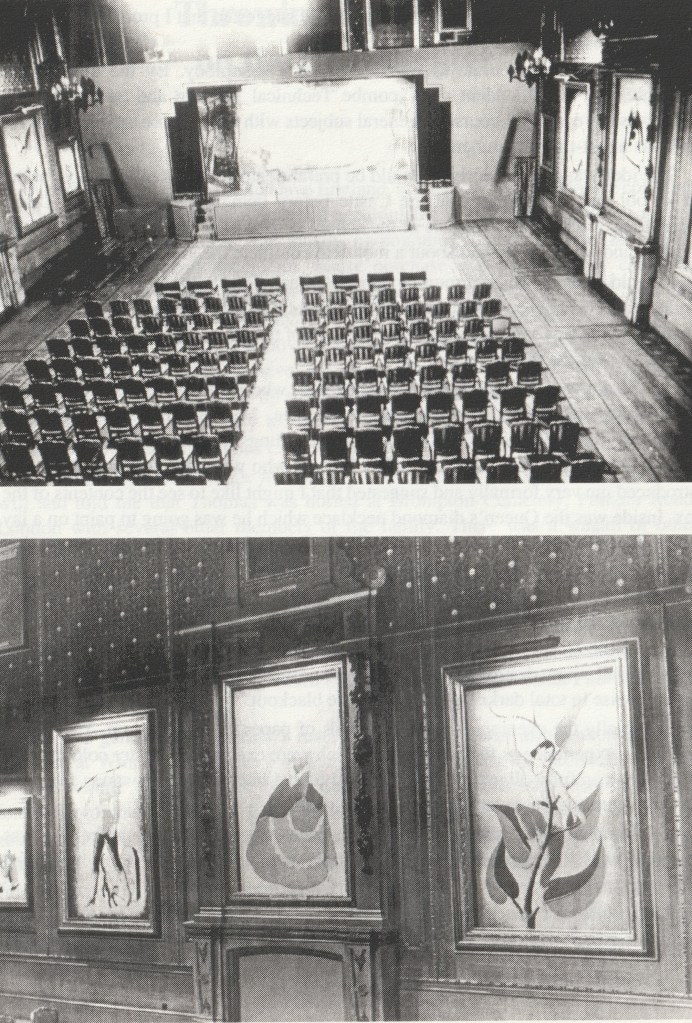
It is not strictly accurate to say that I was a schoolboy. By the time of the pantomimes I was a student at Wycombe Technical Institute and School of Art. There was a preparatory course of general subjects with rather more art than is usual. So I was a part-time art student.
The idea was that the designs should be prefabricated on rolls of wallpaper at the art school and then finished at the Castle before being pasted up by the Castle decorators. A team of colleagues at the school helped to scale up and block-in the designs, and I believe we had about a month to complete the job.
I would bring the rolls of roughly completed paintings to the Castle and continue work on my own. I shared a studio with Sir Gerald Kelly, later President of the Royal Academy, who was still working on two portraits of the King and Queen’s Coronation. Our studio was the throne room.
Sir Gerald was an immensely courteous man who would always address me as “Mr. Whatham” — which rather embarrassed me. He was also a man of great enthusiasms and talked endlessly of artists and paintings and places. On one occasion when I arrived for work, he had a lady with him who was holding a small box. He introduced me very formally and suggested that I might like to see the contents of the box. Inside was the Queen’s diamond necklace which he was going to paint on a lay figure that afternoon. When the lady left Sir Gerald began talking on yet another fascinating topic. He got so carried away that he thrust the jewels into my hands and ran off to get a book he felt compelled to show me.
Most of the time I worked quite alone and my strongest recollections are of the silence of the Castle at night and the romance of walking through a deserted St. Georges Hall — now destroyed — and across the grounds of the Castle in the moonlight, but otherwise in total darkness because of the blackout.
Eventually the evening came for the rolls of paper to be pasted up. This was a harrowing experience as the paintings – which were executed in poster colour – had to be very carefully aligned and could easily have been ruined by stains from the paste. Fortunately they went up without any mishap.
If I stand in the Chamber and imagine what my reaction would be if I was presented with the project now — I can only feel terrified. But then it seemed perfectly straight forward.
Ah! Youth.
Claude Whatham
 Windsor Local History Group