
Artist and Architect
Published in Windlesora 26 (2010)
© WLHG
On Thursday, 16 April 2009, a blue plaque to AY Nutt Artist and Architect was unveiled by the Mayor of Windsor and Maidenhead, Cllr. Dorothy Kemp, It is placed at 63 Kings Road Windsor, his family home from 1873 – 1884.
Who was A Y Nutt? This was a question raised by Judith Hunter, Honorary Curator of the Royal Borough Collection in 1992, when it was decided to mount a major exhibition in the Guildhall of a selection of paintings, sketches and diagrams from The Malahar Collection which has been given to the Royal Borough in 1977. Most of these had the signature AY Nutt and all the items had been catalogued, shelved and were rarely seen. I was Judith’s assistant at the time and volunteered to find the answer to Judith’s question, Four years later we had all the information we needed, and the Guildhall Exhibition 1996 was a successful and popular display of AY Nutts work and legacy in Windsor Castle and the town of Windsor.
Allred Young Nutt was born in 1847 in Cold Overton in Leicestershire, the youngest child of Revd William Nutt and Sarah his second wife. He was educated at the grammar school in Oakham and left at the age of 14 to take up an architect apprenticeship in Leicester. In 1867 he came to Windsor to join the Office of Works in Windsor Castle as a draughtsman. By the time he retired in 1912 he was Head of the Office of Works and Surveyor of St. George’s Chapel and the Mausoleum at Frogmore. In 1884 Mr and Mrs Nutt and their three daughters moved to Garden House, within the Castle grounds until his retirement to Slough in 1912. He died in 1924 and is buried in Windsor Cemetery.
During the first seven years after he came to Windsor, Nutt established a place in the life of the town along with Harry Ward, a friend from his years living in Leicester, at first a visitor but soon to become a resident, Ward was a drawing master and with his help Nutt developed the talent for watercolour painting that was to be so important to him all his life. Ward became art tutor to the daughter of Princess Helena. The story is that Ward was painting in Windsor Great Park and Prince Christian of Schleswig Holstein, husband of Princess Helena, stopped to admire his work and promptly offered the post, the beginning of a friendship with Ward and Nutt. Ward also became drawing master to Princess Beatrice, Queen Victoria’s youngest child. Queen Victoria commissioned Ward to paint pictures of the Albert and Duchess of Kent Mausoleums and Princess Helena commissioned five paintings of buildings and scenes in The Great Park.
Nutt was included in his friend’s new relationships and commissions were to follow. In 1870 he designed a casket for Prince Christian when he was made Lord High Sheriff of the Borough of New Windsor. In 1872 Queen Victoria commissioned detailed drawings of the Royal Dairy at Frogmore. The following year Nutt was employed to make a detailed scaled drawing of the Royal Vault in St. George’s Chapel, to be used in connection with a plan for major changes to be made by Gilbert Scott. These drawings are now in The Public Record Office at Kew.
Nutt was also deeply involved in a new venture in the town with the setting up of The Windsor and Eton Government School of Art. He was the secretary for two years and was successful in getting leading members of the town to become patrons. Nutt remained on the committee and there is a note written in 1894 from him with his comments on the drawings submitted for prizes. Princess Helena was a patron and each year the Guest of Honour at the annual prize giving, which was always held at the Guildhall.
Together Nutt and Ward painted many scenes of Windsor which are included in the Malahar Collection. Ward was best man at Nutt’s wedding in June 1873 but in October of the same year he died after a short and sudden illness. Nutt wrote of him that ‘his ideas were pure and that of a true artist, I am grateful to him for helping me to appreciate nature.’
It is difficult to identify specific work carried out by Nutt as a member of The Office of Works as few plans and drawings bear his signature. However in 1873 at the young age of 26 years, he was given an additional responsibility as Surveyor of St George’s Chapel, employed by the Dean and Chapter. In the Chapel Archives there are plans, drawings, memoranda, accounts, etc, which show his tremendous output of work. From 1880 to 1886 he supervised the restoration of the south front which was in a dangerous state and at the same time, with the help of the Hon. Mrs Wellesley widow of Dean Gerald Wellesley, sufficient money was raised to replace statues in the buttresses of people connected with the chapel from its foundation. For this work he was given a special payment of £25 and a salary increase by the Dean and Chapter.
In 1882 he was responsible for the new window with its Napoleon symbols in the Bray Chapel where the commemorative tomb to The Prince Imperial was first placed, but now can be seen in the nave. In 1888 a number of relics of Charles I were restored to his coffin. A piece of bone from his neck, a tooth and some hair had been removed from his coffin when it had been opened in 1812. They were replaced in a separate box which was lowered by the by The Prince of Wales to rest on top of the King’s coffin. Nutt wrote wrote a very full and detailed account of the work and ceremonial involved, also a drawing of the four coffins, all in good condition except for that of King Henry VIII.
A major piece of work was carried out by Nutt from 1898 to 1902, when with Queen Victoria’s permission, he transformed the large George III Royal Vault, which involved repositioning the coffins which were all moved to niches in the walls of the vault. Monarchs were placed with consorts each with suitable gates, and an altar was built at the east end. Electricity was installed and easy access made to the vault down steps from behind the main altar. Unfortunately the public has no access to the vault.
The Golden Jubilee of Queen Victoria in 1887 was to give Nutt a high public profile when he was commissioned by Eton College to create a ceremonial arch over Slough Road in the vicinity of the college. The Queen would pass through this on her route back to Windsor Castle from Slough station after the celebrations in London. Parker’s book Eton In The Eighties we read that the arch looked to be built of weather-worn brick and lichened stone with the arms of the founder Henry VI placed above the keystone with lilies and lions supported by gorged antelopes. Over the outside buttresses were two niches containing the statues of King Henry VI and his queen Margaret of Anjou. Over the inside buttresses were two more niches with the figures of the two patron saints, St. Mary the Virgin and St. Nicholas, and the admiring visitor could not but notice with regret that the stone of the Virgin’s face, as so often happens with ancient carved figures, had mouldered away. Built of scaffolding, of lathes, of paper, card and paint, you could walk up to it and still think it a mediaeval archway of solid stone and brick. It deceived the amateur and the skilled architect. On the day of the Queen’s arrival when the royal carriage passed through the gate the Queen’s entrance was hailed with fanfare. Four trumpeters suitably dressed stood on the arch. They blew silently upon imitation instruments and the blast which sounded from the battlements came from a professional bugler concealed behind. The arch was strong enough to support these five participants. In the special illuminated Chronicle of the day published by the College it reported that Mr Blomfield RA visiting the school expressed his astonishment that on previous occasion he had not noticed so interesting a relic of mediaeval architecture.
Ten years later, the Diamond Jubilee was a Nutt extravaganza. The Eton Arch was repeated and a second arch erected at the Windsor/Eton Bridge called Porta Victoriana. It too was made of lath, plaster, sand, papier maché, and aged with a worn and stained appearance to look contemporaneous with the start of the Queen’s reign. In the centre was a statuette suggestive of the Queen in her coronation robes. Also included were the coats of arms of the Queen and the late Prince Consort, national quarterings of England, Wales Scotland and Ireland. On the higher turret flew the Royal Standard and on the lower turret the Borough flag. It was illuminated at night and a report in the local paper reads ‘This arch was erected without any interference of traffic, then considerable throughout the 4th June and Ascot Week.’
A third arch was a canopy in the Italian Renaissance style surmounting the statue of the Queen on Castle Hill. Orchids, palms and other plants surrounded the base on the day of the Queen’s return to Windsor from London. For the coronations of Edward VII and George V, Nutt was commissioned on each occasion to build a temporary annexe to Westminster Abbey.
Nutt had created Illuminated Addresses which were presented to the Queen by the Borough and Eton College as part of the Jubilee celebrations. He carried out similar work for local Windsor residents and included drawings of Windsor. In 1902 he designed an address to Miss Violet Gee on her retirement as superintendent of the Sunday School and it includes a drawing of Bachelors’ Acre and the school where the classes were held. For the retirement of Miss MacDonald as matron of the Windsor and Eton Infirmary, there is a drawing of the infirmary building, a hospital ward and Infirmary Crests. A third example is the address to Sir Francis Tress Barry which has drawings of the river also of St Leonard’s Hill. From his Christmas cards we have more knowledge of scenes in Windsor, and with the visits of another artist friend, George Henton, there are excellent photographic records of the town and the local people.
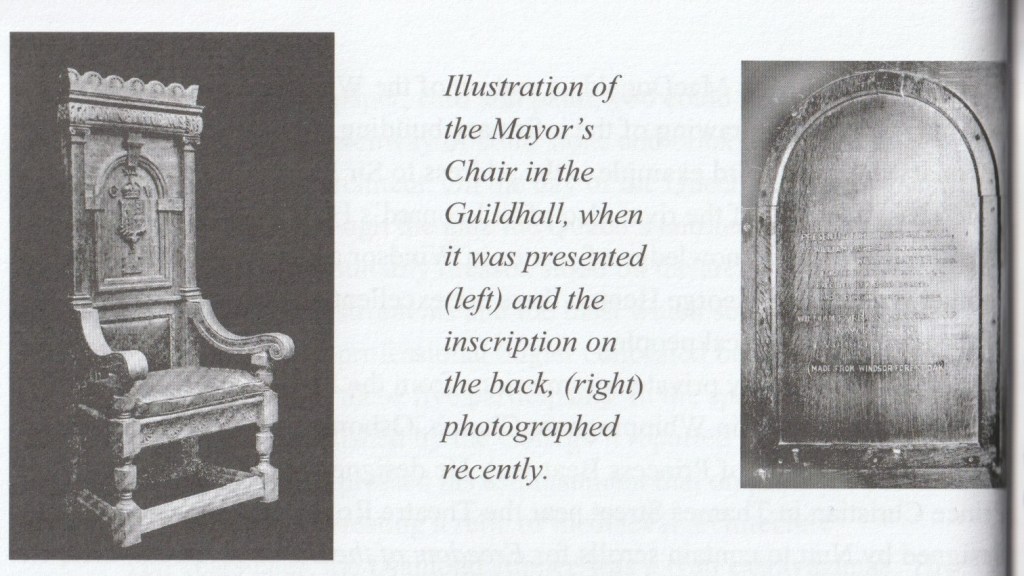
Nutt had many private commissions from the Royal Family such as the Memorial Chapel in Whippingham Church, Osborne to Prince Henry of Battenberg (husband of Princess Beatrice). He designed the memorial to Prince Christian in Thames Street near the Theatre Royal. Caskets were designed by Nutt to contain scrolls for Freedom of the Borough ceremonies, and a plaque at the back of the Mayoral Chair in the Guildhall informs us that it was designed by AY Nutt.
The plaque reads:
PRESENTED FOR WINDSOR GUILDHALL
BY WILLIAM FAIRBANK M,V,0 .J.P JULY 1914
WILLIAM CARTER MAYOR
DESIGNED BY A.Y.NUTT M,V,O. I.S,O
EXECUTED BYA BOND . BUILDER,
AND C DEACON . CARVER
WILLIAM FAIRBANK M,V,O. O,B,E . J,P.
MAYOR 1919-20.
C,V,0.1924 K,G.V.0. 1925
(MADE FROM WINDSOR FOREST OAK)
In 1912 against his wishes, Nutt was forced to retire from his work at the Office of Works, also as Surveyor of St. George’s Chapel and to leave Garden House. A report in the Windsor and Eton Express tells us that there was ‘at the invitation of the Mayor, a meeting at the Guildhall for the two-fold purpose of expressing their sense of the loss that will accrue to Windsor, Eton and the neighbourhood from Mr Nutt’s departure from the town, and secondly for the purpose of presenting him with a cheque and a beautiful bound book containing a list of the donors’ names. Suffice it to say that he had the good and well merited fortune to possess in a singular degree the esteem, respect and we can add, affection of troops of friends of all positions and classes.’
Nutt retired to Sussex Gardens in Slough and continued to work as an architect. In 1916 he was architect for a new church in Goldthorpe, South Yorkshire, commissioned by Lord Halifax whose home was nearby. It was to be in the Renaissance Italian style, High Church and to be built of concrete. This church recently had a grant of one million pounds to for restoration. War Memorials after 1918 were designed by Nutt for St Mary’s Churchyard in Slough, Eton Wick, Sonning, and Boreham but a very elaborate plan for a memorial near Slough station was finally rejected as too expensive. A busy active man to the end, he died quietly lying asleep in his favourite chair in July 1924, and he is buried in Windsor Cemetery.
There is one final question and that is why is it a Malahar not a Nutt Collection held by the Windsor and Borough Museum? His youngest daughter married Revd HT Malahar and lived on the Isle of Wight. It was spinster niece of the Revd Malahar who inherited and stored all this material and so saved it for posterity. There were no children born to any of his three daughters.
Norman Oxley
References
A Y Nutt: In Service to Three Monarchs at Windsor, Norman Oxley
Eton In The Eighties, Eric Parker
Windsor and Royal Borough Museum
Windsor and Eton Express
 Windsor Local History Group