
One small idea that lead to the British Probation Service
Published in Windlesora 27 (2011)
© WLHG
On Monday 6 December 1926 a plaque was unveiled in the corn market area of the Guildhall to a Windsor man who was not the Mayor or any other town official. It is still there and is the only memorial plaque outside the Guildhall. Most people would not recognise the name, but Frederic Rainer had the original idea that started the probation service in this country. Until 2007 his name was commemorated in a Foundation with its headquarters in London. This was then changed to Catch22, and that is the modern expression for what he saw going on and acted to stop.

Many people were involved in crimes, often because they were hungry and sometimes because they were drunk. They were sent to prison as punishment. At the end of their sentence they were released into the same world in which they were hungry and only able to survive by stealing. In fact, Catch22.
Frederic Rainer was born in Queen Street, Windsor (now known as Market Street) and was baptised at Windsor Parish Church in October 1836. His parents were George and Susannah Rainer and they already had several children. George Rainer was a stonemason.
Frederic went to the National School in Windsor, left when he was 14 years old and was apprenticed as a printer to the Windsor & Eton Express. He attended the Parish Church and was a special protégé of the Vicar, Canon Ellison.
There were quite a few public houses in the area where he lived, including the Three Tuns and the George IV and he often saw drunkenness. So when in 1859 Canon Ellison started a temperance movement in Windsor Frederic was one of the first to join. Three years later the Vicar started the Church of England Temperance Society, a national movement. At that time Frederic married Miss Louisa Robinson at the Parish Church and moved to London to take up a job with Gilbert and Rivington. He saw many prisoners who appeared in court again and again.
‘Offence after offence and sentence after sentence appear to be the inevitable lot of him whose foot has once slipped. Can nothing be done to arrest the downward career?‘ asked Frederic.
He sent five shillings to his old friend Canon Ellison, who was now Chairman of the CETS, and asked him to start a fund to help these people. The society responded by sending a missionary to the court in 1876.
The first two missionaries were ex-guardsmen from the Victoria Barracks, Nelson and Bachelor. Bachelor had saved Nelson from committing suicide and he then lived on until he was 86, dying only a month before the unveiling of the plaque. The organisation was first known as the London Police Court Mission.
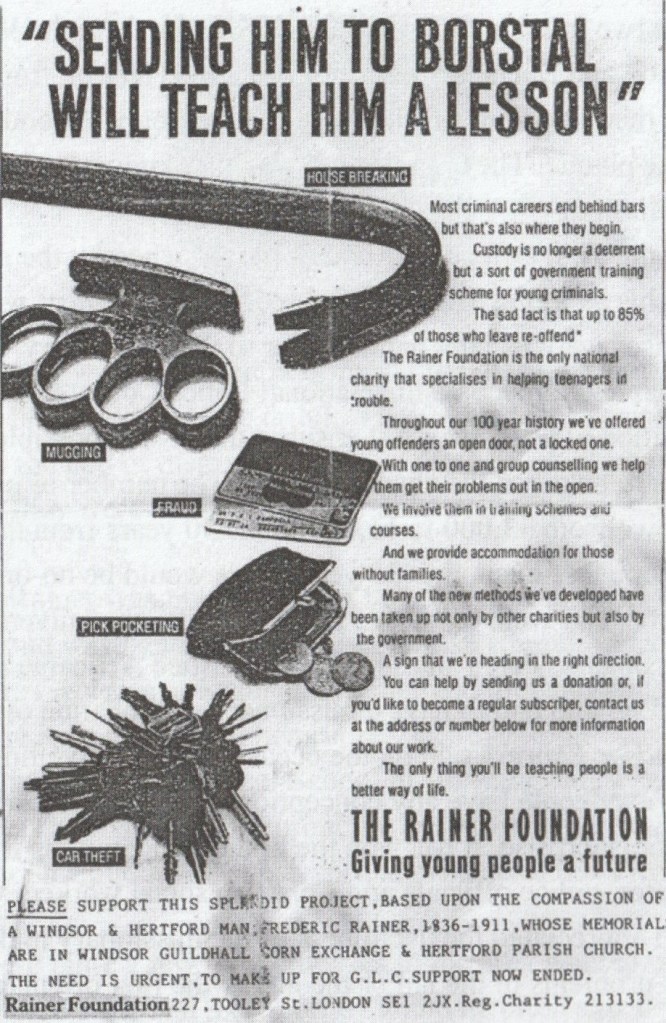
In 1887 the First Offenders Act was passed whereby the offender could be released on his agreeing to appear and received judgement when called upon. These cases were usually handed over to the Missionary. The movement expanded to become the National Police Courts Mission and in 1907 the Probation of Offenders Act ensured that it was possible for many more offenders to be given the chance of help. The number of people in prison went down from 33,000 to 11,000 in the 30 years from the 1890s. However the hope that in another 30 years there would be no-one in prison has not worked out so well. In July 1926, on the fiftieth anniversary of the first Court Missionary, Part 1 of the Criminal Justice Act came into force and every court in England had to have a missionary or probation officer. The Windsor Express said on the occasion of the unveiling:
‘Few people have any conception of the vastness of this important enterprise. It has won the highest encomiums from judges, magistrates, police officials and Christian social workers who have seen and appreciated the usefulness of the missionary in dealing with difficult problems of the lad or the girl or the first offender who has had a friend at court to help or speak for them at a crisis in their lives which meant the making or the marring of the future.’
Frederic Rainer moved to Hertford to take up the position of manager of Stephen Austin & Sons, Oriental Printers. He had spent his evenings learning various Oriental and Arabic languages and his skills as a translator were much sought after. He moved back to London and died at Wroxall in 1911. There is also a monument to him in All Saints Church Hertford where he set up a branch of the CETS.
Pamela Marson
Reference
Windsor & Eton Express 3 and 10 December 1926
Parish register of St John the Baptist Church Windsor.
 Windsor Local History Group