
and the Last Public Execution at Reading Gaol
Published in Windlesora 27 (2011)
© WLHG
On Monday 30 December 1861, Windsor was still reeling from the news of the death of Prince Albert, the Prince Consort, two weeks earlier in Windsor Castle. All of the pages of the Windsor and Eton Express were bordered in black, and the journalists were writing copious eulogies about his good works in the local community.
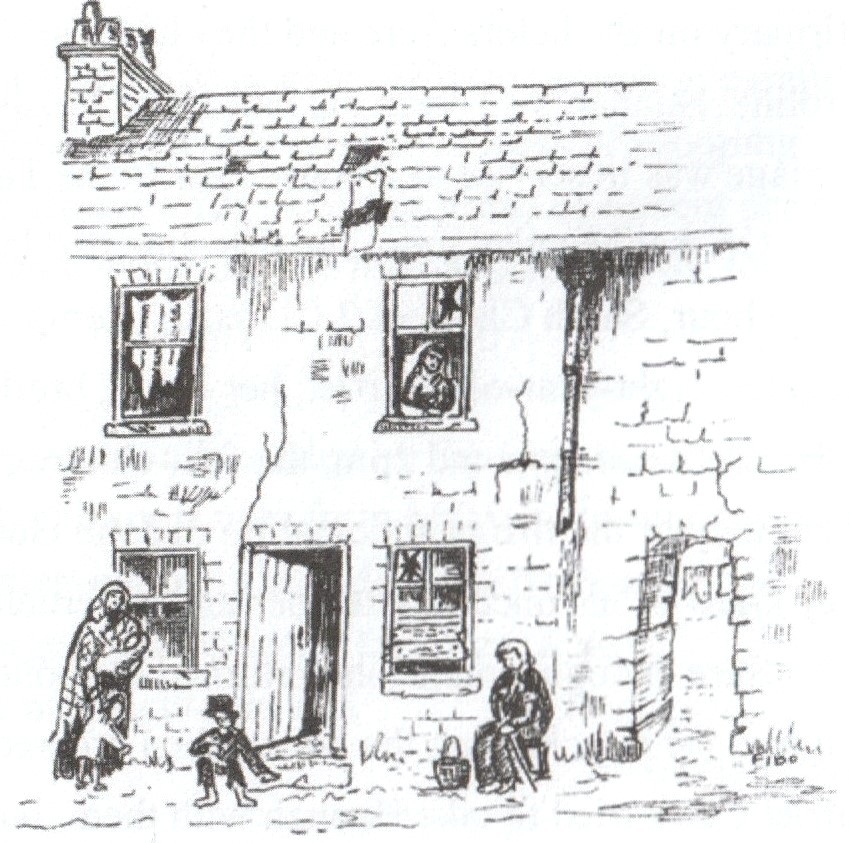
In the poorest areas of the town, the daily struggle continued as normal. At number 5 Clarence Clump lived a family very typical of the area. Father John Gould was a bricklayer’s labourer, more often out of work than in, because of his drunkenness and violent temper. His wife Caroline kept them from the workhouse by working as a charwoman at the Royal Windsor Infirmary on Bachelors Acre and they had a six-year-old daughter Hannah Caroline. Hannah’s 13-year-old half sister Elizabeth from Caroline’s first marriage was in service at a house near to the Three Elms in Hatch Lane.
On that Monday morning, Caroline had left her daughter in the care of a neighbour, Sarah Clark, of 2 Clarence Clump. Hannah played with Sarah’s daughter, eight-year-old Harriet, her young brother and another boy, Tommy Webb. Between 1pm and 2pm, the four children went back to number 5 where they lit the fire in anticipation of John Gould’s return from the pub. They knew of his uncertain temper and his cruelty towards Hannah.
Sure enough, when John returned at about 3pm he shouted at his daughter for not cleaning the house, then ordered the other children out. Harriet Clark tried to take Hannah with them, but her father would not let her go and as they left Harriet saw him take a razor from a shelf. A few minutes later, he appeared at the Clark’s house and called out, ‘Mrs Clark, I want you.’ Alerted by her own daughter and fearing that he had injured the child, she followed, but was unprepared for the sight which greeted her. Hannah was kneeling at the foot of the stairs with her head resting on the bottom step, barely alive and covered in blood from a throat wound. Sarah Clark shouted, ‘Oh! You vagabond, you have cut the child’s throat,’ then she turned and ran away in fear. As she looked back, she saw that Hannah had been thrown out of the door against the wall nearby.
Next door neighbour, 13-year-old Samuel Wilkins, one of a family of eleven, had seen Hannah being thrown against the wall, and rushed to pick her up. She was still alive and struggling to breathe when another neighbour Charles Coker from 41 South Place took her and ran as fast as he could along South Place and Charles Street into Victoria Street and along to Bachelors Acre. He was too late, and Hannah died before reaching the Infirmary. The surgeon Mr James Ellison confirmed the cause of death as loss of blood from a divided jugular vein, caused by a sharp instrument. It is not recorded at what point Caroline Gould, working in the Infirmary, discovered her daughter’s fate.
What could have possessed John Gould to do such a thing, and what combination of circumstances led to Hannah’s death? He made no attempt to deny his responsibility, indeed his first words to Charles Coker were, ‘I have done it.‘ When policeman Peter Radbourne arrived to arrest him he struggled at first, but then as he was being escorted up Peascod Street to the police station he said, ‘I have done it; I have done it because I am tired of my life. I’m happy now.’
John Gould was born in Eton in 1822 to a respectable family, and his father was known as a bowler at cricket. He attended Eton Porny school and from there started an apprenticeship as a trunk-maker, but he was dismissed as being unreliable, and for stealing money from his master. His life of crime continued in October 1843, when he stole £3 from his father, who declined to press charges. In August 1845, he assaulted a man named Robert Kail and stole his watch near to The Hope Inn at Frogmore, then on 23 February 1846 he assaulted a policeman. Mr Devereux, a hatter with a shop in the Castle Ditch in Thames Street called the police to a fight outside his premises and when PC.Benham arrived he found Gould and his drinking partner stripped and fighting. Gould turned on the policeman, punching him in the face and kicking his legs. The next day, he appeared before the Mayor, Mr Adams, and was fined 10 shillings with 4/6d costs, but subsequently spent 14 days in jail for default on payment. He appeared to be contrite, saying that his friend had bought him a few beers, and he had not eaten for 24 hours. Further assaults on the police followed in April 1847 and June 1849, and convictions for being drunk and fighting in Windsor High Street and Thames Street in February and September 1859. During one of his encounters with the police, he received a severe wound on the back of the head, and some claimed that his behaviour when drunk became even more erratic after that. By this time he was married and living with his wife and child in Clarence Clump, but his reputation was such that few local builders would employ him. To add to his problems, he broke his wrist in a fall from a ladder or scaffold about a year before the murder.
The squalid living conditions of South Place and Clarence Clump at that time have been well documented. In the 1861 Census, the 48 small properties were home to over 200 people, with no water, and only a few privies in an enclosed yard between South Place and Clewer Lane.
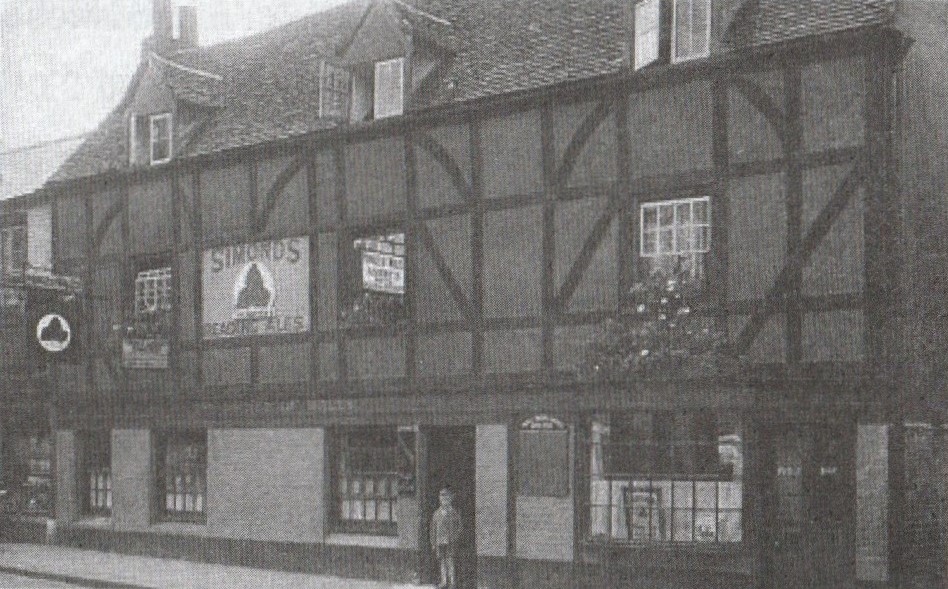
In the week leading up to the murder John Gould was in his local pub, Rance’s beer-house, The Prince of Wales, in Clewer Lane every day. On that fateful Monday, he was drinking with Reuben Turner, a carpenter who had known him since childhood, and said ‘I shall be locked up tomorrow.‘ When Turner asked ‘What are you going to be locked up for?‘ he said ‘For murder.’ He also said that he would not be alive on the first of April. He did not say who he planned to murder, but clearly showed some premeditation.
The wheels of justice moved swiftly. The next morning, Tuesday 31 December, at the Town Hall, the Magistrates Court convened in the Justices’ room before the mayor WB Holderness. Evidence was heard from Sarah Clark, Harriet Clark, Charles Coker, PC Radbourne and others. When the zid prisoner was asked if he had anything to say under caution, he appeared nervous and trembling and said, ‘All I have got to say is that it would not have happened if I had not been drinking. As soon as ever I gets anything to drink, I don’t know what I am about. My head is all over covered with bruises, it has been so knocked about and cut open. That makes me not know what I am about at times.‘
The mayor then committed him for trial at Reading Assizes on a charge of wilful murder. At the same time the Coroner’s inquest was being held in the Council chamber before TW Marlin, Esq, coroner with Mr JW Caley as foreman of the jury. The same witnesses were examined, along with the surgeon James Ellison, and the jury recorded a verdict of Wilful Murder. John Gould was accompanied straight to Windsor Central railway station by Police Sergeant Noble, and taken by train to Reading. As they approached their destination, he pointed to the gaol and said, ‘That will be my last home in this world.’
By the time of his trial at Reading Assizes on 26 February 1862 before Mr Baron Channell, John Gould had made a full confession, and the evidence was a formality. During Reuben Turner’s evidence, it emerged that Gould had attempted to commit suicide several years earlier by hanging. There was little else to be said about his state of mind at the time of the murder and Mr George Russell, on behalf of the defendant, made a valiant attempt to prove that he was insane, but to no avail.
The verdict was Guilty, and the judge put on the black cap to deliver the sentence of death by hanging. The days between the trial and the execution on 14 March were spent in the condemned cell on B2 landing at Reading gaol, much of the time with the chaplain, the Rev. JB Colvil. John Gould’s wife, sister and stepdaughter visited him for the last time on 10 March and he was frequently seen shedding tears of remorse. Elizabeth gave him a Bible and a handkerchief, which he later gave to the prison chaplain as he stood on the scaffold, to be returned to her. A petition for a reprieve with over 400 signatures was presented to the Home Secretary, Sir George Grey, but he ruled that there was no reason to interfere with the due execution of the sentence.
The scaffold was erected on the roof of the gatehouse, and on the appointed day about 4000 people assembled outside the gaol. At midday, the procession including prison staff, the chaplain and the executioner William
Calcraft emerged, and within 25 seconds John Gould was hanged. He took one or two minutes to die, then his body was left for one hour before being cut down, as was the custom. During that time, the drop was shielded on one side to spare the sensibilities of passengers arriving by train at Reading station. The outcry at the barbarity of the spectacle was such that this was the last public execution at Reading Gaol. John Gould was buried in plot number 3 close to the prison wall, and in recent years, a brass plate has been placed at the spot.
Little Hannah Gould was buried in Clewer churchyard, but there is no headstone to mark the place. The Victorian dwellings featured in this story no longer exist. Clarence Clump was a small group of properties approached by an alleyway from Alma Road, directly opposite Clewer Fields. It is now the site of the car park of The Copper Horse. South Place was crowded up against the garden walls of the large houses in Clarence Crescent, and is remembered today as South Path, a footpath separating those walls from the Ward Royal estate. The site of The Royal Infirmary on Bachelors Acre is now an office building and Windsor Liberal Club. The Prince of Wales was a popular pub until the late 1940s, then became retail premises. It was swept away along with all the other shops and pubs in Oxford Road (the former Clewer Lane) to make way for the Ward Royal development in the late 1960s.
Sue Ashley
Sources
Windsor and Eton Express, 4 January-15 March 1862, and earlier court reports.
Judith Hunter PhD, A Victorian Childhood in Windsor.
Anthony Stokes, Pit of Shame (The Real Ballad of Reading Gaol). Waterside Press 2007.
Angus MacNaghten, Windsor in Victorian Times.
1861 census for England and Wales.
The photograph is reproduced by permission of Annemarie Halfpap and shows her father Frederick Rogers as a child outside The Prince of Wales in Oxford Road. The Rogers family, first William and then David had the pub from 1907 to the 1930s.
 Windsor Local History Group