
Published in Windlesora 30 (2014)
© WLHG
A Bronze Ballooning Trophy
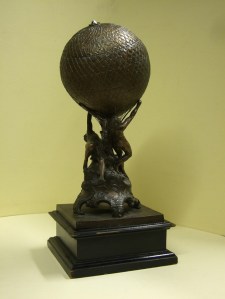
Dedicated to P Y Alexander, in memory of the ascent of 15th
September 1898 by the German Society for the furthering of
aeronautics in Berlin
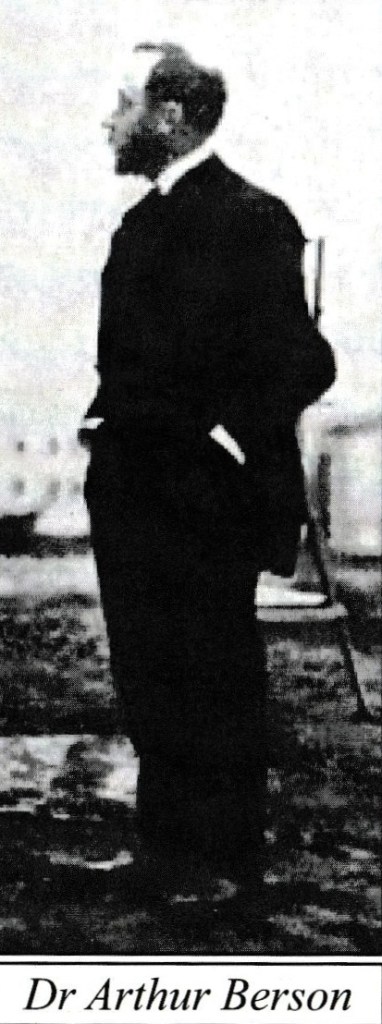
“Oxygen!”, gasped Dr Berson, as the celebrated British aeronaut, Stanley Spencer, handed him a tube from an oxygen vessel to suck on. The thirty year old, Polish-born meteorologist from the Berlin Observatory was making a gurgling noise and feeling rather giddy as he struggled to breathe in the thin air nearly five miles above Victorian London.
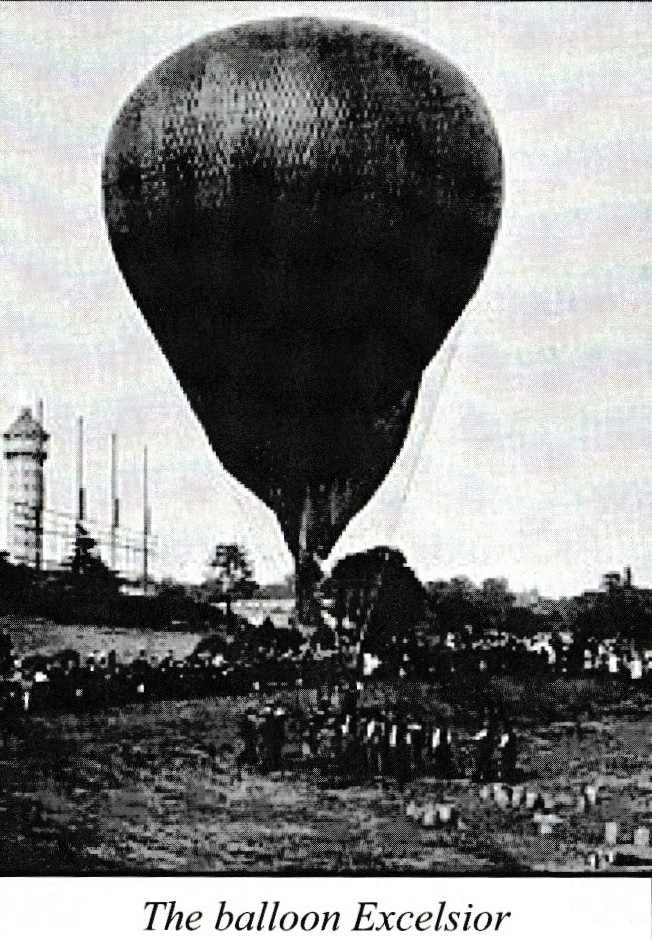
The two men had set off in the hydrogen balloon Excelsior, from Crystal Palace at five o’clock in the afternoon, on September 1898, to explore the high atmosphere. Taking an array of sealed scientific instruments with them, many of which were specially designed for the event, they were able to obtain a great deal of useful information. Using his own thermometer and barometer, Spencer recorded a maximum altitude of 27, 500 feet and a minimum temperature of just 29 degrees Fahrenheit (61 degrees below freezing point).
The men had been provided with heavy woollen clothing to protect them from the extreme cold, but they were both shivering in the tiny five-foot by three-and-a-half-foot open basket on that sunny afternoon. The extraordinarily clear air gave Spencer and Berson an excellent view of the coast of France, along the east coast of England to the Wash, a good deal of the English Channel, and they claimed they could even see the steamers in the Channel.
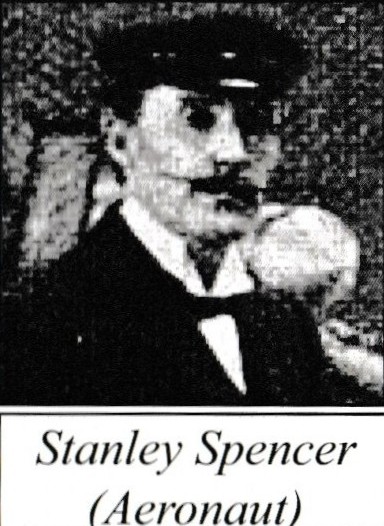
Stanley Spencer released sand ballast at intervals to compensate for the loss of lift caused by the gradual escape of gas from the balloon. He skillfully navigated Excelsior in the air streams, climbing higher and higher, until only four bags of ballast remained, and these were needed in order to land. Having climbed to the maximum possible height, Spencer opened a valve to release some hydrogen gas from the balloon, and Excelsior began to descend, rapidly. The balloon was falling fast, so Spencer released some ballast to reduce the rate of descent, but the balloon was falling faster than the released sand ballast. Alarmingly, the sand was sticking to the varnished sides of the balloon. Eventually, the rate of descent slowed, Spencer regained control, and they landed at Romford.
“We got a decent bump, but no harm done”, said Spencer cheerfully, when he was interviewed by the Daily Telegraph shortly afterwards at the C G Spencer & Sons balloon works in Canonbury.
A grateful Dr Berson told Spencer that the balloon ascent from Crystal Palace had been the most successful of a series of similar scientific ascents that he had made from St Petersburg, Moscow, and Berlin. Writing about the Excelsior ascent in Berliner Wissenschaftliche Luftfahrten (Berlin Scientific Aeronautics) the only English meteorologist to take part in the European project, Patrick Young Alexander is credited with having organised and financed the record-breaking balloon ascent.
The 56,500 cubic foot capacity balloon had been inflated with 40,000 cubic feet of hydrogen gas, allowing room for expansion of the gas as the balloon ascended. Although the highly flammable hydrogen gas was more expensive than coal gas, it could lift 75 to 80 pounds per 1,000 cubic feet compared to only 35 pounds of coal gas. PY Alexander’s provision of hydrogen gas was crucial to the success of the balloon ascent. Following the landing in Romford, the experienced aeronaut, Spencer, noticed that the balloon contained insufficient gas to keep it afloat; in other words, he had to land the balloon or crash!

At the same time, at the sports ground in Friednau, Berlin, as part of the same project, the German balloonist Reinhard Suring, made a similar ascent | so that the two sets of test results could be compared. The Crystal Palace ascent, organised by P Y Alexander, showed that hydrogen gas in a slack balloon, and taking sufficient supplies of oxygen and warm clothing, were absolutely essential for any attempt to explore the atmosphere above 25,000 feet.
After a lifetime of making dangerous balloon ascents and over two thousand parachute jumps, Stanley Spencer died of typhoid fever on Malta in January 27th 1906. He was on his way back from Calcutta where he had been arranging yet another balloon ascent. Arthur Joseph Stanislaus Berson died on December 31st 1942 aged 83. A few month later, Patrick Young Alexander, a former Master and Benefactor of the Imperial Service College, died in Windsor on July 7th 1943, aged 76. Having inherited a £60,000 fortune (approximately £5 million today) he was almost penniless. His headstone reads: Something Attempted, Something Done.
Peter Quennell
References
‘Five Miles Up in a Balloon‘, The New York Times, 26th September 1898.
Wissenschaftliche Luftfahrten (Scientific Aeronautics), Richard Assmann and Arthur Berson, 1899
‘Who’s Who In Ballooning‘, Robert Reichs, 1983.
‘Patrick Y Alexander, 1867-1943, Patron and Pioneer of Aeronautics‘, Gordon Cullingham, 1984.
See also Windlesora Nos: 2, 3, 4, and 5.
Windsor and Royal Borough Museum object 424.58.4 on their website [accessed 5/2/25].
 Windsor Local History Group