
A Windsor Institution
Sir Francis Tress Barry played a significant role in the establishment of Alexandra Gardens. The land for the gardens was initially purchased by Windsor Borough in 1889 for £3,000 using the Health Act. Plans to create a riverside garden date from around 1893, when the bank was straightened and cleansed of ‘squalid piles of refuse’ from the local slums. Then, in 1902, Sir Francis Tress Barry paid off the outstanding mortgage, leading to the full transfer of the land to Windsor.

On Tuesday, 15th July 1902, the Alexandra Gardens were opened by Princess Christian, Queen Victoria’s daughter. The Gardens were named in honour of the new Queen Consort, Alexandra, the Princess’s sister-in-law. In August of that year, a plane tree was planted to celebrate the Coronation of Edward VII and his new Queen, Alexandra. A bandstand was erected, and the band of the Royal Horse Guards played there on Wednesdays from 3 pm to 5 pm.

In 1904, Sir Francis further extended Alexandra Gardens by contributing another £1,985 towards the purchase of additional land, which included the area from the railway arches along Thames Avenue, now renamed Barry Avenue. Part of this land was developed into a public walkway and flood barrier along the Thames.
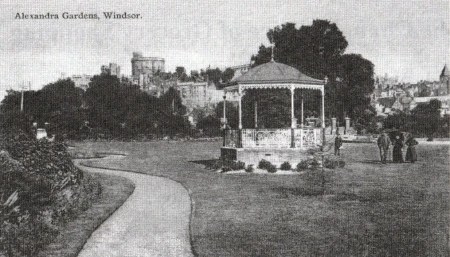
Over the years, Alexandra Gardens has been a cherished recreational venue for the community, with features such as tennis courts, a round garden with a drinking fountain, and delightful walks through excellent flowerbeds. During World War II, the gardens’ iron gates and railings were removed for the war effort, and the round pond was filled in. The pond was later re-instated but, due to leaks, was made into a flowerbed in the 1960s before it was eventually removed in the 1990s.
Nowadays, the Gardens hosts events such as the Windsor Triathlon, Pride, free music at the band stand, the Royal Windsor Wheel, and Windsor on Ice. Whether you love or hate the commercial activities, they do contribute financially to RBWM. Alexandra Gardens remains a significant part of Windsor’s history and a beloved spot for locals and visitors alike. Next time you are walking through, look for the coronation tree and the restored plaques telling the story.
This is just a short snippet and difficult to do the gardens justice; please see Windlesora 23 and RWWS for much more information (see below).
SOURCES
“Alexandra Gardens and Sir Francis Tress Barry, Bart“ by Valerie Batt-Rawden in Windlesora 23.
“Sir Francis Tress Barry – A Forgotten Windsor Philanthropist” by Valerie Batt-Rawden in Windlesora 30.
“Alexandra Gardens” by the Royal Windsor Website.
“The Promenade at Windsor Riverside” by the Royal Windsor Website
“The Story of Windsor” by Raymond South
 Windsor Local History Group