
Published in Windlesora 24 (2008)
©WLHG
George V Memorial
On 11th December 1936 the Duke of York succeeded to the Throne on the abdication of his elder brother, King Edward VIII. The projected coronation of the latter had already been fixed for 12th May 1937 and the date was retained for the new monarch.
In just two months of that remarkable year, the Royal Borough of New Windsor was destined to provide the setting for a memorable sequence of royal events which commenced with the unveiling of the magnificent George V Memorial on St George’s Day. The site selected at the corner of Thames Street and Datchet Road was on land owned by a former brewery. It had been purchased by Lord Wakefield at the time of the Silver Jubilee in 1935 as a birthday gift to George V by whom it was then presented to the Dean and Canons. They in their turn dedicated part of the land for the Memorial.
The memorial itself, designed by Sir Edwin Lutyens and constructed of Portland stone was paid for not only by citizens of Windsor and the neighbouring towns, but also by the city of Windsor, Ontario.
On that St George’s Day, there assembled for the unveiling a considerable concourse, which included the writer who, from the vantage point of his father’s shoulders, watched the ceremony with childhood wonder.
The band was found by the Coldstream Guards, soldiers of which regiment lined the streets in the immediate vicinity. On the steps of the Memorial stood troopers of the Royal Horse Guards. Members of the clergy were headed by the Archbishop of Canterbury and Dr Baillie, Dean of Windsor. The occasion was rendered the more impressive by the presence of a goodly number of the Royal Family. First to arrive were the elderly Princesses, Helen Victoria and Marie Louise, followed by the Earl and Countess of Athlone, Princess Arthur of Connaught and the Duke and Duchess of Kent. Thereafter came Queen Mary with the Duchess of Gloucester. The Duke of Gloucester, as High Steward for Windsor, then received the King and Queen, to whom, with other local notables, was presented Sir Edwin Lutyens. After a welcome by the Mayor, Arthur Churcher, the King spoke as follows:
‘Thank you Mr Mayor for the Address which you have read to me. It was with gratitude to the people of the Royal Borough of Windsor that I shallunveil the Memorial to my dear Father, which they have set up in this place. They have ever been foremost in their loyalty and this Memorial will be a new link in the long chain of associations which has bound together my House and the citizens of Windsor.
In itself the Memorial seems to me finely conceived and finely executed. It is fortunate also in its site, standing as it does against the background of the Castle, reminding us of the long and wonderfully continuous history of the English Monarchy and the English people.’
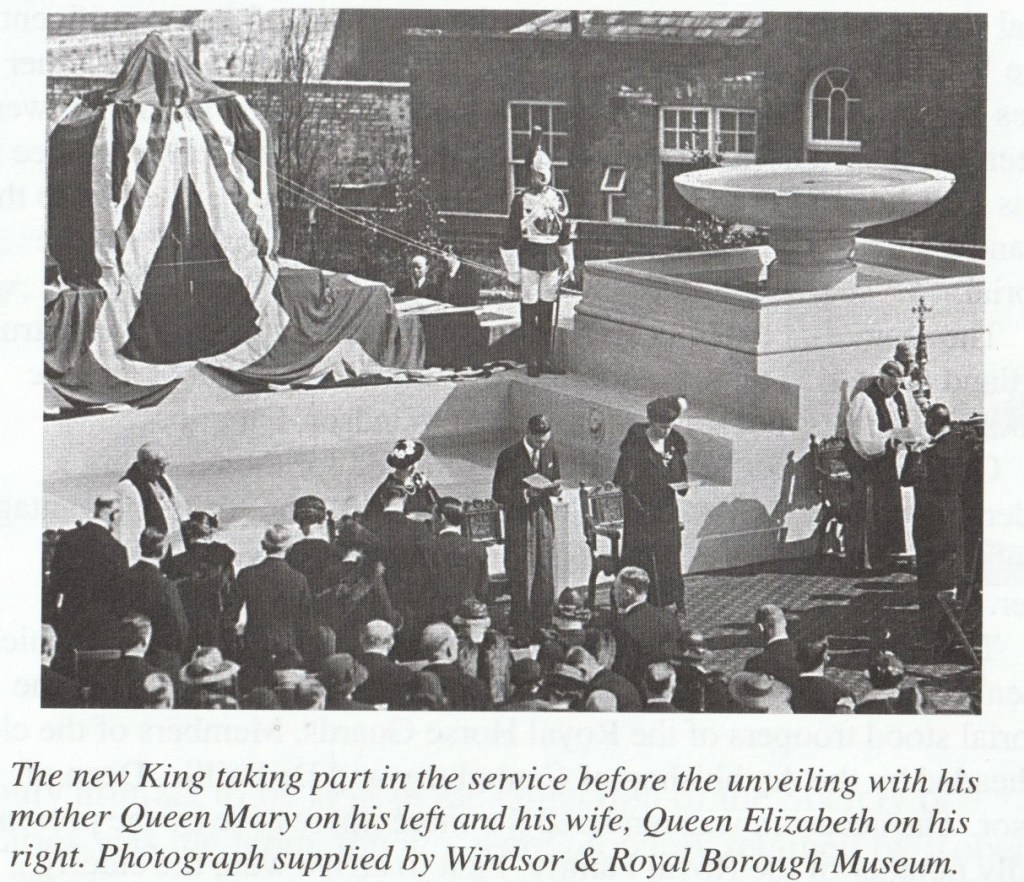
His Majesty then proceeded to the unveiling; the flags fell away, the water flowed and the King laid a wreath. Thus, seventy years ago, Windsor witnessed for the first time this noble addition to its architectural heritage, for all the world like a crowned, iced wedding cake set between two giant saucers, a delight to the eye and a fitting monument to a worthy and well loved representative of England’s constitutional monarchy.
Seventy years later the water no longer flows. Trees, which heavily overshadow the memorial, also probably damaged the fountain mechanism with their roots. Windsorand Maidenhead Council have filled in the basin and turned it into a flower bed.
And Three Weeks Later – The Coronation
‘Memory plays strange pranks but there must be very few who will not remember till the end of their lives the day on which King George VI was crowned’. So ran the editorial in the Windsor & Eton Express.
The memories of thousands of Windsorians of that far off Coronation Day on 12th May 1937, were augmented that week by a cornucopia of activities in the Royal Borough.

The town was smothered in great swathes of flags and bunting. On Coronation Day, amongst the concourse filling every nook and cranny in Westminster Abbey, were those great musical figures from St George’s Chapel, Dr Fellowes, Sir Walford Davies and Dr Harris, the latter being then the Organist and Master of the Choristers. The choirs of St George’s Chapel and Eton College Chapel, took part in the Service.
Those millions with ears to their radio sets, this being the first ever broadcast of a Coronation, heard Archbishop Lang of Canterbury intone the moment of crowning: ‘Oh God, the Crown of the Faithful: Bless we beseech thee and sanctify this our servant GEORGE our King: and as thou dost this day set a Crown of pure gold upon his head, so enrich his royal heart with thine abundant grace, and crown him with all princely virtues, through the King Eternal, Jesus Christ our Lord.’
In the Great Park the guns signalled at 12.31 pm the actual moment of crowning.
From two to eight in the afternoon the Home Park provided the mise en scéne for a gathering of some 1800 Windsor school children, of which the writer was a miniscule part. The juvenile assembly, after giving voice to a sustained chorus of patriotic songs, was treated to tea, the delights of a fun fair and a copy each of a book Our King and Queen ‘Presented by the Mayor and Corporation of the Royal Borough of Windsor as a memento of the Coronation of their Majesties King George VI and Queen Elizabeth on 12th May 1937 and we hope it will prove of great interest and value.’ The writer’s copy, a little battered after 70 years, still remains a valued part of his library. Displays were given by the Windsor Scouts and Girl Guides and a sports demonstration by the Windsor Church Lads Brigade.
Large size photographs of the new King and Queen in oak frames surmounted with the Royal Arms and autographed, were presented to 1100 old folk of the town, who were over 65, together with a gift of five shillings.
Numerous teas and suppers were served on long trestle tables in many of the town’s flag bedecked streets and Mr Reginald Try provided coaches to give children two hour drives around the neighbourhood. There was a Coronation Ball and a Coronation Concert in the King Edward Horse Hall which then still stood in York Road, given by the Windsor & Eton Choral Society under its honorary conductor, Mr G Mervyn Bruxner. Windsor Castle and St George’s Chapel were floodlit in fairytale splendour, not then so customary a sight as it is today.
For Windsor it was, as in so many towns and villages, a magical week, the Express providing a final tribute: ‘We know that He who on Wednesday was crowned in Westminster Abbey, will do his part; our own loyalty we repledge every time we sing or hear the familiar words “God Save the King”.’
Amidst these national celebrations, Windsor still had its own especial part to come. On Saturday 12th June the King and Queen and the two small Princesses graced Windsor with a State Entry. Excitement was high and the streets were thronged to witness the conferment of this unique honour on the Borough. After a halt at Agars Plough where the Royal party was greeted by Lord Cottesloe, Lord Lieutenant of Buckinghamshire, Sir Hugh Cecil and Claude Elliott, the Provost and Headmaster respectively of Eton College, together with the Masters and boys, the State Coach drawn by Windsor Greys proceeded beneath a triumphal arch on Windsor Bridge up Thames Hill to Boehm’s commanding statue of Queen Victoria. Here, headed by the Duke of Gloucester High Steward, were assembled the Mayor and Corporation, whom the Chief Constable in a new uniform led to their seats. There they were joined by the Lord Lieutenant for Berkshire, Mr AT Loyd. Room was found for 5000 children to watch this historic occasion.
The Ceremony over, the Royal Procession drove into the Castle via the Long Walk where over 15,000 children, two thirds from outside Windsor, cheered the Royal Family on their way.
It was a day of processions for there were three more to come. A mammoth parade of decorated floats, entitled Windsor Through the Ages, months in the making for which the historical notes were written by that great benefactress of Windsor, Miss Doris Mellor, and involving some 400 performers, threaded its way through Windsor’s streets. The brilliantly elaborate tableau included:
Magna Carta ‘Perhaps the most important event in the history of Windsor’,
‘The Installation of the Black Prince as a Knight of the Garter’ (organised by Raymond South, prolific contributor to Windlesora in the past),
‘Queen Elizabeth receiving a marriage proposal from the King of Sweden’ (Windsor & Eton Operatic and Dramatic Society) and
‘Charles II receiving the King of Battam’ (Windsor & Eton Choral Society).
The writer who excitedly watched these processions from a first floor window at his father’s optical practice in Peascod Street clearly remembers the terrifying spectre of Herne the Hunter and became ever afterwards an addict of Harrison Ainsworth’s Windsor Castle wherein stories of this menacing spirit abound.
Next came a cavalcade of decorated cars for which the first prize was awarded to R F Surplus & Co, the second to Mr Horace Dodge of St Leonard’ Hill and the third to Messrs AA Clark Limited.
Lastly, after nightfall, a torchlight procession with bands of over 500 firemen drawn from sixty brigades, whose flaring torches held high, reflected dazzlingly in the helmets of burnished brass remains lodged in the writer’s memory. Truly, it was a night to remember.
Windsor’s Coronation commemorations were not yet over. A week after the State Entry, the Coronation Memorial Grove was planted near Cumberland Gate in the Great Park. The King planted the first of sixty oak trees, representing the countries of the British Empire. Of this imaginative enterprise it is recorded ‘As far as possible the tree representing each territory will be placed in a position corresponding with the territory’s compass point in relation to the British Isles’.
The final flowering of Windsor’s Coronation year was a River Carnival organised by Eton Excelsior Rowing Club. The Alexandra Gardens, and the newly constructed Riverside Walk as well as the Castle and Eton College were all floodlit for the evening. Windsor and Eton Operatic and Dramatic Society won first prize for illuminated craft, with what the judges described as ‘two splendid exhibits — the King’s Horses and the Viking’s Funeral’.
A quotation from Harrison Ainsworth is decidedly fitting to end this Royalist essay: ‘It was now the joyous month of June; and where is June so joyous as within the Courts and Halls of peerless Windsor? There stands the Castle dating back as far as the Conqueror, and boasting since its foundation as succession of Royal inmates, while at its foot lies a region of unequalled felicity and beauty — full of happy homes and loving, loyal hearts.’
 Windsor Local History Group