
Published in Windlesora 13 (1994)
© WLHG
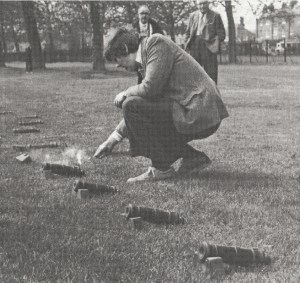
The Royal Borough of Windsor and Maidenhead is unique in this country – a civilian organisation which regularly fires gun salutes.
The custom goes back to the eighteenth century and there are records of salutes in 1754, 1762 and 1764 during the reign of George III. In those days the firing of the cannons was a private affair and amongst the Borough Records are bills for firing salutes in 1822, 1823, 1824 and 1830. The cost in 1830 was £6 “to be paid to the Town Sergeant for attending the Bulletin during the late king’s illness and for firing Canon on the occasion of His Present Majesty’s Arrival at Windsor, including Gunpowder etc.” The monarchs referred to were George III and William IV. The various records call them “canon”, “Cannonades” or “Carronades”.
Ownership of the cannon was claimed by the bombardier until in 1938 Alderman White purchased them from him and presented them to the Borough Council who took over the custom of firing Royal Salutes.
The origin of the cannon is obscure, it is possible that they were originally part of the equipment of Captain Inglis’ beautiful miniature man-of-war ‘Victorine’ which used to sail on Virginia Water, in the early nineteenth century. Originally there were twenty-two but one was stolen while on display at the Guildhall, so now there is the bare minimum number of twenty-one.
My predecessor as Town Clerk of the Royal Borough of Windsor, John Siddall, had considerable correspondence with the Carron Iron Company of Scotland to try to establish the origin of the cannon. This proved abortive as the company could find no record of having made them. The letter ended with the admonition that they should not be called carronades, as the name was exclusive to the products of that company!
My own involvement began in late 1960, when as an ex-gunner, I became interested in the cannon. Salutes were, and still are, fired on the Queen’s birthday, April 21st and the occasion of the birth of a child to the Sovereign.
The cannon are quite small – one foot long, one and a quarter inch bore and about twelve pounds in weight. They were fired at one minute intervals, but I was sternly reminded by a retired Admiral that minute guns were for funerals and hardly appropriate for Her Majesty’s birthday. The interval is now half a minute.
The method of firing was through the touch hole, using a Bengal match held in a bulldog clip attached to a broom handle – a rather Heath Robinson arrangement which did not last too long. As part of the ceremonies creating Prince Charles an Honorary Freeman, a 19 gun salute was fired as he entered the Home Park Public. The salute had to be fired in quick time, but after the first six or so the clip bent, so the bombardier, Ted Lobley, fired the remaining guns with hand-held matches. The Duke of Edinburgh, who was watching on the dais remarked to Ian Keeler, deputy Mayor, “That looks bloody dangerous!”
Shortly after this an examination of the cannon showed that the touch holes had become enlarged to the extent that they were becoming dangerous.
Gordon Cullingham suggested we seek help from the admiralty, but as an ex-gunner with a younger brother who was Deputy Commandant of the Royal Artillery Depot at Woolwich, I sought his advice and help. As a result a master gunner (WO) came and examined the cannon and took them away for repair. I believe they finished up at the REME apprentices school at Arborfield where the touch holes were drilled out and plugged and the plugs drilled with a small diameter hole to take a modern fuse, the new firing medium. The cannon were then returned to Woolwich where officialdom insisted that they had to be proofed – test fired – before being returned. The scientists at Woolwich Arsenal undertook this task as a welcome change from testing modern breech loading high velocity weapons. At the end of the tests Bombardier Bashford and I spent a pleasant and instructive day at Woolwich. We came back with the cannon and a revised method of loading and firing which used about half the previous quantity of black powder but produced just as good a bang.
There have been a few incidents connected with firing salutes. On one Sunday a cease-fire had to be ordered whilst the Royal Family came back from Royal Lodge. On another, it was noticed that there were three people and a polo pony in the park on the opposite side of the Long Walk. They proved to be the Duke of Edinburgh, Prince Edward and a groom!
After the re-organisation of the borough the custom of firing salutes continued and we now have a keen new bombardier, a member of the Maidenhead Rifle Club, who has made new carriages for the cannon which look extremely smart. I hope the borough and its successors will continue the ancient custom of firing Royal Salutes and if you want to see for yourself, be in the Long walk at 12 noon on 21st April and you may even be asked to fire one of the cannon.
George Waldram
 Windsor Local History Group