
Published in Windlesora 29 (2013)
© WLHG
Windsor’s Connection with two Coronations
The story begins with the accession of King William IV on the death of his brother King George IV in 1830. The late King had been very unpopular and few mourned his departure. He had led an extravagant lifestyle and this with his dissolute way of life earned him the contempt of the people and dimmed the prestige of the monarchy. By 1830 there were political and social changes with the end of a long period of Tory rule and rise of the Whig party.
William IV was unassuming and discouraged pomp and ceremony and wanted to be disassociated from the lifestyle of his late brother. His coronation was an opportunity to show this, and was chosen to be a much simpler affair. A temporary annexe was built at the west end of Westminster Abbey to be used as a Robing Room for the main participants in the coronation service and this has continued at all coronations from that time. There is little information about the annexe for Queen Victoria’s coronation, but for Edward VII’s coronation the annexe is well documented; its design, construction, and furnishing was the work of a Windsor resident, Mr Alfred Young Nutt. He was am employee of The Ministry of Works at Windsor Castle, Surveyor of St. George’s Chapel and the Frogmore Mausoleum as well as being involved in town affairs.
Mr Nutt first came to be known for his skill in creating faked temporary buildings in 1887. He was commissioned by Eton College to create a ceremonial arch over Slough Road in the vicinity of the college, which the Queen would pass under on her route back to Windsor Castle after the Golden Jubilee celebrations in London. The arch looked to be weather-worn brick and lichened stone with the arms of the founder Henry VI placed above the keystone. Over the outside buttresses were two niches with the figures of King Henry and his Queen, Margaret of Anjou. Over the inside buttresses were two more niches with the figures of the patron saints, St Mary the Virgin and St Nicholas, and the admiring visitor could not but notice with regret that the stone of the Virgin’s face, as so often happens with ancient carved figures, had mouldered away.
Built of scaffolding, lathed with paper, card and paint, you could walk up to it and still think it a mediaeval archway of solid stone and brick. It deceived both the amateur and skilled architect. This arch was repeated ten years later for the Diamond Jubilee when another arch was erected at the Windsor/Eton Bridge called the Porta Victoriana. In the centre was a statuette suggestive of the Queen in her coronation robes. A third arch was a canopy in the Italian Renaissance style surmounting the statue of the Queen on Castle Hill. Nutt’s work in Windsor led to his being commissioned to construct an annexe for the coronation in 1902.
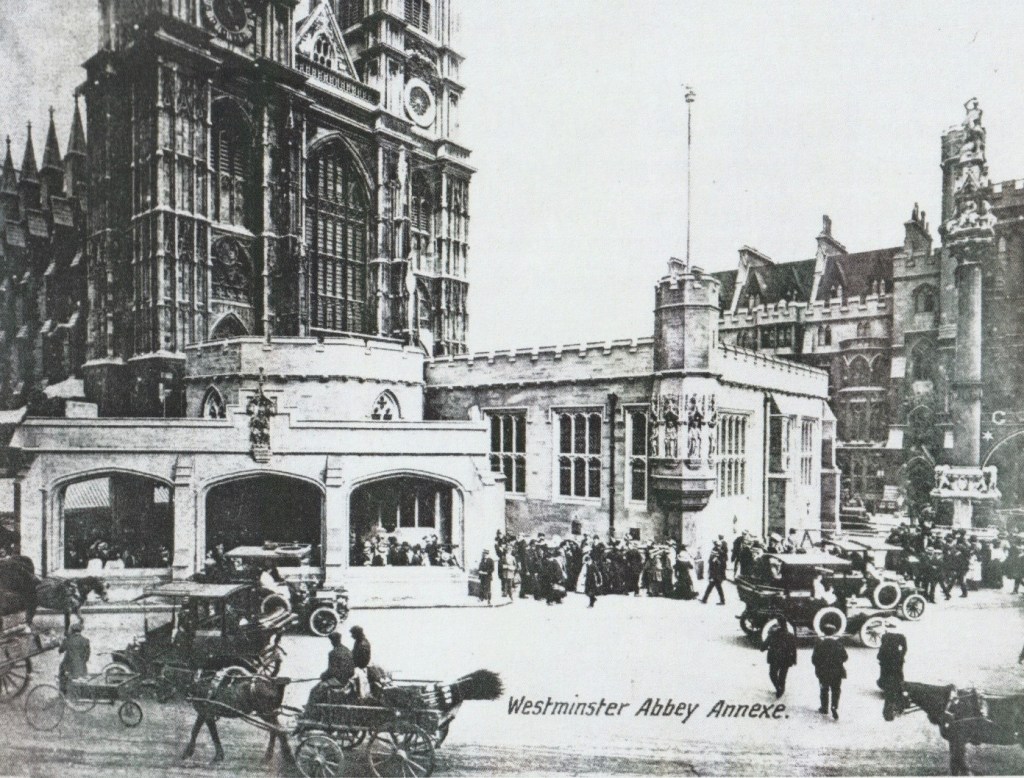
A report in the Auckland Star of 13th August 1902, gives details of the building.
“The style of architecture is fifteenth-century Gothic that of the Jerusalem Chamber, to which, on its southern side, the new part is attached. The result is that one can hardly tell where the Abbey ends and the annexe begins. In reality, it is all wood and plaster, the new part of course, but so dexterously has the “faking” process been effected that the most critical could hardly determine the fact off-hand. Every detail will bear the closest inspection. Notice especially the effect of age produced by the crumbling shields and other devices or reliefs figuring at intervals round the walls. Also, the cleverly carved grotesques and gargoyles up above, the solid buttresses suggesting centuries of wind and weather and the niches all round the building, to be filled with statues with all the Edwards of the Royal line. It is an amazing effective artifice”.
The interior consisted of two small rooms and the large Robing Hall which was 117 feet long, 62 feet wide and 30 feet high. It had a massive timber roof supported by a row of square wooden pillars down the centre of the room and lighted by quaint fifteenth-century windows decorated by badges embracing the Norman, Plantagenet, Lancastrian, York, Tudor, Stuart and Hanoverian periods. The papering, which bore the Rose, Shamrock and Thistle, was relieved at intervals by fine tapestry and armour. Some came from the Duke of Marlborough’s fine collection of Burgundian tapestries, and the armour, selected from the Tower of London, was arranged by Mr Guy Laking, the Royal Armourer. On display were twelve complete cap-d-pie suits on models standing on brackets, about 200 halberds and hafted weapons, and some 200 pieces of miscellaneous armour whose value was beyond price.
Great attention to detail was lavished on the annexe despite its short life. It was in a conspicuous place where it was admired and studied by the thousands who thronged to Westminster Abbey, not only for the coronation itself but for several weeks afterwards to see the furnishings . The newspapers of the time speak of the “sixpenny snake” that wound round the Abbey and along the
Embankment; these spectators entered the Abbey through Mr. Nutt’s annexe.
The national and provincial newspapers were enthusiastic. The Birmingham Post called it “This most skilful forgery”. The Star wrote: “The Abbey Annexe, the unique lathe and plaster structure”, and the Daily Telegraph: “This annexe, most successful from an artistic point of view”.
However the highest accolade came in 1911 when it was decided to re-build the annexe for the coronation of George V.
Norman Oxley
Footnote
The annexe for the 1953 coronation is best remembered for the heraldic statues of The Queen’s Beasts, depicting the genealogy of Queen Elizabeth II which lined the front. The original statues are now in Canada, but Portland stone replicas were created in 1958 and are on display outside the Palm House in Kew Gardens.
References
A Y Nutt: In Service to Three Monarchs at Windsor Norman Oxley Royal Books 1997
Auckland Star 13 August 1902
Wikipedia web site
 Windsor Local History Group