
Published in Windlesora 10 (1991)
© WLHG
In 1958 a firm of architects was called in to make a survey of the Windsor Steam Laundry which had suffered badly from neglect of maintenance due to the War. It had been run throughout the war by Mrs Wilkinson, wife of the then proprietor who had joined the Army, and employed some 60 to 80 people. Employees had been responsible for fire-watching, taking it in turns to spend a night in the office.
The Laundry, stood in Peascod Street on the site of the present entrance to King Edward Court from Peascod Street. It had been a thriving business numbering among its customers the main hotels and King Edward’s Hospital. It was finally demolished to make way for the King Edward Court development.
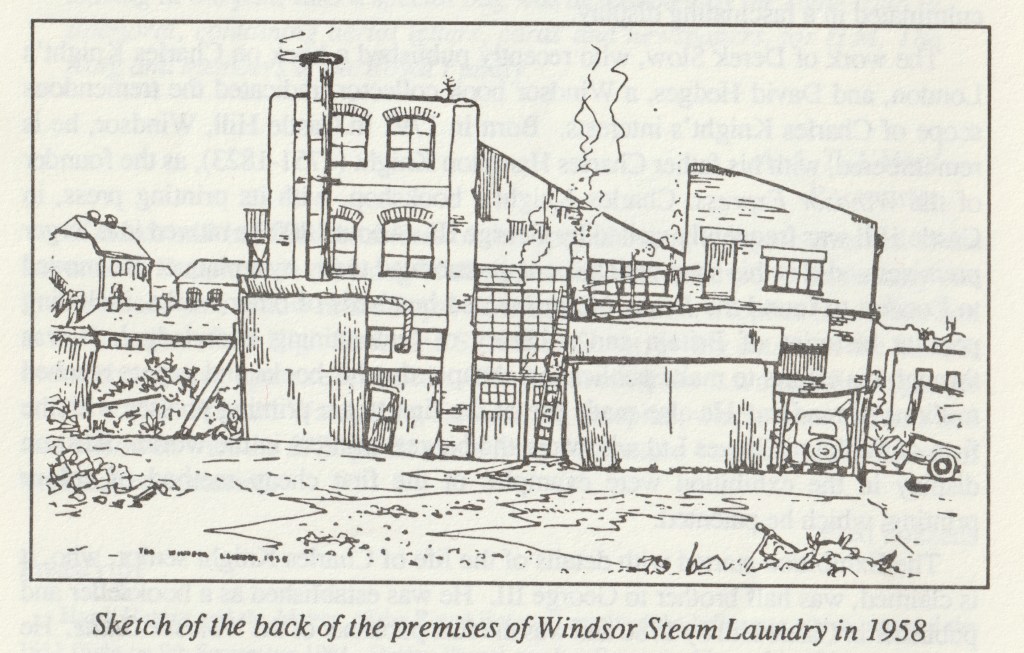
When he undertook the survey in 1958, the architect made the drawing of the back view of the premises, shown here, and he describes what he saw at that time. His comments provide a vivid picture of the working conditions of those employed in the ramshackle building which by then had structural cracks through which daylight could be seen.
‘On the top of the old four-storey block there is a small tree growing from the rotten and sodden brickwork. Just in front of that is a corrugated iron shed and sheet stall smoke stack for the large old coke-fired boiler, which fed hot water into the building through the lagged pipe that can be seen bending out of the right-hand side of the tin shed. Behind the shed, under the timber shoreing holding it up, can be seen the boilerman stoker cooling off with a cigarette. The door to the boiler room is set open to cool off the stoke hole. To the top right of the picture is a second floor office and, very properly, a fire escape route from it was provided. This consisted of a ladder laid diagonally across an asbestos cement sheeted roof, complete with handrail on bracket supports and a vertical wooden ladder set buttress-wise against the adjacent sheeted building. Note the washstand mirror, with carved cherrywood surround, carefully propped at the top of this ladder. This enabled the stoker of the boiler to see the top of the boiler chimney from inside the boiler house when it was raining, and judge from the colour and amount of the smoke, the state of the boiler and whether it required attention or not.
From the double doors at the foot of the ladder can be seen emerging a stream of dirty soapy water. The drains in the area could not take this outflow, so it flooded the yard and soaked into the ground. The holes and hollows produced were filled up with ash and clinker from the boiler. To the right of the picture there is an old car rusting away in a dangerous garage, and someone is throwing laundry boxes out of a van. There is no insulation in the place and little more than natural ventilation. Just above the ladder is a rickety ventilation duct made of old tins riveted together, between the windows which lit the ironing and finishing area.’
Michael A. A. Bayley
(Web editor’s note September 2023: In the summer of 1966, The Ricky-Tick club was due to be turfed out of the old TA premises they used by the river at Clewer Mead. A newspaper article around July 1966, details the possible move to part of the old Windsor Steam Laundry. John Mansfield, in his book, ‘As You Were : The True Adventures of the Ricky Tick club’ tells of the problems he had trying to get council permission for his club. But, maybe it was just as well, as the state of the building sounds worse than Clewer Mead !)
 Windsor Local History Group