
Half a Century of Talents, Tenors and Triumphs
Published in Windlesora 28 (2012)
©2012, WLHG
“There is nothing like music for transporting one a thousand miles from hateful surroundings into realms of bliss” – Diana Mosely née Mitford.
Windsor citizens before WWII enjoyed the blessings of music and drama, often by way of the Windsor & Eton Opera and Dramatic Society, the locus for whose productions for many years was the old Victorian Royal Albert Institute building in Sheet Street. The Society presented annually, drama, a light opera and a revue. The blight of war signaled the demise of both the operatic and dramatic segments of the Society, whereas the revues, with a new producer, became the Windsor Theatre Guild, which celebrated its 70th birthday in 2009. Although the Theatre Guild gradually annexed the field of drama, Windsor lacked any exposure to light opera over a span of some 30 years, but in 1961, this cultural void was brought to an end.
In November 1961, a small but imaginatively inspired group of enthusiasts came together, determined to recreate the thriving operatic scene which had been defunct since 1939. In the front room of Chris and Margaret Gilson’s home in Old Windsor gathered the four initial founders. The campaign was afoot.
Publicity for the new venture was afforded via the Windsor, Slough & Lion Express. News of the regenerated phoenix spread and in February 1962, the first meeting of an ad hoc committee was held in Windsor Parish Church Hlall, Jim Howard became the all-important Chairman, Bob Appleton, the equally essential Secretary and Chris Gilson, the Treasurer. Publicity — a vital factor for the nascent Society — fell to the lot of June Holmes. Margaret Gilson assumed responsibility for costumes and the husband and wife team of Don and Muriel Shorter, took charge of Front of House. The name of the infant prodigy would be The Windsor & Eton Operatic Society.
The First Decade
The Society’s entrance onto the Windsor scene was heralded with a production of The Pirates of Penzance at the East Berkshire College in Claremont Road. The venue was somewhat ironic considering the College began life in the old Royal Albert Institute building where the pre-war Operatic and Dramatic Society had its home.
From the beginning, the Society was remarkably fortunate in the calibre of the most vital of its participants: the Producer and the Musical Director. It was said of Eric Bond on moving south to take up a teaching post in Windsor (hat ‘It was surely Lancashire’s loss and Berkshire’s gain’. Eric Bond came to Windsor with 30 years’ experience of light opera including composition of libretti and lyrics. The fact that he produced the first seven of the Society’s shows and others intermittently thereafter was an inestimable advantage in the early years of the fledgling society. John Willan and Morris Maggs shared the musical directorship of the first seven shows and with strong musical backgrounds and accomplishments ensured an excellence to match that of Eric Bond’s productions.
Such a venture, of course, posed a raft of anxieties, not the least of which was that of finance. As a new society there was no core audience but this worry receded when the 16-strong Committee of the Windsor, Eton and Ascot Chamber of Trade agreed to underwrite the first show to the extent of £5 per head. Money 4 values were very different in 1962 (ticket prices ranged from 3/- to 6/-, subscriptions were £1 per year; 5/- for juniors) and a guarantee of £80 was sufficient to soothe the Treasurer’s troubled brow.
Among the cast of that first production were names that for some years figured frequently in the Society’s annals: Martyn Cable, Mark Randall, Pat Cross, Ruth Hissey, David Rossiter and Richard Willan, brother of John. Don Shorter, an extrovert hairdresser known as ‘The Singing Barber’ played leads for years to come. One only of the originals has survived the entire span of 50 years Barbara Chivers was 16 when she joined and she continues as a most mellifluous member of the chorus to this day.
Pirates passed off triumphantly: as the local paper recorded ‘They achieve a really right rollicking presentation of Gilbert and Sullivan’s Pirates of Penzance Producer Eric Bond can be really satisfied with the Society’s first effort’.
May of 1963 witnessed the Society’s second show The Mikado and with it the arrival of two exceptional soprano soloists who for the next few shows delighted audiences — Jill Maggs and Kathy Clark. Included in the chorus of schoolgirls appears the name of one who thereafter was to become indispensable. Doris Lett became the Society’s Secretary in 1971 and thus achieves her 40th anniversary simultaneously with the Society’s 50th.
An early decision was taken that neither soloists nor Producers, Musical Directors or Officers, would be paid, apart from occasionally for travel expenses, and this has remained the Society’s policy. When in 1983 the Society mounted Mascagni’s Cavalleria Rusticana, the Icelandic contralto, Sigridur Ella Magnusdottir, was scheduled to play the part of Lola for Reykjavik Radio. She traveled at her own expense to be able to sing the part with the Windsor & Eton Operatic Society.
The Society was determined to become not just a G&S Society and following The Gondoliers and Iolanthe in 1964 and 1965, the next two selections were Sigmund Romberg’s The Student Prince and Merrie England by Edward German. In 1968 the Society instituted its long tradition of two shows each year, save in 1972, when a projected showing of Rudolf Friml’s The Vagabond King was abandoned on account of illness.
The Second Decade
East Berks College lacked various facilities requisite for the Society and until the early Seventies, Churchmead School at Datchet became the Society’s venue followed briefly by Windsor Grammar School. In 1975, the Society was relieved from its perennial concern as to where the next show would be. A guardian angel in the shape of Eton College offered the magnificence of the Farrer Theatre for its spring production of Die Fledermaus.
As vital as the venue for the show was a location for auditions and rehearsals. Initially, in Clewer Hall — Barbara Chivers still remembers the wind whistling through the broken windows — there came successively to the rescue the late lamented King Edward Horse Hall and then Trevelyan and Oakfield Schools, rehearsals at the latter continuing for nearly twenty years.
The aspirations of the Society were expanding and school halls, generously as they had been made available, were becoming less attractive, especially in comparison with those at the Farrer. The only other fully equipped theatre in the neighbourhood was The Planet at Slough and between 1977 and 1986, the Society was able to perform alternately between the two, in the spring at the former and in the autumn at the latter.
The Society attracted a galaxy of personalities to its ranks, many of whom were talented school teachers. Some successfully filled more than one role. Brian Ewart, Freda Lewis and Polly Clark produced and performed, Brian Midgley and Brian Henry (‘The Two Brians’) both took to the boards and served as Musical Directors. The latter, a senior master at Windsor Boys’ School and a brilliant musician, first performed as Hilarion in Princess Ida in 1970, became Chairman in 1980 and has served an amazing 27 times as Musical Director up to The Marriage of Figaro in April 2011.
Audiences beheld sparkling performances from talented soloists including Reg Perkins, Colin Anthony, Ken Millett, Carol Pearce and Sallie Brooks. Sallie, who later married Keith Ward, one time Chairman, displayed considerable acting ability and with her beautiful soprano voice, played many parts in the Society’s successes.
Others who played major parts in the 70s and 80s included Mary Atkinson, a fine contralto, Lewis Ashman, Tony Ayling, with a formidable bass voice, and Helen Banfield, with her husband Alan, is still closely associated with the Society. David Upton, author of a couple of ‘undiscovered’ Sherlock Holmes stories, has served loyally as a rehearsal pianist with only two absences for the last 35 years. Since the Spring of 1976 Trevor Morgan and John Dixon, have been efficiently active behind the scenes, The 1970 production of The Merry Widow was electrified when it became known, on the last night, that the aunt of Churchmead School’s Headmaster, who was in the audience, had herself known Franz Lehar in Vienna.
The Gondoliers in April 1974, marked the first repeat and the President in his Programme Note challenged St Matthew’s dictum: ‘Use not vain repetitions as the heathen do; for they think that they shall be erred for their much speaking’.
The following year witnessed the Society’s 21st production, The Mikado, but it was looking forward rather than back. The Presidential Note quoted George Bernard Shaw: ‘Reminiscences make one feel so deliciously aged and sad’.
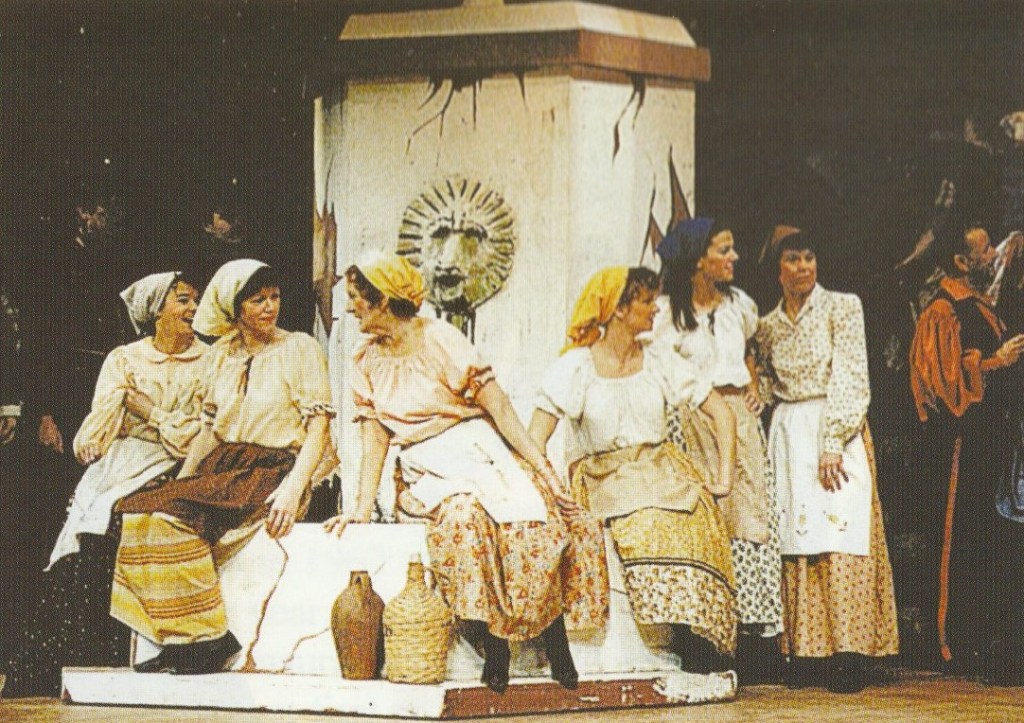
In 1976, with Freda Lewis as Producer and the Two Brians as joint Musical Directors, the Society launched forth, for the first time, into Grand Opera. That production of The Magic Flute was a watershed in the Society’s history. Thenceforth Ne plus ultra could have been its motto. Success breeds success and in 1978 the heights were again achieved with a spirited production of Bizet’s Carmen.
The Third Decade
In 1981 Offenbach’s centenary was celebrated with Orpheus in the Underworld. This production was significant in the Society’s history, marking the first appearance as Producer of the talented David Thomas. Former Deputy Headmaster of Burnham Grammar School, he was himself a consummate actor and an acclaimed Director for the Windsor Theatre Guild. He has now produced with flair and felicity, no less than 20 of the Society’s productions.
A glittering Masked Ball in 1982 betokened another historic occasion when in conjunction with the Rotary Club of Windsor & Eton, the Society mounted its first Royal Gala, the Guest of Honour being HRH Prince Philip, Duke of Edinburgh. This event was the first of a series of magnificent Galas held each year during the Spring production, all the others being in partnership with the Rotary Club of Windsor St George. The Duke of Edinburgh honoured the Society twice more at the productions of Turandot and Jolanthe in 1985 and 1997.
1983 shone forth as perhaps the most splendid of these Royal Galas when HM The Queen Mother attended a joint programme of Cavalleria Rusticana and Trial by Jury. Thereafter HRH The Princess Royal was welcomed to see Carmen in 1988. The Princess was asked what had caused her to accept the invitation beyond that it was in aid of her charity Children in Need. ‘Well’, she replied ‘I had never seen Carmen before and my father told me that you put on extremely good shows’.

HMS Pinafore in 2001 saw a splendid visit by the Earl and Countess of Wessex, who delighted many present at the interval drinks party by seeking out the youngsters serving the drinks and canapés. Between 1983 and 2004, this pairing of the two organisations reaped substantial rewards for both organisations, not to mention the large sums raised for various charities, both local and national. The other well-known names which graced these sparkling slack Tie and Champagne fuelled occasions included the Duchess of Norfolk, the Lady May Abel Smith and the Rt Hon. Countess Mountbatten of Burma, who were respectively present for Nabucco in 1986, Aida in 1990 and The Gondoliers in 1992. For the brilliant production, some say the most brilliant ever produced by the Society — of Don Carlos in 1996, the Spanish Ambassador and his wife attended the Gala Night and with a party of 16 were subsequently entertained to a superb dinner in Windsor Castle at the invitation of the Governor and Constable, Sir Patrick Palmer. For the 1999 Gala Production of Die Fledermaus the guest of Honour was Dr Joachim Oppinger, an attaché at the Austrian Embassy, with his wife. The most recent of these 23 Galas was The Magic Flute in 2004, the guest of honour on that occasion being the Duchess of Wellington.
Ruddigore in 1983 was ably produced by the aforementioned Sallie Ward (formerly Sallie Brooks). She produced for many years before moving to Park Opera at the Wilde Theatre at Bracknell. The Chairmanship was taken for the next year or two by Hugh Tulloch, who was lost to the Society when he died of injuries sustained in a car accident. Polly Clark, another skilled member, whose husband Jeremy was, for a long time, the Society’s Treasurer, produced the 1984 production of The Gondoliers.
Bill Wyllie made his debut about this time. He was an accomplished actor and a professional artist and Head of Art at Bearwood College. Amongst other credits he produced Yeoman of the Guard for the Society in 1988.
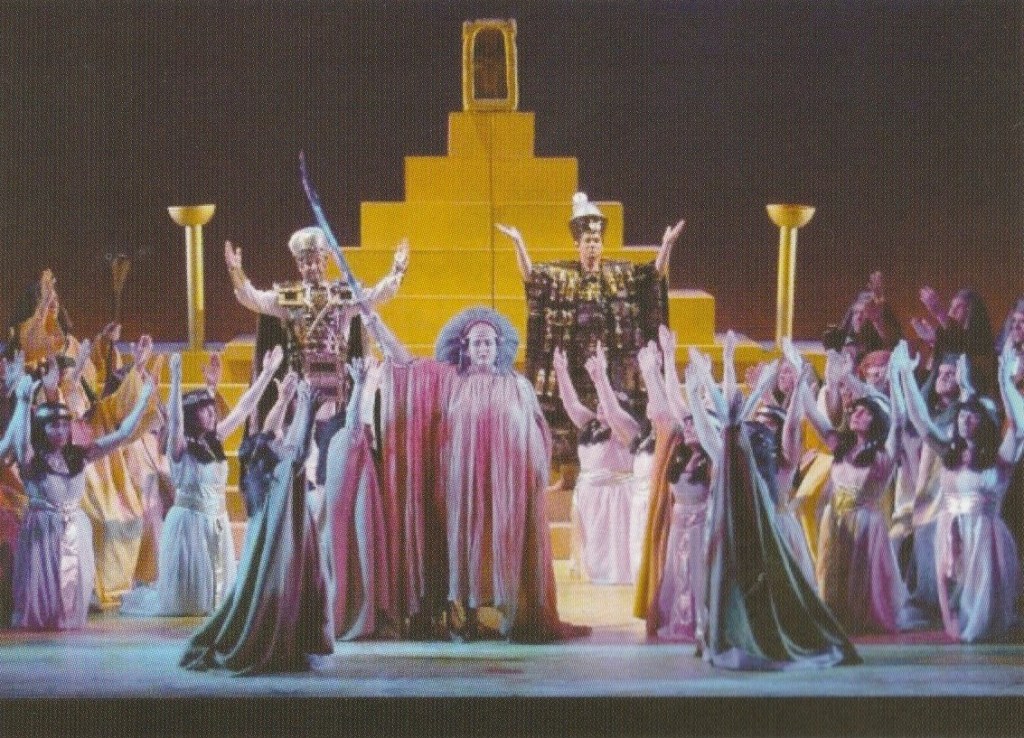
Aida in 1990, was the Society’s 50th production and one of its most ambitious. Although David Thomas — uncharacteristically was unable to bring horses and chariots onto the Farrer stage, the show was an enormous hit, earning much praise for Brian Henry’s musical directorship. Brian Henry, as David Thomas, deserves a chapter on his own for his loyalty and acting, Chairmanship and skilled musicality as Musical Director.
With what the then Chairman called ‘The folding of the Fulcrum’ at Slough, the Society prepared for the next two shows, Mikado and Pirates, at the Wilde Theatre. It was in the latter that Ian Henderson, another mainstay of the Society, performed his second role as Ko-Ko, having excelled as The Lord Chancellor, in Iolanthe the prev.
The Fourth Decade
At Otello in 1991, besides the welcome accorded to the Very Revd Patrick Mitchell, Dean of Windsor and Mrs Mitchell, the Society benefitted from the appointment of Freda Lewis as Producer. She had already produced several shows for the Society and Ofel/o notched up another triumph.
Rosalind Nockles, a teacher of English and Drama at St Bernard’s Convent, was responsible for the next production, HMS Pinafore. Three years later she produced a novel interpretation of The Mikado. David Thomas had already embraced modernity with his 1992 rendering of The Gondoliers set in an airport. Rosalind Nockles’ preferred locus was Windsor beset with crowds o
Japanese camera-touting tourists.

Guest of Honour at the 60th show, Turandot, was HM Lord Lieutenant of Berkshire, Mr John Henderson and his wife. Princess Turandot was played by Diana Vivian, who thereafter performed in several lead roles and who, in the Society’s 50th year, will be musical director of The Gondoliers. Turandot won the Kathleen Oyler Trophy, awarded for the best chorus work. The cup was presented to Nigel Hague as Chairman at the London Area AGM of the National Operatic and Dramatic Association. There were ‘gasps of surprise that an amateur dramatic society should even attempt a production of Turandot’.
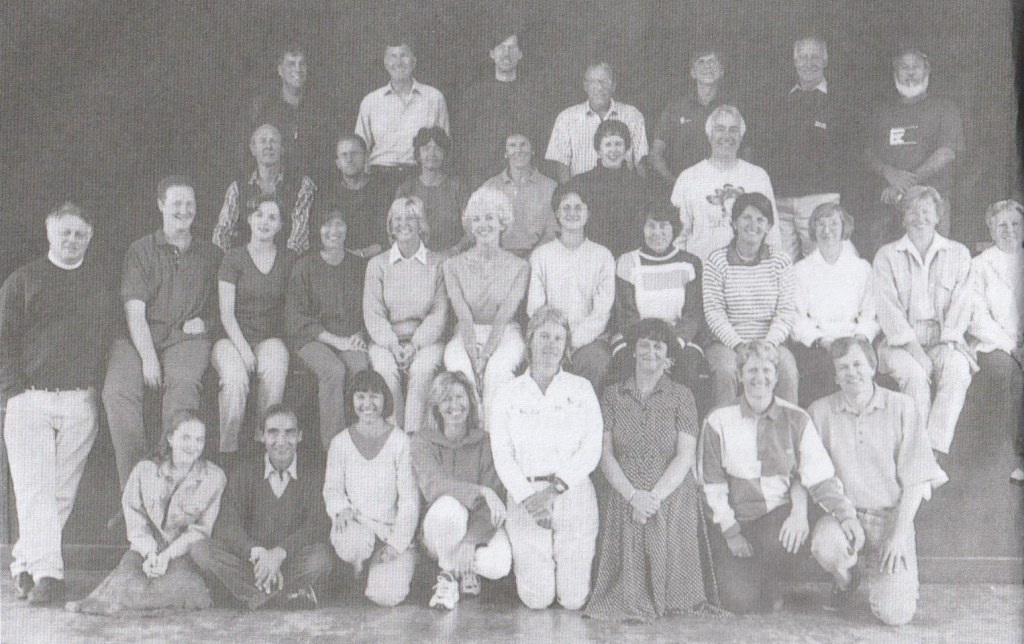
lhe next production, Ruddigore, witnessed the first appearance of Debra Morley, as Rose Maybud, she had appeared in a wide range of oratorio and recital performances in England and abroad and been the recipient of numerous prizes.
The 1996 spring production of Don Carlos ‘one of the grandest operas of them all’ in Nigel Hague’s words, was the most ambitious so far and arguably the most magnificent show in the Society’s history. It was again in the tried hands of Brian Henry and David Thomas as Musical Director and Producer.
At the autumn production that year, Lady Hallifax was welcomed as Guest of Honour. As the widow of Sir David Hallifax, former Governor and Constable of Windsor Castle, it was fitting that the chosen charity for the Gala Night was Windsor Sea Cadets.
In 1999, another new challenge was successfully essayed in a fine production of Wagner’s Flying Dutchman and the second production in the Millennium year of Patience marked the musical directorship of Gillian Dibden, towering figure in the world of choral singing.
There have been many husband and wife teams within the Society, none more jointly talented than Jonathan Bungard, sometime a Lay Clerk of St George’s Chapel, an excellent musical director who has also sung a number of roles, and his wife, Tara Overend, whose first appearance was in The Elixir of Love as Adina, and who has brilliantly performed leading roles in many of the Society’s subsequent productions.
With the close of the Fourth Decade, statistics indicate that in all those years over 400 audiences occupied more than 120,000 seats.
The Fifth Decade
‘Well! Would you believe it? The Windsor & Eton Operatic Society is 40 years old. What an achievement and what a cause for celebration’, so wrote Ray lsowyer, the Chairman in the programme for the autumn production of The Gondoliers in 2002.
The Presidential Note in the Nabucco programme for 2004 was rather less sanguine: ‘2004 will appear in the Society’s history book as a time of considerable anxiety anent the unlooked for but inescapable and probably permanent unavailability in April of the Farrer Theatre’. Although Eton College sought to be as helpful as ever, an alteration in the examination pattern meant that the Society was faced with a serious problem. After intense consideration it was decided to accept the College’s offer of an alternative date in July and this offer was repeated in July of 2005 with the Society’s eightieth production Aida. However, with the Society staging two more grand operas, The Magic Flute and La Boheme in the autumns of 2004 and 2005, an interval of little more than three months in those two years was not realistically sustainable. As the Presidential Note in the Mikado programme explained ‘The sad and sobering sequel is that for the first time since 1972, the Society’s 2006 presentations have been regrettably restricted to one production only’.
Commendable enterprise and energy on the part of the Committee resulted in the 2007 spring show The Sorcerer taking place at the Courtyard Theatre at Norden Farm in Maidenhead. Comparatively new, Norden Farm had been developed for Windsor & Maidenhead Borough Council and was sumptuously equipped. Qualms there were aplenty. For one thing, Norden Farm had only 240 sellable seats, whereas at the Farrer Theatre there were 401. Furthermore, it was uncertain how many of the Society’s audiences would elect to make the journey to a not-very-accessible part of Maidenhead. The President wrote ‘It may be doubted … if Moses himself, with the benefit of Divine Assistance in his leadership of the Israelites out of Egypt expended more anxious thought or nervous foreboding as did the Society in risking the move to Norden Farm for the 2007 spring venue.’
In the event, this production, although showing a loss, was not an unmitigated disaster and the Society’s return to the Farrer in October for Eugene Onegin restored some vestiges of equilibrium.
Accordingly, the spring shows in 2008, 2009 and 2010, were all held successfully at Norden Farm; indeed, an ambitious production of Tosca in 2009 brought full houses and a profit into the Society’s coffers.
Orpheus in the Underworld, the Society’s fiftieth show at the Farrer, was the 27th Charity Gala in conjunction with The Rotary Club of Windsor St George. There have been none since then but the tradition will be revived this year.
A sparkling production of The Merry Widow marked the end of 2010. In the spring of 2011 — the 50th year — Eton College was able to offer the Farrer Theatre in April, when a superb production of Mozart’s The Marriage of Figaro crowned that important anniversary. After performing, again at the Farrer, The Gondoliers for a record-breaking sixth time, the Society, in recognition of the Queen’s Diamond Jubilee will, in the spring of 2012, revert to Norden Farm, patriotically to perform Merrie England and full of confidence for the future the Society looks forward to serving its appreciatively musical public in Windsor, Eton and widely beyond for the next half century.
John Handcock
The author, who has been President of the Society since 1962, would like to thank particularly John and June Holmes, Barbara Chivers and Margaret Gilson for their helpful reminiscences.
The company has decided that in future they will be known as Windsor & Eton Opera, as this is a more reflective and appropriate name for the 21st century.
With thanks to the Windsor & Eton Operatic Society for the photos.
 Windsor Local History Group