
A View of 50 years of the National Health Service
in Windsor and Maidenhead
Published in Windlesora 17 (1999)
© WLHG
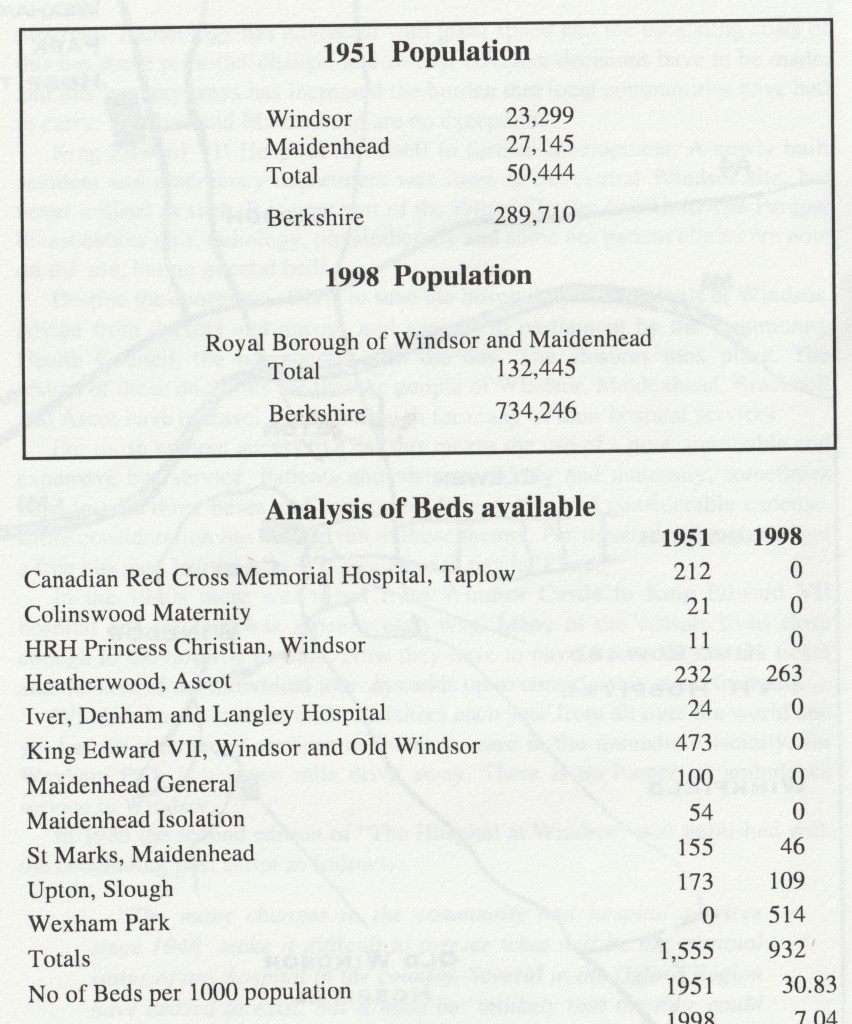
On asking the question “What benefits have the last 50 years of a National Health Service given to the population of the Royal Borough of Windsor and Maidenhead?”, the answer must be controversial. Many residents would support the view that with the loss of general beds and an emergency service at King Edward VII Hospital we have a great deal less than we had in 1948.
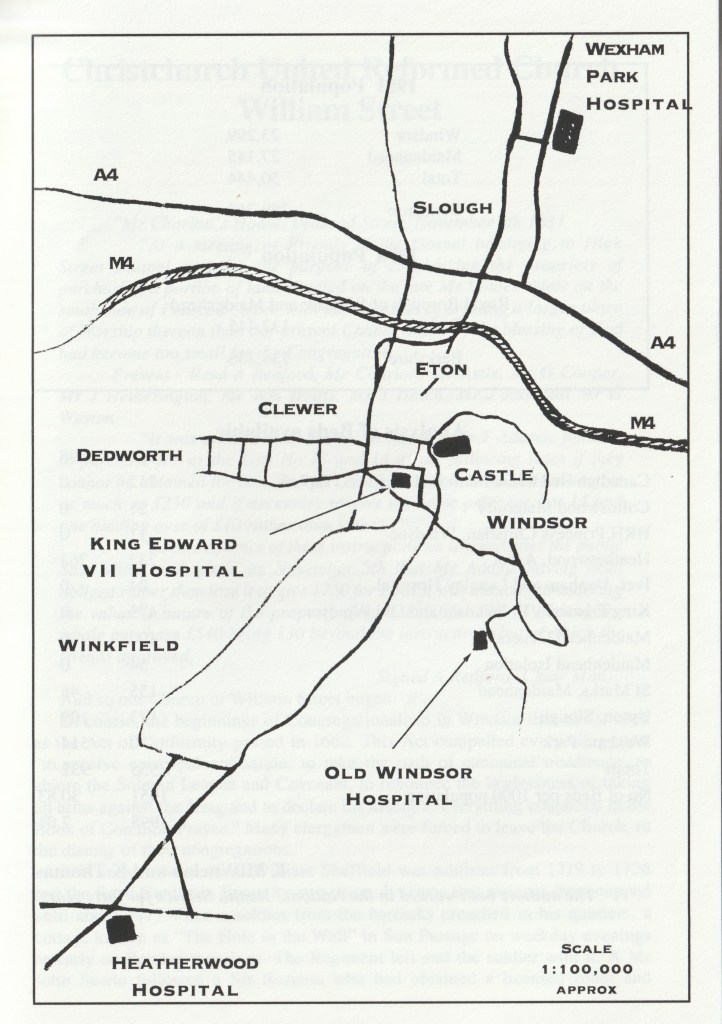
Clarification of that statement is necessary. Before 1948 the East Berkshire area had many facilities and a wide range of medical care was available locally. The Royal Borough of New Windsor had what could be described as a vibrant district hospital. King Edward VII opened in 1908 and served the people of Windsor for over 80 years. The book The Hospital at Windsor by J E McCauley gives a very clear history of the facilities provided and it identifies the interest of local people who gave a vast amount of money over the years to sustain a hospital at Windsor and provide care for the immediate environs. King Edward VII, with two sites, one in central Windsor and one at Old Windsor, was the focus of that care. Maidenhead was provided with the Canadian Red Cross Hospital at Taplow, St Lukes and St Marks. Heatherwood served Ascot and Bracknell with orthopaedic, maternity and general facilities. There were casualty units at King Edward VII, at Heatherwood and at Upton Hospital in central Slough. The tireless work of the general practitioners in this area has supported the populace of Windsor but their tasks have been made more difficult by the endless changes.
The building of a new hospital at Wexham Park meant the gradual closure of general medical and surgical beds in local hospitals and their removal to the site north of Slough. The closure of many units gave great disadvantage to the population of Windsor and Maidenhead. While accepting that Wexham Park has excellent specialist units, there are no longer accident and emergency facilities, nor an intensive care unit, and no general or medical beds in Windsor or Maidenhead.
When modern buildings are established it does lead to developments and advancements of medicine, and over the last 50 years there has been much progress. Technology has advanced with great speed and the escalating costs of this has made priorities change, and so cost effective decisions have to be made, and this in many ways has increased the burden that local communities have had to carry. Windsor and Maidenhead are no exception.
King Edward VII Hospital lent itself to further development. A newly built accident and emergency department was there at the central Windsor site, but never utilised as such. It is now part of the Prince Charles Eye Unit. The Parapet breast cancer unit, radiology, physiotherapy and some out patient clinics are now on the site, but no general beds.
Despite the enormous efforts to save the hospital by the residents of Windsor, advice from doctors and nurses, and appeals to parliament by the Community Health Council, the bureaucrats won the day. The closures took place. The results of those decisions are that the people of Windsor, Maidenhead, Bracknell and Ascot have to travel to north Slough for many of their hospital services.
For those without access to a car this means the use of a poor, unreliable and expensive bus service. Patients and visitors, elderly and maternity, sometimes need to take three buses and can expect long delays and considerable expense. Little consideration has been given to these factors. Pensioners in Slough can get a free bus pass but those in Windsor have to pay half fare.
In the 1940s there was a bus from Windsor Castle to King Edward VII hospital and the fare was a penny each way. Many of the visitors lived close enough to the hospital to walk. Now they have to pay £5 for a day return ticket and the cost of the individual journeys adds up to considerably more than this.
Windsor has over three million visitors each year from all over the world and yet has no emergency services or intensive care in the immediate vicinity, for Wexham Park is a seven mile drive away. There is no longer an ambulance service in Windsor.
In 1985 the second edition of “The Hospital at Windsor” was published with the concluding post script as follows:
“The many changes in the community and hospital services since 1948 make it difficult to foresee what will be the eventual status of any hospital in the country. Several in the Oxford Region have ceased to exist, but it must be unlikely that the time could come when the hospital at Windsor will not have an important role in the care of the sick in that area.”
A prophetic statement, and one that in 1998 one would like to have realised for total care for the sick in Windsor after 50 years of the National Health Service.
K M Whelan and K Thomas
The authors both worked in the National Health Service for forty years.
 Windsor Local History Group