
– The First Fifty Years
Published in Windlesora 13 (1994)
© WLHG
The present Windsor Boys’ School is the successor to what for many years was known first as the Windsor County Boys’ School and then as Windsor Grammar School. In 1977 it became ‘comprehensive’ and has since been known as Windsor Boys’ School. This was a revolutionary change and gave a broader base, but continuity with the past has been maintained and many of the traditions associated with the old secondary school have been carried through to the new school. The narrative that follows covers the story from its foundation in 1908 to its Jubilee in 1958.
Windsor, unlike many towns of similar antiquity and importance, has no ancient grammar school. More’s the pity for the historian! He cannot garnish his narrative with those tales of colourful custom and picturesque tradition that give to the past so much of its fascination.
If the Windsor Boys’ School is young, it is because Eton College is old. When the college was founded in the fifteenth century, it was ordained that it should be called ‘the mirror and mistress of all other grammar schools, and no other grammar school should be founded in Windsor or elsewhere within ten miles’. Such a provision could not long have been binding, but the college was there and, so long as it retained its plebeian as well as its patrician side, the tradesmen of Eton and Windsor continued to send their sons to the famous school which lay at their doors. The existence of a school at St. George’s and the foundation of the Royal Free School in the eighteenth century may also have had their influence.
So it was not until the beginning of the present century when the Education Act of 1902 placed upon the councils the duty of setting up county schools that the Windsor County Boys’ School came to be founded in 1908.
The house which formed the basis of the school had for years been known as Church House. It was situated in the shadow of Trinity Church, where East Berkshire College at Windsor was later built. The school began with a mere 46 boys. You can see them in some old photographs, the younger boys with their Eton collars – excellent targets for flying ink.
The early days appear to have been somewhat chaotic – the new block consisting of two laboratories and an assembly hall was not ready and bricks, piles of timber and cement made the surroundings more like a builder’s yard. The inside of the old house was nearly as bad, as the red concrete was being laid on the floors. On top of all this there was no furniture on the opening day, or for some time after – not a chair or a desk or a table.
Nevertheless, once the school had settled in, the surroundings were pleasant enough. There was no hard asphalted playground. Instead there was a garden, with a hedge of yews and evergreens. In the middle of the garden was a circular lawn with some very fine old trees, including two specimens of the ‘Chinese Tree of Heaven’. Behind the building were lawns and rose-beds. The field – alongside the present Claremont Road – was fringed with chestnuts and limes. Its great feature, however, was a walnut tree, remembered by those at school in the early days as the frequent scene of illegal depredations.
Despite all the limitations of the early buildings, the school quickly became a community with a tradition and a life of its own. That this was so was largely due to the personality of the first headmaster. Mr George Wade had been at Balliol College Oxford, under the great Jowett, and had formerly been headmaster of Wallingford Grammar School. He presided over the school for the first eleven years of its life and during that time left an abiding impression. That he could inspire awe in his pupils many stories testify, but it was with affection as well as with respect that the OWs of the early days remembered him. I can still recall the part that he took in the Remembrance Services of the 1930s and the dignity of his contributions.
In 1914 came the war. Most of those who had been at the school in the early years came to be involved before it ended in 1918. Sixteen gave their lives, including L.C.J. Burnett, J.R. Lambdin, J.A. Ottrey and L.F. Woodland, whose names were chosen when the new house system was established after the war. The four houses remained the basis of much of the life and activity of the school until, with increasing numbers, it was deemed expedient to increase the number of houses to eight – Allen, Burgess, Ford and Warwick were selected from the OWs who had died in the Second War.
Despite the turmoil of war the school grew in numbers and importance. Nevertheless so long as the war lasted, life was bound to be abnormal. Frequent and unsettling changes took place in the school staff. Men who fondly imagined that their days of teaching were over were brought back to fill the gaps – often to the delight of merciless schoolboys. There was one temporary member of staff, for example, who was so deaf that a massed comb-and-tissue paper band could perform with impunity in his classes . . .
At the time the school’s growth seemed very slow. There was one occasion indeed when a worthy alderman on the town council suggested that it ‘should become mixed in order that numbers might be increased’! It was 1917 before the hundred was passed, but after the war secondary education throughout the country expanded rapidly and school numbers rose term by term until a high-water mark was reached in 1922 when 219 boys were on the register. Many were fee-payers and could begin as young as eight, but it was rare in the early days for a boy to remain after he was sixteen. In 1920, however, a small set of three boys embarked on the two-year course leading to the Higher Certificate. ‘The importance of this development,’ wrote Mr S.R. Gibson, headmaster 1921-26, ‘cannot be over-emphasised’. It marked the extension of the school age to 18 instead of 16 for the more able boys; it gave the school more mature leaders; and it led to a real connection with the Universities. In 1923 three University Scholarships were gained.
Mr Gibson, who left in 1926 to become headmaster of Bec School, Tooting, was associated with many developments that remained features of the life of the school for years afterwards – some of them to the present day – the beginning of the house system, the institution of ‘rugger’ in place of ‘soccer’, the organisation of the library, the beginnings of school societies, the development of the Cadet Corps and of dramatic performances.
In 1926 Mr Gibson’s place was taken by Mr S. Gammon, who came from University College School, Hampstead, and remained for four years. He too made a distinctive contribution to the life of the school. In particular he did everything possible to encourage out-of-school activities. Many of these were under the umbrella of the Hobbies Club, which included such varied activities as wireless, wood-work and metal-work, model engineering, chess and natural history. And – a great event in the history of the school – the Cocoa Tree Club was formed in 1929. This was a debating and literary society which normally met on Saturday evenings, with cocoa as the main beverage.
Mr Gammon left in 1930. His place was taken by Mr H. Fairhurst, who remained as headmaster until 1958. Twenty-eight years is a long time in the life of any educational establishment and the school reached maturity under his leadership.
Most important of all the developments during his headship was the removal to the new school buildings in Maidenhead Road at the beginning of 1939. The simple fact was that with the increase in numbers the old school in Trinity Place had become completely inadequate. Attempts to provide additional accommodation in the shape of huts could not offer a solution. The huts were cold and draughty. There was a story current when I came to the school in 1930 that during the great frost of 1929 the temperature inside the geography hut was lower over a period of several days than the outdoor temperature in Iceland. I can remember having to take my sixth-form historians in the boiler room – at least it was warm. There were all kinds of nooks and crannies that endeared the buildings to its inmates. There were the attics, for instance. I remember the creaking wooden stairs, the dim light that came through dusty skylights, the crumbling plaster. Several school societies had their hide-outs here until they were condemned as unsafe.
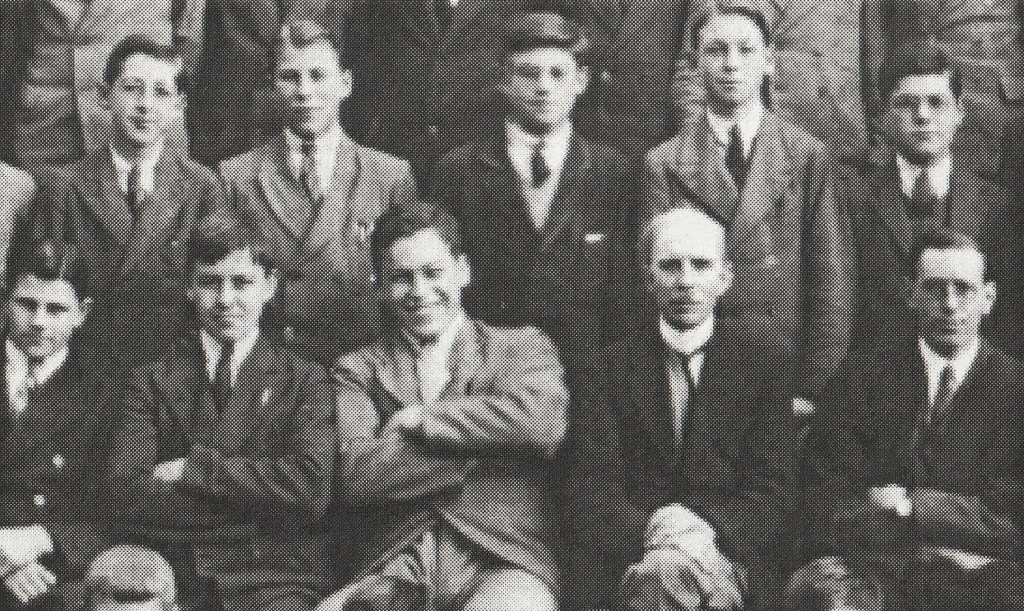
Nevertheless the sixth form grew and produced more and more boys who were to have successful and even brilliant careers in life. There was for example the trio consisting of Maurice Bond, Jack Springett and Charles Smith. The first two both had distinguished careers at Cambridge. In due course Jack Springett became Director of Education for Essex and Maurice Bond Clerk of the Records of the House of Lords and a recognised authority on medieval manuscripts. Charles Smith had perhaps the most meteoric career of any Old Windsorian – Open Scholar in History at Wadham College, Oxford at sixteen, a senior officerof the Oxford Union, Labour MP for Colchester when he was still only twenty-eight, Secretary of the Post Office Engineering Union, a life-peer as Lord Delacourt-Smith of New Windsor, Privy Councillor and a member of Harold Wilson’s administration in the late sixties – all this, though he died at the age of 55 in 1972. Two of the School Captains in the thirties, J.W. Buckstone and G.H.W. Hagger, lost their lives in the second war when both held the promise of a brilliant future.


The original school buildings, adjacent to Holy Trinity Church
The increase in numbers gradually made conditions in the existing buildings intolerable. Numbers had risen by 1934 to over 270. Eventually a solution was found, but not until many projects had been discussed and abandoned. The school already leased the playing fields of the Clewer St Stephen’s High School in Maidenhead Road. The opportunity came to purchase the site and buildings. Plans made for utilising the existing buildings were fortunately rejected and in their place a new school was built. It still remains the nucleus of the present buildings, though many additions have been made since. The Earl of Athlone, accompanied by Princess Alice, opened the new buildings officially in January 1939.
Within months of the move the second war broke out. It was providential that the school moved when it did, but for much of the war we found ourselves sharing our buildings with an evacuated London school — and a Girls’ School at that, the Clapham High School for Girls. Rumour had it that the girls were put on the wrong train at Waterloo and arrived at Windsor instead of Chichester where their brothers had gone.
We had our air raids – or our air raid alarms. We had none of the deep, damp underground shelters which so many schools had. It was thought good enough in our case to board up the cloakrooms with baulks of timber like railway sleepers – perhaps that is what they were – and when the sirens went we poured down from the classrooms and waited for the all-clear to sound. In the meantime an attempt – rather futile in the circumstances – was made to continue work among the coats and macs in the dingy atmosphere of our ill-lit cloak-rooms.
Members of staff came and went and the gaps left by war service were filled mostly by ladies whose ability to cope with boys varied considerably. School match programmes had to be severely curtailed through the shortage of any kind of transport. In the background the battles raged and many of those at School in the 1930s gave their lives.
May 1945 came and we waited for the news of Germany’s surrender while the sports were being concluded on the school field. There followed a gradual return to normality. The only notable interruption to the life of the school in the post-war years came in March 1947. One eventful Monday morning we found that the school was inaccessible. We had had hard frost and snow for weeks and then came a sudden thaw and heavy rain – and the waters of the Thames rose rapidly and spread across many square miles of neighbouring countryside. Over the week-end the school was flooded, the lower corridors to a depth of three feet. The wooden blocks that formed the floors were forced up and floated around in their hundreds. Desks were awash and it was possible to paddle canoes across the field and into the school itself. After the first onrush of waters, the level rose very slowly but just sufficiently to cover the floors of the gym and the hall, where much damage was done. Fortunately it was near to the end of term and by the time we re-assembled after the holidays things were back to normal. Some of the walls and cupboards, however, bore the mark of the flood-line for years and many books showed signs of their temporary submergence.
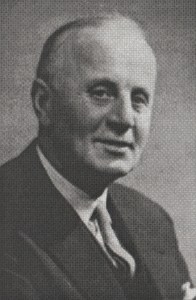
It is not easy to do justice to the contribution which Mr Fairhurst made to the development of the school during the twenty-eight years for which he was headmaster. He presided over the expansion of the school in numbers and academic distinction as well as the transition from the old buildings to the new, with all the larger opportunities that this made possible. A man of enthusiasms himself, Mr Fairhurst had the great gift of being able to stimulate enthusiasm in others. He interested himself in a wide range of school activities, encouraging and expressing appreciation of efforts made by others.
With two school activities in particular he was intimately associated, dramatics and the Cadet Corps. His vitality found expression in his love of the stage. He often took part in plays, and for many years he played the leading part opposite Mrs Targett in the production of school plays. With the Cadet Corps he had an even closer association. His dapper form and military bearing – and voice – were merely the outward and visible sign of the keen leadership he gave. Not merely with the school Cadet Corps but in the County Association he played a leading part and it was a fitting tribute to his services when he was awarded the M.B.E.
His educational activities were not confined to the school. He was a member of the Berkshire Education Committee for many years and Chairman of the Windsor Divisional Education Executive.
These additional activities expressed his interest in the wider field of education. But his own school was the focus of his activity. He had the vision to see what the school could become and the drive that could translate the vision into reality.
Among his contributions his judgment in building up the staff of the school was outstanding. It is tempting to write a series of pen portraits of members of the staff, but any such attempt would involve making invidious distinctions – and would moreover consume inordinate numbers of words! Perhaps one exception can be made. There has already been a reference to Mrs Targett. With one break she was a member of the staff from 1921 until the war years. Leaving out temporary (mostly war-time) and part-time (e.g. music) appointments she was the only permanent woman member of the staff. She thus holds a unique position. She brought to the school qualities of sensitiveness and imagination which no man could have rivalled. Her work as editor of the school magazine, The Windsorian, her association with the school plays, her influence as ‘mother’ of the juniors, her very special approach to the teaching of history, especially social history, all these endeared her to generations of Windsorians. Incidentally, she loved the old school buildings and disliked the new, the former with their homely qualities, the latter with their formal structure – ‘too much like a factory’ was her comment.
If it is difficult to write about some members of staff and leave out others, it is even more difficult to write about individual boys without making invidious distinctions. If I made my own selection I would almost certainly think first of two groups with which I was closely associated – the sixth-form historians and the naturalists who shared with me in the field-work of the Nature Club. Many of them became my friends and I look back to the time at school when such friendships were born. But I have a deep appreciation of many who were neither historians nor ornithologists. I could produce a long list of names, but lists of names are apt to be boring and even meaningless. There is one field, however, namely that of sport, where two members of the school in the 1950s achieved international distinction. The first was Francis Drewett, who was capped for the England Under-fifteen Rugby team in 1952 and became Captain in 1953. Secondly there was Stan Eldon, who was outstanding in athletics. In 1958 he won the AAA six miles championship in 28 min 5 sec – a new British national and English native record. In the same year he ran for England in the international cross-country at Cardiff and defeated the French Olympic champion, Alain Mimoun.

Another thirty-six years have come and gone since the departure of Mr Fairhurst. During that time the school has had only two headmasters – Mr G.S. Parker and Mr P.A. Blake. Mr Parker most importantly had the oversight of the transition to comprehension in the seventies. But he also initiated and inspired many of the developments that led expansion of the school in numbers and in academic and athletic activities and distinction. Mr Blake, who first came to the school as an assistant master in 1959, followed suit and the opening by HM The Queen in April 1993 of the splendid new block, together with all the ancillary developments, was a fitting tribute to his leadership. In my own narrative I sought to go no further than 1958, but the story of the school has continued to the present day and will continue into the future.
Raymond South
Raymond South became Senior History Master at the school in 1930 and was Deputy Headmaster when he retired in 1968. He met many of those who were at the school when it opened in 1908.
References
History of Windsor County Boys’ School, 1908-1929
The Windsor County Boys’ School, 1908-1938
Windsorian (Jubilee issue 1958)
Jubilee Lecture at the School, 1958. R. South
‘Eton College, a Grammar School for Windsor?‘ Windlesora No 6.
 Windsor Local History Group